
DiasR: Dual-Modal Identity-Anchored Sparse Routing for Efficient Multi-Subject Video Generation
Abstract
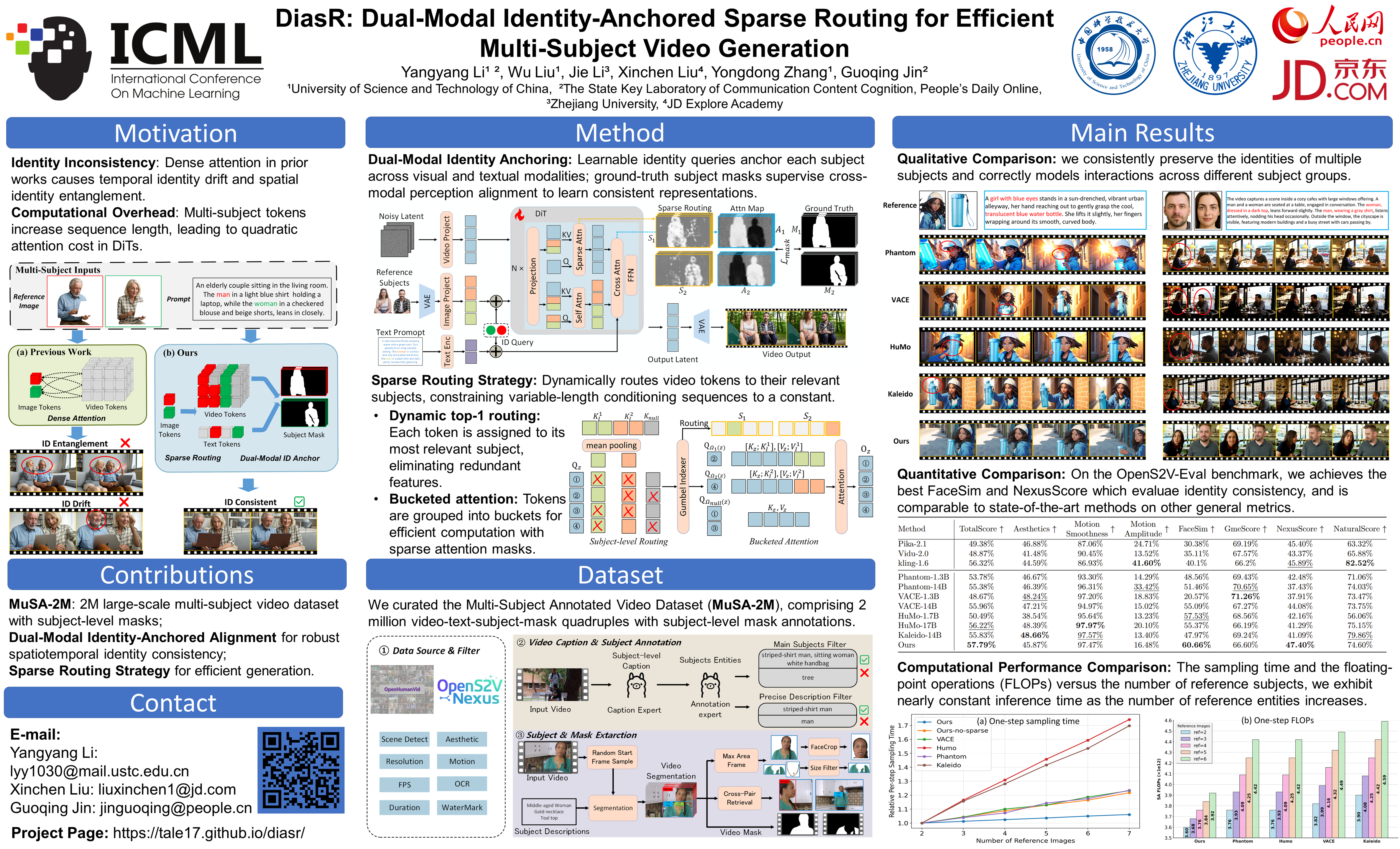
Personalized multi-subject video generation is a promising direction within the field of controllable video generation; however, existing methods face challenges in maintaining cross-frame identity consistency and incur high computational overhead. To address these issues, we propose DiasR, an efficient framework that integrates Dual-Modal Identity-Anchored Alignment and a novel Sparse Routing Strategy. The Dual-Modal Identity-Anchored Alignment employs learnable identity queries to align visual and textual modalities with ground-truth subject masks, thereby mitigating cross-frame identity drift. The Sparse Routing Strategy dynamically routes video tokens to relevant subjects and groups them through bucket aggregation, reducing computational overhead and alleviating identity entanglement induced by redundant tokens. We also construct MuSA-2M, a large-scale dataset comprising 2 million annotated samples equipped with subject-level masks, which fills the gap in existing multi-subject video datasets. Experiments conducted on the OpenS2V-Eval benchmark demonstrate that our method achieves superior performance in identity consistency, text fidelity, and video naturalness. Notably, it maintains a nearly constant inference time as the number of reference subjects increases, outperforming existing baselines in both efficiency and generation quality for scenarios involving multi-subject interactions. Project Page: https://tale17.github.io/diasr.
Lay Summary
Creating videos with multiple consistent subjects from user-provided references is still difficult for current AI video generation systems. Existing methods often struggle to keep each person or object looking consistent throughout the video, especially when several subjects appear together. In addition, these systems can become very slow and expensive as the number of subjects increases. In this work, we introduce DiasR, a new framework that improves both the quality and efficiency of personalized multi-subject video generation. Our method helps the system better understand and track each subject across video frames, reducing cases where identities become mixed up or change over time. It also focuses computation only on the most relevant parts of the video, making the generation process faster and more scalable. To support this research, we also build MuSA-2M, a large-scale dataset containing 2 million annotated video samples with detailed subject information. Experiments show that our approach produces videos with more consistent identities, better alignment with text descriptions, and more natural motion compared with existing methods. Importantly, our method remains efficient even when handling many subjects at once, making it especially useful for generating complex scenes involving multiple interacting characters.