
G-RANS: Generalizable Residual-Aware Neural Solvers for Sparse Systems
Abstract
Lay Summary
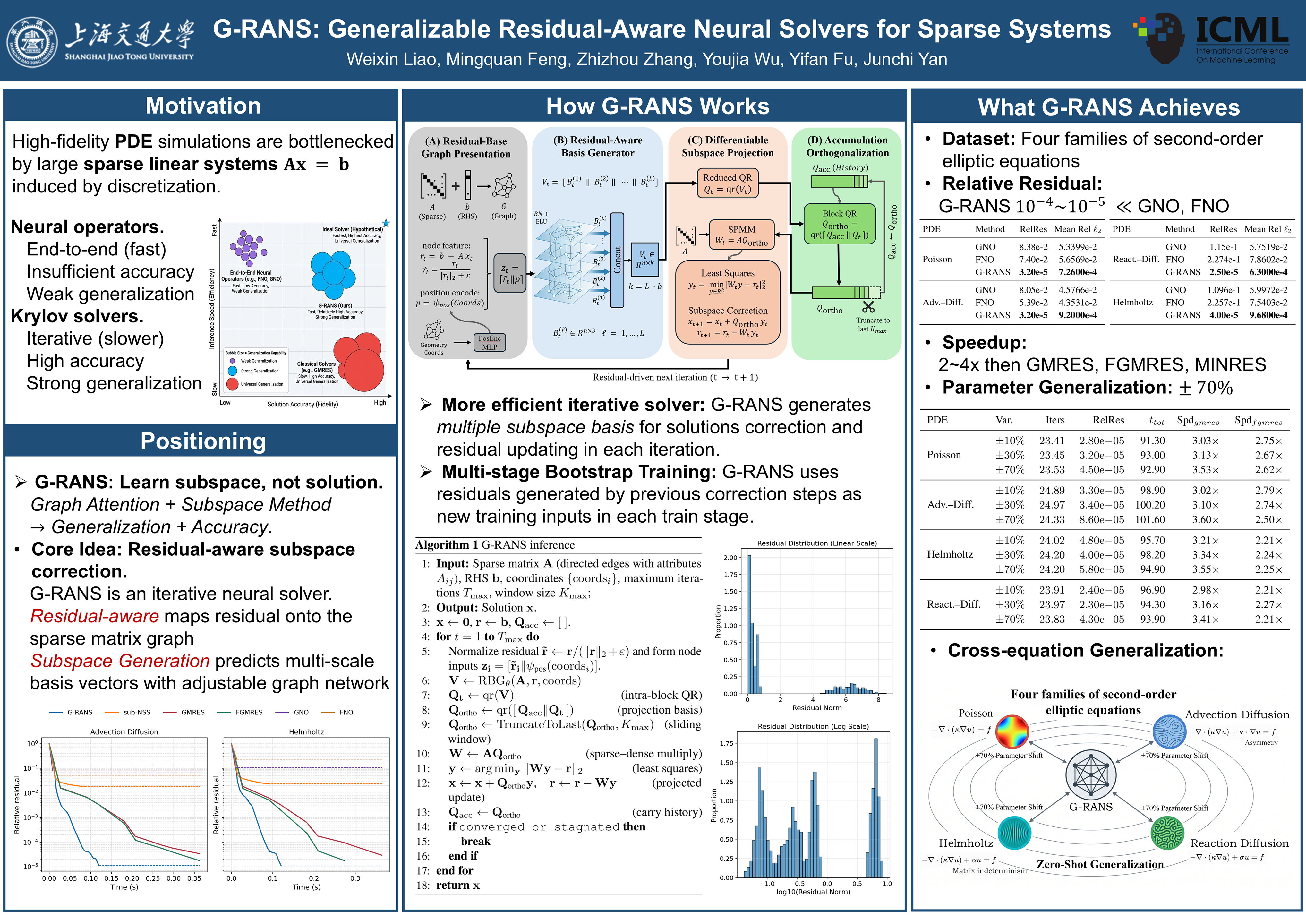
Simulating complex physical systems, such as fluid dynamics or electromagnetic fields, frequently requires solving massive mathematical equation systems. In scientific computing, these primarily take the form of discrete systems of Partial Differential Equations (PDEs). While classical numerical solvers are highly accurate for these systems, they are computationally expensive and often bottleneck high-resolution simulations. Recent artificial intelligence (AI) methods attempt to accelerate this process but typically struggle with low accuracy and fail to generalize when physical parameters change. In this paper, we introduce G-RANS, a novel hybrid solver that integrates the efficiency of neural networks with the rigorous framework of classical iterative methods. Rather than predicting the final solution in a single step, G-RANS dynamically analyzes the ongoing calculation errors and generates precise, sequential correction steps. This approach allows the model to continuously adapt to the evolving error state, overcoming the performance stagnation observed in previous AI-based solvers. Our evaluations, which primarily focus on discrete systems of PDEs, demonstrate that G-RANS achieves the high accuracy required for scientific computing. It remains robust even under severe variations in physical parameters and operates 2 to 4 times faster than standard classical solvers. This work provides a scalable, efficient, and reliable tool to accelerate complex scientific simulations and engineering design workflows.