
Agentic Framework for Epidemiological Modeling
Abstract
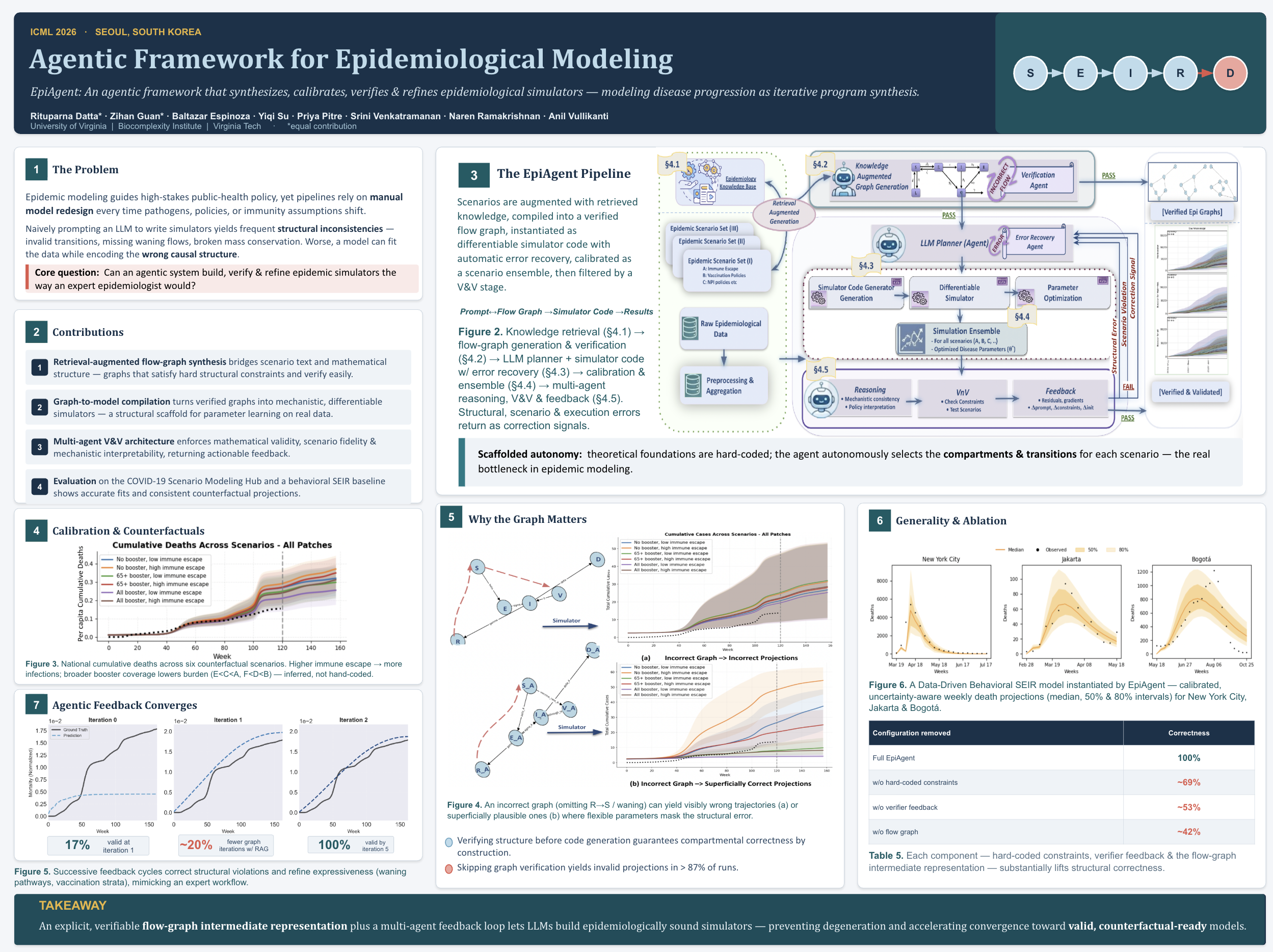
Epidemic modeling is essential for public health planning, yet traditional approaches rely on fixed model classes that require manual redesign as pathogens, policies, and scenario assumptions evolve. We introduce EpiAgent, an agentic framework that automatically synthesizes, calibrates, verifies, and refines epidemiological simulators by modeling disease progression as an iterative program synthesis problem. A central design choice is an explicit epidemiological flow graph intermediate representation that links scenario specifications to model structure and enables strong, modular correctness checks before code is generated. Verified flow graphs are then compiled into mechanistic models supporting interpretable parameter learning under physical and epidemiological constraints. Evaluation on epidemiological scenario case studies demonstrates that EpiAgent captures complex growth dynamics and produces epidemiologically consistent counterfactual projections across varying vaccination and immune escape assumptions. Our results show that the agentic feedback loop prevents degeneration and significantly accelerates convergence toward valid models by mimicking professional expert workflows.
Lay Summary
This paper introduces EPIAGENT, a framework that helps build models for understanding how infectious diseases spread. Traditionally, creating such models requires significant expert effort, careful mathematical design, and detailed assumptions about how people interact. This makes it difficult to quickly adapt models to new diseases, regions, or intervention strategies. EPIAGENT addresses this challenge by allowing users to describe an outbreak scenario in natural language. The system then uses relevant public health knowledge and data to automatically construct a structured model of disease spread. It represents how infections move through populations using a graph-based structure and refines the model by checking consistency with known epidemiological principles. The framework can also incorporate external information, such as documented disease behaviors or intervention effects, to improve reliability. Once built, the model can simulate different “what-if” scenarios, such as changes in vaccination rates, mobility restrictions, or transmission levels, to estimate their potential impact on infections and deaths. Overall, EPIAGENT aims to make epidemiological modeling more accessible, adaptable, and consistent, enabling faster and more reliable exploration of public health interventions.