
DASH: Faster Shampoo via Batched Block Preconditioning and Efficient Inverse-Root Solvers
Ionut-Vlad Modoranu ⋅ Philip Zmushko ⋅ Erik Schultheis ⋅ Mher Safaryan ⋅ Dan Alistarh
Abstract
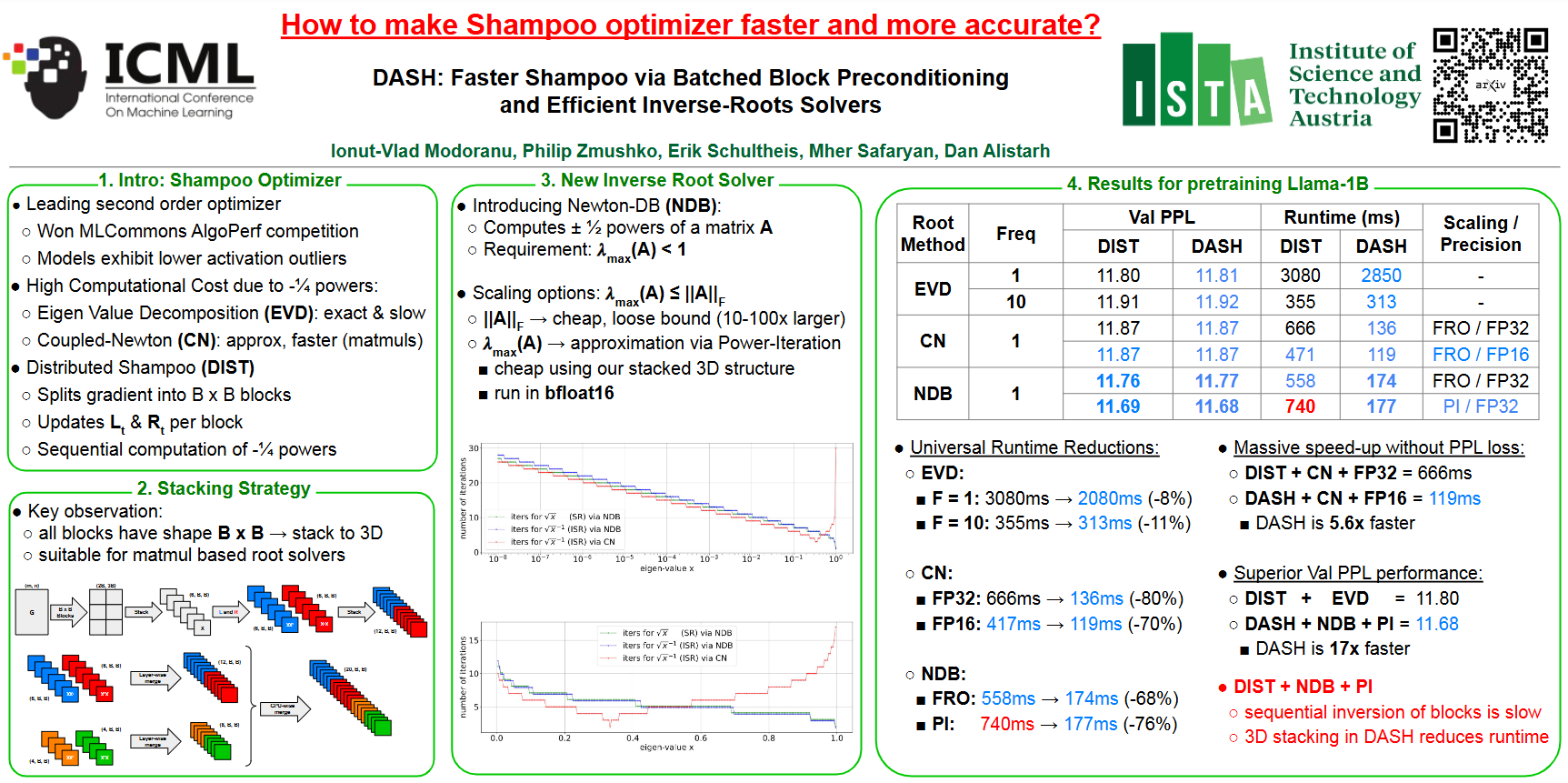
Shampoo is one of the leading approximate second-order optimizers: a variant of it has won the MLCommons AlgoPerf competition, and it has been shown to produce models with lower activation outliers that are easier to compress. Yet, applying Shampoo currently comes at the cost of significant computational slowdown, due to its expensive internal operations. In this paper, we take a significant step to address this shortcoming by proposing DASH (for Distributed Accelerated SHampoo), a faster implementation of Distributed Shampoo based on two main new techniques: First, we show that preconditioner blocks can be stacked into 3D tensors to significantly improve GPU utilization; second, we introduce the Newton-DB iteration and the Chebyshev polynomial approximations as novel and faster approaches for computing the inverse matrix roots required by Shampoo. Along with these algorithmic contributions, we provide a first in-depth analysis of how matrix scaling critically affects Shampoo convergence. On the practical side, our GPU-aware implementation achieves up to $5.6\times$ faster optimizer steps compared to the well-optimized Distributed Shampoo, while Newton-DB attains the lowest validation perplexity per iteration among all tested methods. Our code is available at https://github.com/IST-DASLab/DASH.
Lay Summary
We identify a bottleneck in the implementation of the Distributed Shampoo optimizer and fix it by stacking the gradient and preconditioner blocks into a 3D tensor. This 3D structure allows faster running time for the iterative root inverse methods. We fix the existing Coupled-Newton method and show it works with float16 precision. Moreover, we propose NewtonDB as an alternative to Coupled-Newton and Eigenvalue Decomposition to compute the inverse roots. We replace the frobenius norm scaling with power-iteration based scaling, which is much faster (due to batched matmuls) and more accurate when using the 3D tensor.
Video
Chat is not available.
Successful Page Load