
From geometry to dynamics: Learning overdamped Langevin dynamics from sparse observations with geometric constraints
Abstract
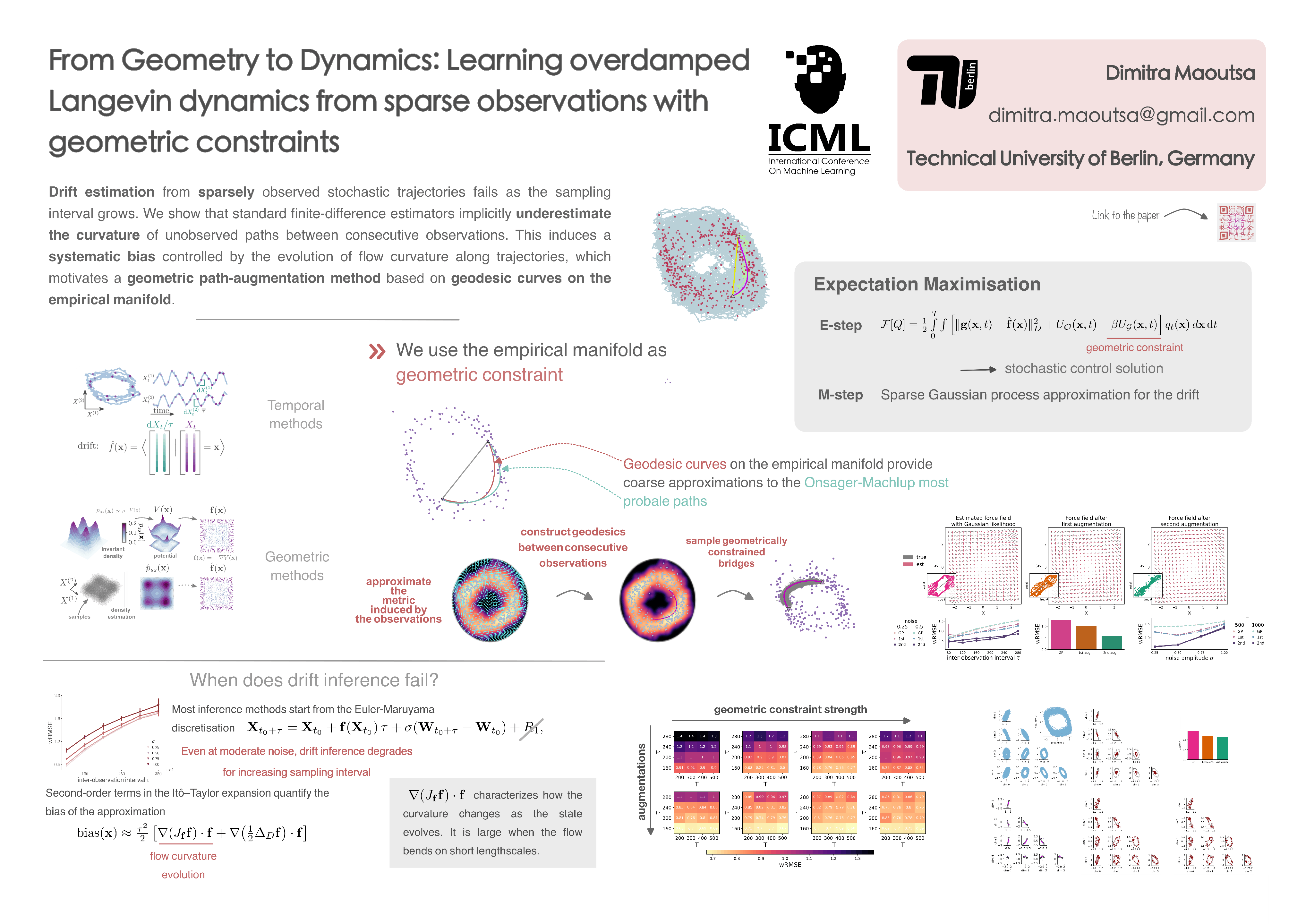
How can we learn the laws underlying the dynamics of stochastic systems when their trajectories are sampled sparsely in time? Existing methods either require temporally resolved high-frequency observations, or rely on geometric arguments that apply only to conservative systems, limiting the range of dynamics they can recover. Here, we present a new framework that reconciles these two perspectives by reformulating inference as a stochastic control problem. Our method uses geometry-driven path augmentation, guided by structure in the system’s invariant density to reconstruct likely trajectories and infer the underlying dynamics without assuming specific parametric models. Applied to overdamped Langevin systems, our approach accurately recovers stochastic dynamics even from severely undersampled data, outperforming existing methods in synthetic benchmarks. This work demonstrates the effectiveness of incorporating geometric inductive biases into stochastic system identification methods, with broad applications across physics, biology, and control.
Lay Summary
Many natural systems, such as cells, ecosystems, or particles in a fluid, evolve in ways that are partly predictable and partly random. Scientists often want to infer the rules governing such systems from measurements, but this becomes difficult when observations are sparse in time: if we only measure the system occasionally, many different dynamics could explain the same data. This paper introduces a method for learning these governing rules by combining temporal information with geometric information from the observed data. The key idea is that even when individual trajectories are missing, the cloud of observations reveals where the system tends to spend time. We employ this geometric information to guide the reconstruction of plausible paths between sparse observations, and then use these reconstructed paths to estimate the underlying dynamics. In tests on stochastic dynamical systems where the true dynamics are known, the method recovers the driving forces more accurately than existing approaches, especially when observations are far apart in time. This provides a way to learn stochastic dynamics from limited temporal data, with potential relevance for scientific domains where high-frequency measurements are difficult or expensive.