
Heavy-tailed Physics-Informed Neural Networks
Abstract
Lay Summary
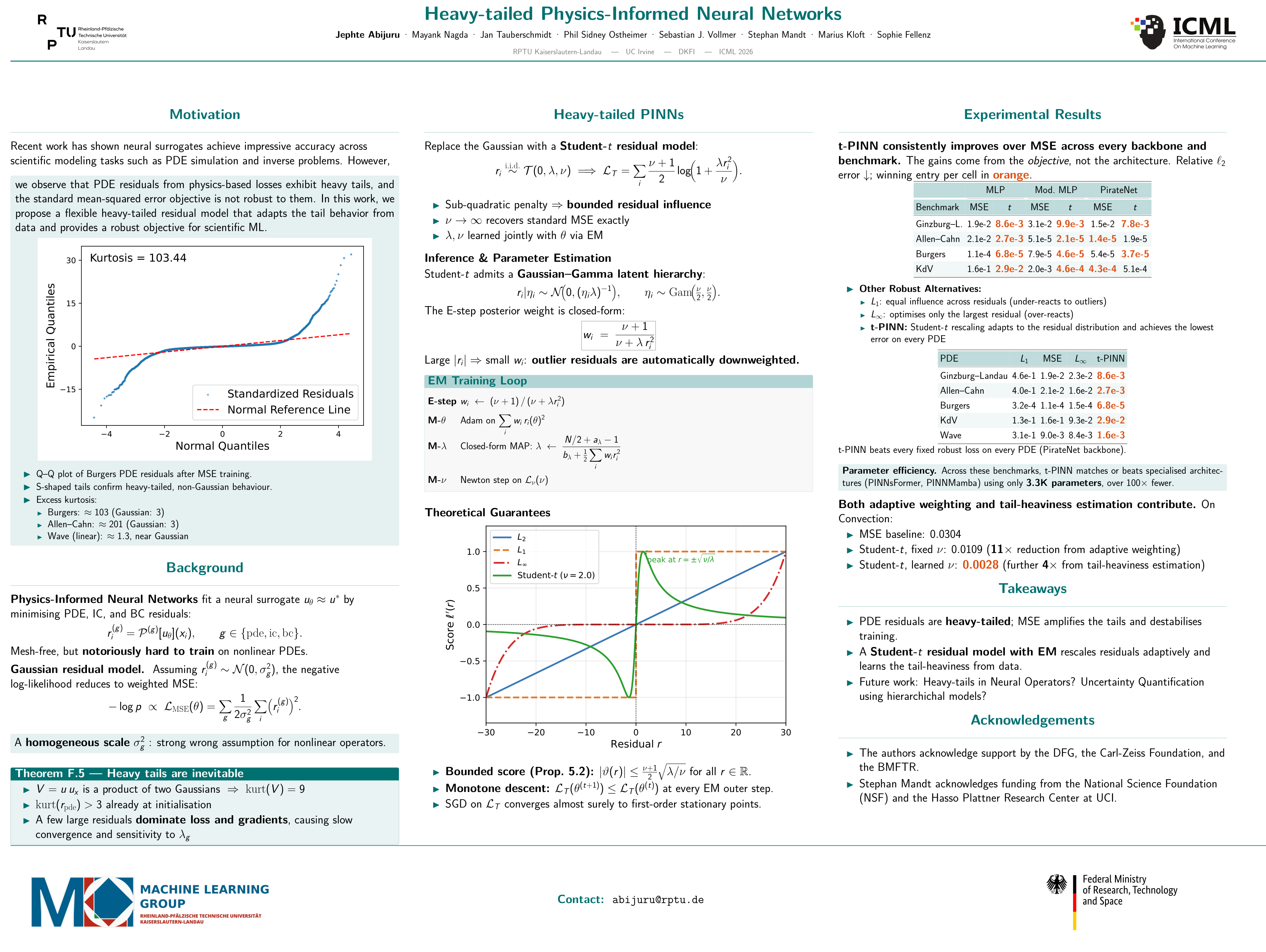
Physics-informed neural networks, or PINNs, are designed to solve physics problems by learning from both data and the equations that describe the underlying system. In standard PINN training, all errors are treated using a squared-error loss. This means that very large errors receive much more attention than smaller ones. That can be problematic because, during training, PINNs often produce errors that are uneven and sometimes extreme. A few difficult points can therefore dominate the learning process and make the model train poorly. This work proposes a more robust way to train PINNs. Instead of assuming that the training errors behave nicely, it models them with a Student-t distribution, which is better at handling occasional large errors. The resulting method automatically adjusts the importance of each error: ordinary errors are still used, but unusually large ones are prevented from overwhelming the training. The approach can be implemented as a weighted version of the usual PINN loss, so existing PINN training methods can still be used. The paper also provides theoretical support for the method and shows, across several difficult physics benchmarks, that it improves both accuracy and reliability compared with standard PINN training.