
Unlearning Isn’t Forgetting: Revealing Hidden Leakage in Class Unlearning Evaluations
Abstract
Lay Summary
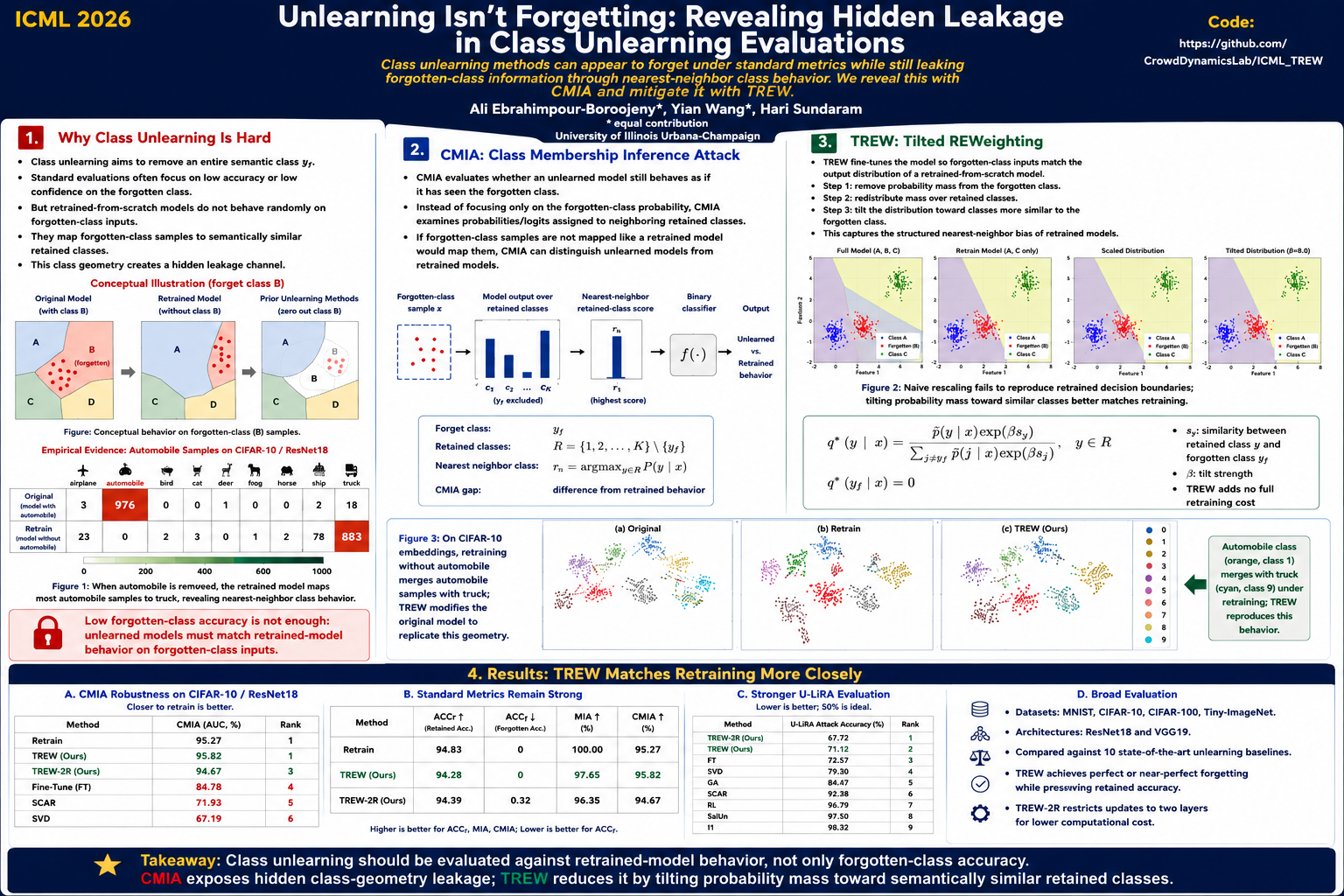
Modern AI systems are increasingly expected to respect requests to delete information, such as when a user invokes their “right to be forgotten” under privacy regulations like GDPR. A growing research area called machine unlearning aims to remove specific data or concepts from trained models without requiring the expensive process of retraining them from scratch. In this work, we show that many existing class-unlearning methods only create the appearance of forgetting. Although these methods often pass standard evaluation tests, they can still leave behind subtle traces of the deleted class. By studying how models retrained from scratch behave after a class is removed, we found that forgotten examples are often reassigned to semantically similar classes—for example, a model that has never seen automobiles may classify them as trucks. Existing evaluation protocols largely overlook this behavior, allowing hidden information leakage to go undetected. To address this problem, we introduce a new privacy attack called Class Membership Inference Attack (CMIA), which can detect whether a supposedly forgotten class still influenced a model by examining its predictions on related classes. Using CMIA, we show that many state-of-the-art unlearning methods remain vulnerable to privacy leakage. We also propose a new unlearning technique called Tilted REWeighting (TREW). Rather than simply suppressing predictions for the forgotten class, TREW redistributes probability toward similar remaining classes in a way that better matches the behavior of a model retrained from scratch. Across several widely used image datasets, TREW reduces privacy leakage while maintaining strong predictive performance. Our findings suggest that evaluating machine unlearning requires more than checking whether a model stops recognizing a forgotten class—it must also verify that no hidden traces of that class remain in the model’s behavior.