
Towards Trustworthy and Identifiable Virtual Face Generation
Abstract
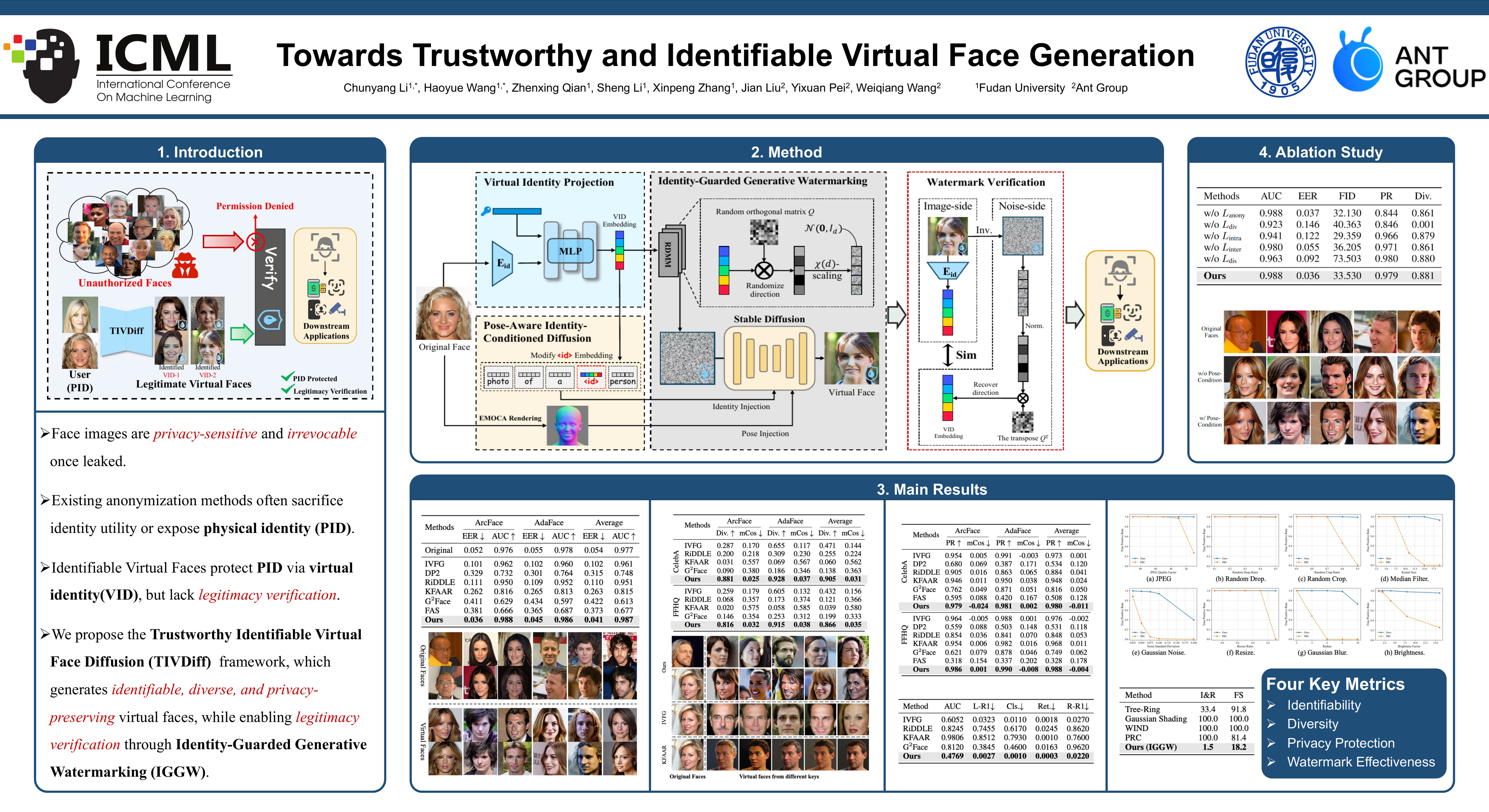
Identifiable virtual face (IVF) generation aims to transform a user's original face into a virtual face for high utility privacy protection. The IVF is visually and statistically different from the original face, which can still be used for recognizing the user's identity. Despite this advantage, these schemes are unable to verify the trustworthiness of the IVF, the quality and controllability of which is often limited. To address these issues, we propose TIVDiff, a diffusion-based framework for trustworthy and identifiable virtual face generation. TIVDiff learns a virtual identity (VID) space via Virtual Identity Projection (VIP) and synthesizes high-quality virtual faces conditioned on VID and 3D facial geometry for pose and expression preservation. To enable the trustworthiness of IVF, we further propose an Identity-Guarded Generative Watermarking (IGGW) scheme to bind the diffusion initial noise with VID through a reversible mapping mechanism. This enables the embedding of an imperceptible cue into IVF for legitimacy verification. Experiments demonstrate the advantage of our TIVDiff over the state-of-the-art IVF generation schemes in terms of image quality, identifiability and trustworthiness.
Lay Summary
This work studies how to protect facial privacy while still allowing reliable identity recognition when needed. We propose TIVDiff, a method that transforms a person’s real face into a virtual face. The generated virtual face looks different from the original one, helping reduce privacy risks, while still preserving enough identity information for authorized recognition tasks. Compared with existing approaches, TIVDiff produces more realistic and higher-quality virtual faces, while better preserving natural facial attributes such as pose and expression. In addition, we introduce a hidden verification mechanism that embeds an invisible trace into the generated virtual face without affecting its appearance. This allows the system to verify whether a virtual face was generated by a trusted process. Experimental results show that TIVDiff outperforms existing methods in visual quality, identity preservation, and trustworthiness verification.