
LDARNet: DNA Adaptive Representation Network with Learnable Tokenization for Genomic Modeling
Abstract
Lay Summary
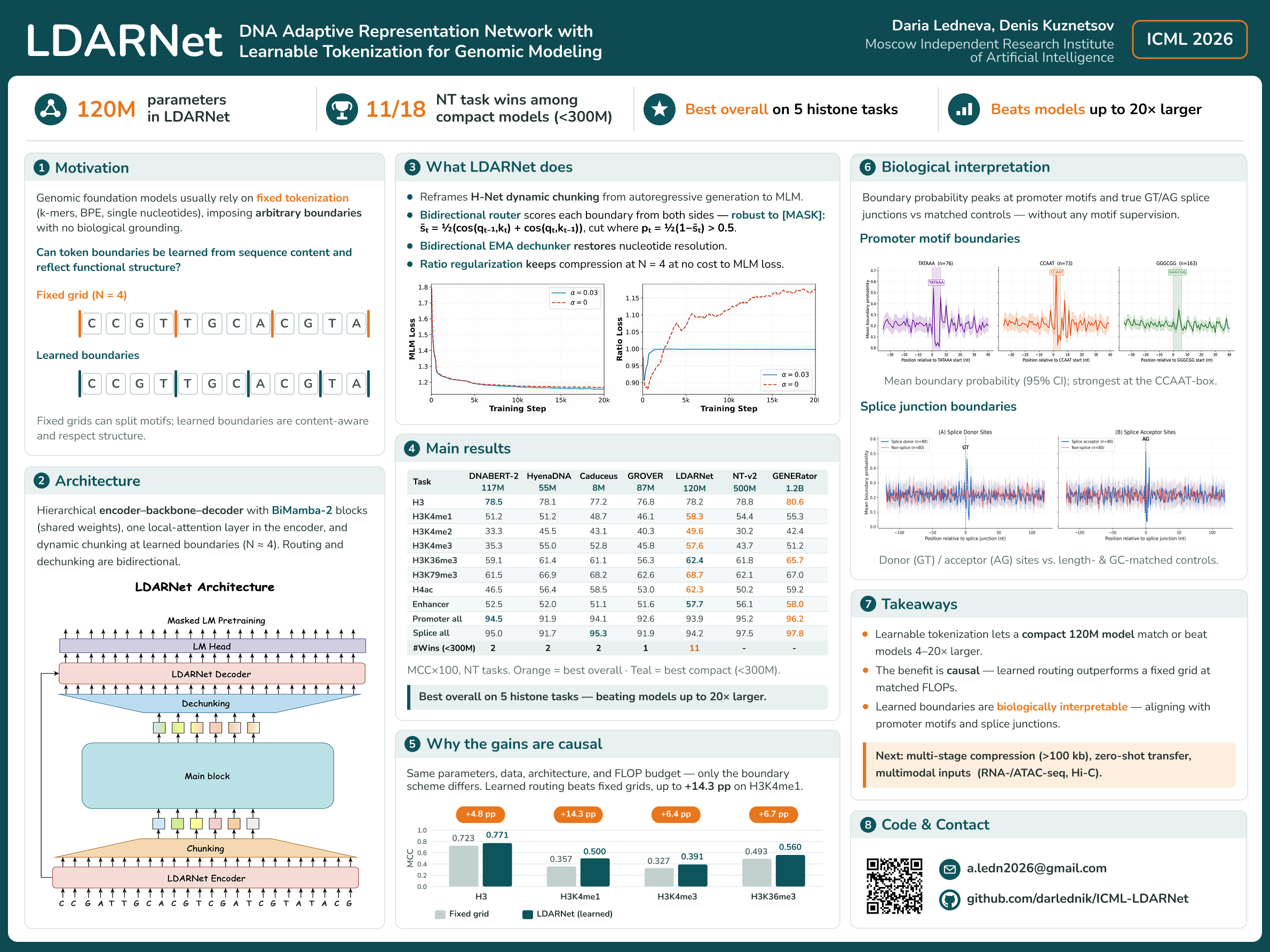
DNA is the instruction manual of life, and computers can now read it the way they read text - but unlike English, DNA has no spaces telling the computer where one "word" ends and the next begins. Most genomic AI models work around this by chopping DNA into fixed-length pieces, like cutting a book into 6-letter chunks regardless of where words actually appear. This can split meaningful biological signals across pieces and obscure how cells read their own genome. We built LDARNet, an AI model that learns where to place the cuts instead of using a fixed rule. As it reads DNA during training, it figures out for itself which positions look like natural boundaries. The result is twofold. First, our model matches or beats models up to 20 times its size on a wide range of genomic prediction tasks, especially those involving gene regulation. Second, when we examine where the model decides to cut, those positions line up with real biological landmarks - promoters and splice sites that biologists have known about for decades - even though we never told the model about them. This makes the model both more efficient and more interpretable for biologists.