
RNA-FM: Flow-Matching Generative Model for Genome-wide RNA-Seq Prediction
Abstract
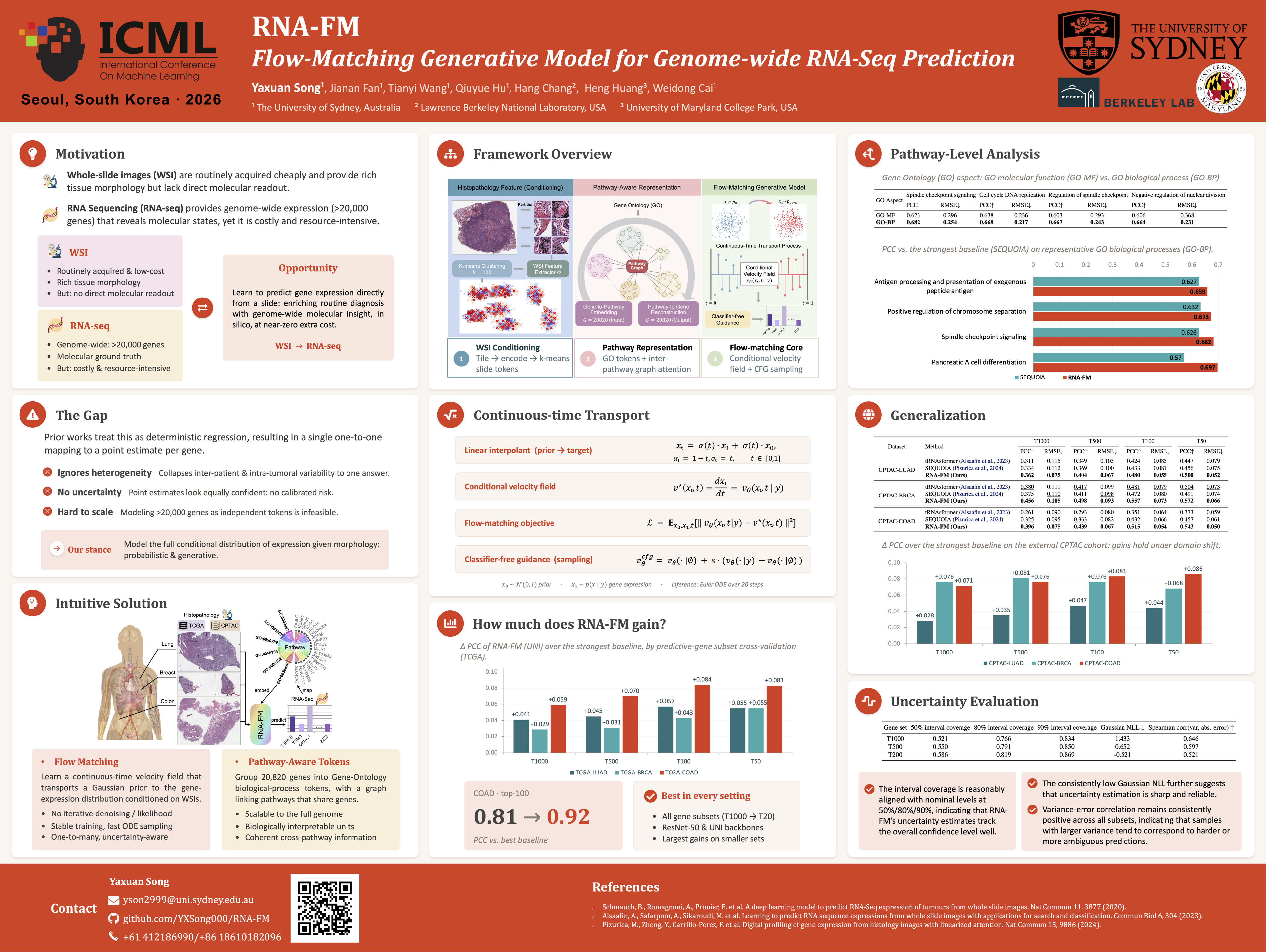
Histopathology whole-slide images (WSIs) are routinely acquired in clinical practice and contain rich tissue morphology but lack direct molecular architecture and functional programs defining pathological states, whereas RNA sequencing (RNA-seq) provides genome-wide transcriptional profiles at substantial cost, thereby motivating WSI-based genome-wide transcriptomic prediction. Existing approaches for predicting gene expression from WSIs predominantly rely on deterministic regression with one-to-one mapping, limiting their ability to capture biological heterogeneity and predictive uncertainty. We propose RNA-FM, a flow-matching generative framework for genome-wide bulk RNA-seq prediction from WSIs. RNA-FM formulates transcriptomic prediction as a continuous-time conditional transport problem, learning a velocity field that maps a simple prior to the target gene expression distribution conditioned on morphologies. By integrating pathway-level structure, RNA-FM enables scalable and biologically interpretable genome-wide gene expression imputation. Extensive experiments demonstrate that RNA-FM consistently outperforms state-of-the-art approaches while maintaining biological meaningfulness. Code is available at https://github.com/YXSong000/RNA-FM.
Lay Summary
Histopathology slides are routinely collected in hospitals and show detailed tissue structures, but they do not directly reveal which genes are active in the tissue. RNA sequencing can measure this gene activity across the whole genome, but it is costly and not always available for every patient or study sample. We introduce RNA-FM, a generative method that predicts genome-wide RNA sequencing profiles from pathology slide images. Unlike earlier methods that produce a single fixed-point prediction, RNA-FM can model a range of possible gene activity patterns for the same image. This is important because tumors and other tissues are biologically diverse, and similar-looking tissue can still have different molecular behavior. To make the prediction more meaningful, RNA-FM groups genes by known biological pathways, rather than treating thousands of genes as unrelated outputs. This helps the model scale to 20,820 genes while keeping its predictions easier to interpret. Across lung, breast, and colon cancer datasets, RNA-FM predicts gene expression more accurately than existing methods and performs well on external validation data. This work may help connect routine pathology imaging with molecular information, supporting more accessible and informative biomedical research.