
HiDe: Rethinking The Zoom-IN method in High Resolution MLLMs via Hierarchical Decoupling
Abstract
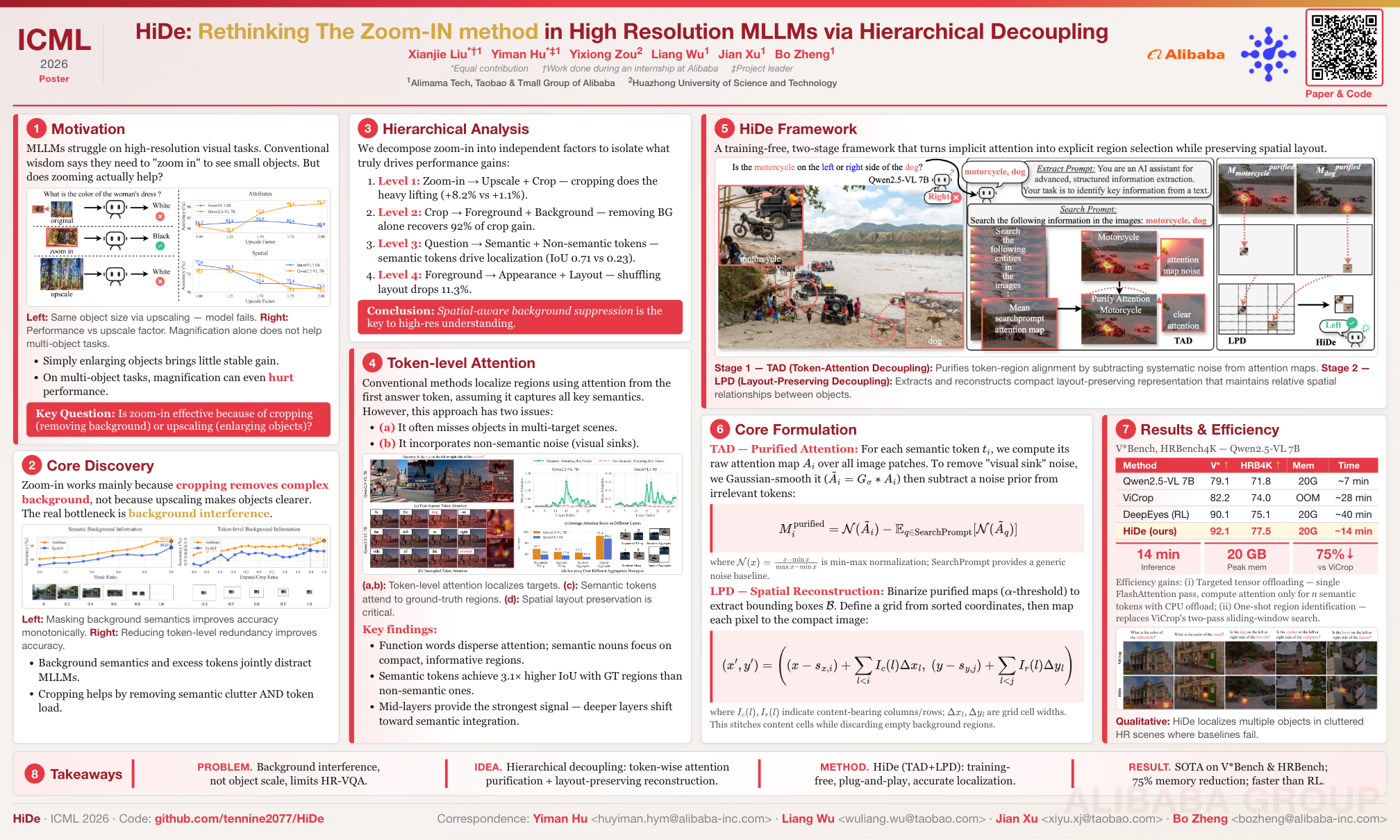
Multimodal Large Language Models have made substantial progress on visual understanding tasks, yet they still perform poorly on high-resolution images. Prior work often attributes this limitation to perceptual constraints, arguing that MLLMs fail to recognize small objects and therefore rely on ''zoom-in" strategies to recover fine details. In contrast, our analysis shows that the dominant failure mode is background interference rather than object size. We study the "zoom-in" operation through a hierarchical decoupling analysis and propose the Hierarchical Decoupling Framework, a training-free method that turns implicit attention into explicit region selection. HiDe first performs Token-wise Attention Decoupling to disentangle question semantics and identify the most informative tokens, then uses their attention patterns to pinpoint the corresponding visual regions. It subsequently applies Layout-Preserving Decoupling to extract these regions from cluttered backgrounds and construct a compact representation that retains key spatial structure while filtering out irrelevant context. HiDe achieves state-of-the-art results on high-resolution benchmarks like Vstar Bench. It boosts Qwen2.5-VL 7B and InternVL3 8B to state of the art performance, reaching 92.1\% and 91.6\% on Vstar Bench, and even surpasses reinforcement learning based methods. After optimization, HiDe reduces memory usage by 75\% compared with the previous training-free approach. Code will be available at https://tennine2077.github.io/HiDe.github.io/.
Lay Summary
Multimodal Large Language Models that understand both images and text often struggle with detailed, high-resolution photos. Many assume this limitation stems from missing small objects, which motivates zoom-in strategies to recover fine details. However, our analysis reveals that distracting backgrounds constitute the primary source of errors. We propose HiDe, a training-free method that helps AI focus on what matters. HiDe first links question words to the most relevant image areas, then extracts those regions while preserving their layout and filtering out clutter. On high-resolution benchmarks, HiDe boosts leading models like Qwen2.5-VL 7B and InternVL3 8B to over 91% accuracy. These results surpass even methods that require extensive training, while memory usage is reduced by 75%. By enabling clearer visual reasoning, HiDe advances reliable AI understanding for complex, real-world images.