
Regularized Offline Policy Optimization with Posterior Hybrid Bayesian Belief
Abstract
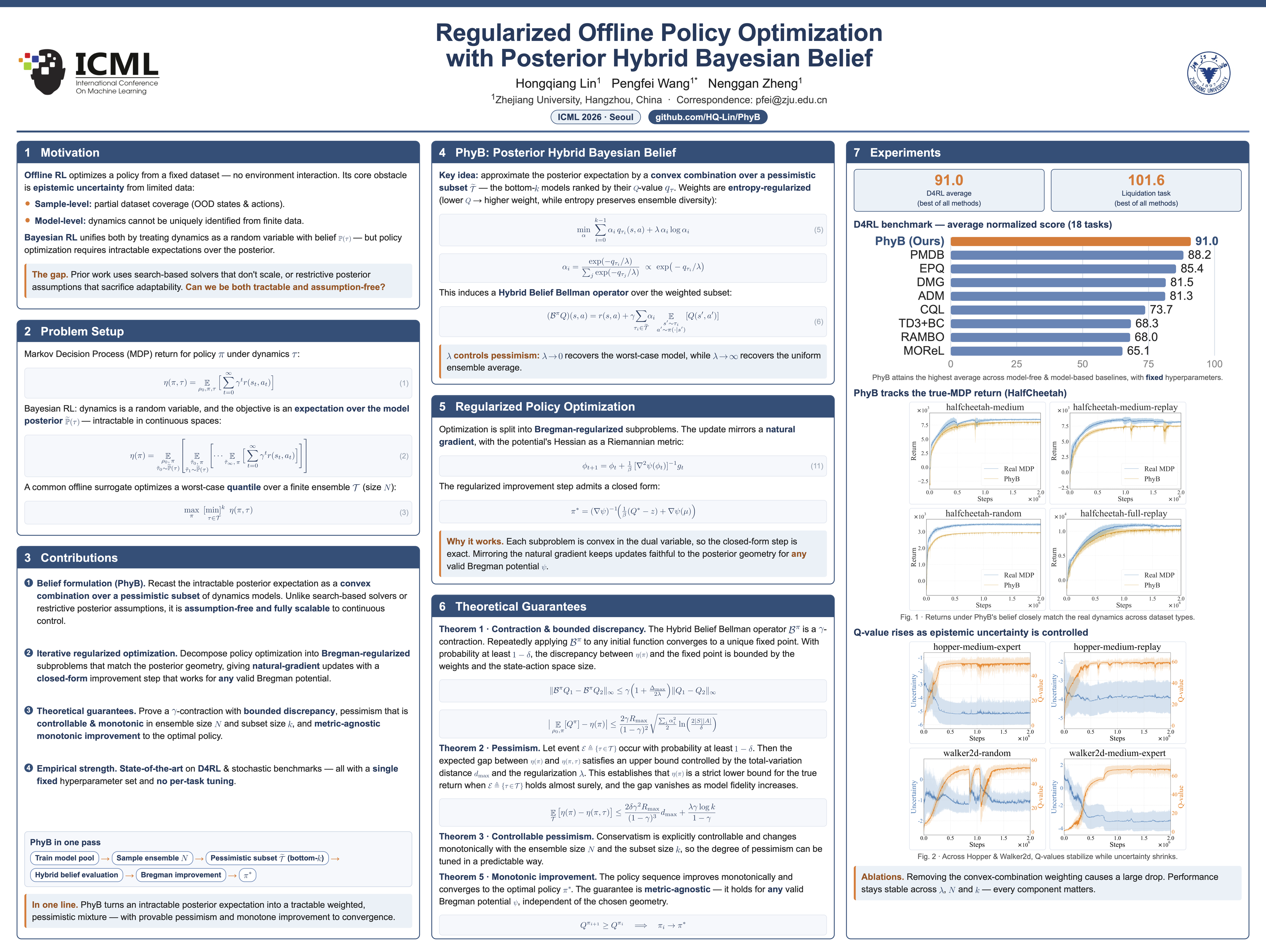
Offline reinforcement learning (RL) aims to optimize policies from pre-collected datasets. A bottleneck of this paradigm is managing epistemic uncertainty, which arises from limited data coverage (sample-level) and the ambiguity in identifying transition dynamics from finite data (model-level). To provide a unified quantification of these uncertainties, Bayesian RL has been proposed by treating the dynamics model as a random variable and maintaining a corresponding belief. Despite its theoretical appeal, policy optimization in Bayesian RL remains computationally challenging as it requires solving composite objectives with expectations. Prior methods either employ search-based techniques with poor computational scalability or impose restrictive posterior assumptions that sacrifice the adaptability of Bayesian RL. To address these limitations, we propose Posterior Hybrid Bayesian Belief (PhyB), which reformulates the expectation as a convex combination over a subset of dynamics models. Theoretical analysis demonstrates that the objective discrepancy induced by this approximation remains bounded. Based on PhyB, we develop an iterative regularized policy optimization algorithm that provides metric-agnostic guarantees for monotonic improvement until convergence. Empirical results demonstrate that PhyB achieves state-of-the-art performance on various benchmarks.
Lay Summary
Offline reinforcement learning (RL) trains artificial intelligence (AI) using only pre-collected historical data, which avoids risky real-world trial and error. However, a major bottleneck is managing uncertainty, as limited data leaves the AI unsure about the true physical laws of its environment. A framework known as Bayesian RL addresses this by maintaining a probabilistic belief over multiple potential environment models, but optimizing decisions across all these possibilities is computationally overwhelming. Existing approaches either scale poorly or make restrictive assumptions that ruin the AI's flexibility. To resolve this, we present Posterior Hybrid Bayesian Belief (PhyB), which discretizes the continuous belief space using a carefully selected subset of potential environment models. Our theoretical analysis demonstrates that the objective discrepancy incurred by this tractable approximation is strictly bounded. Based on PhyB, we develop an optimization algorithm that guarantees steady performance gains until convergence. Our method achieves state-of-the-art performance on various benchmarks, proving that complex automation systems can be controlled reliably and efficiently without requiring complete data coverage.