
HyperPotter: Spell the Charm of High-Order Interactions in Audio Deepfake Detection
Abstract
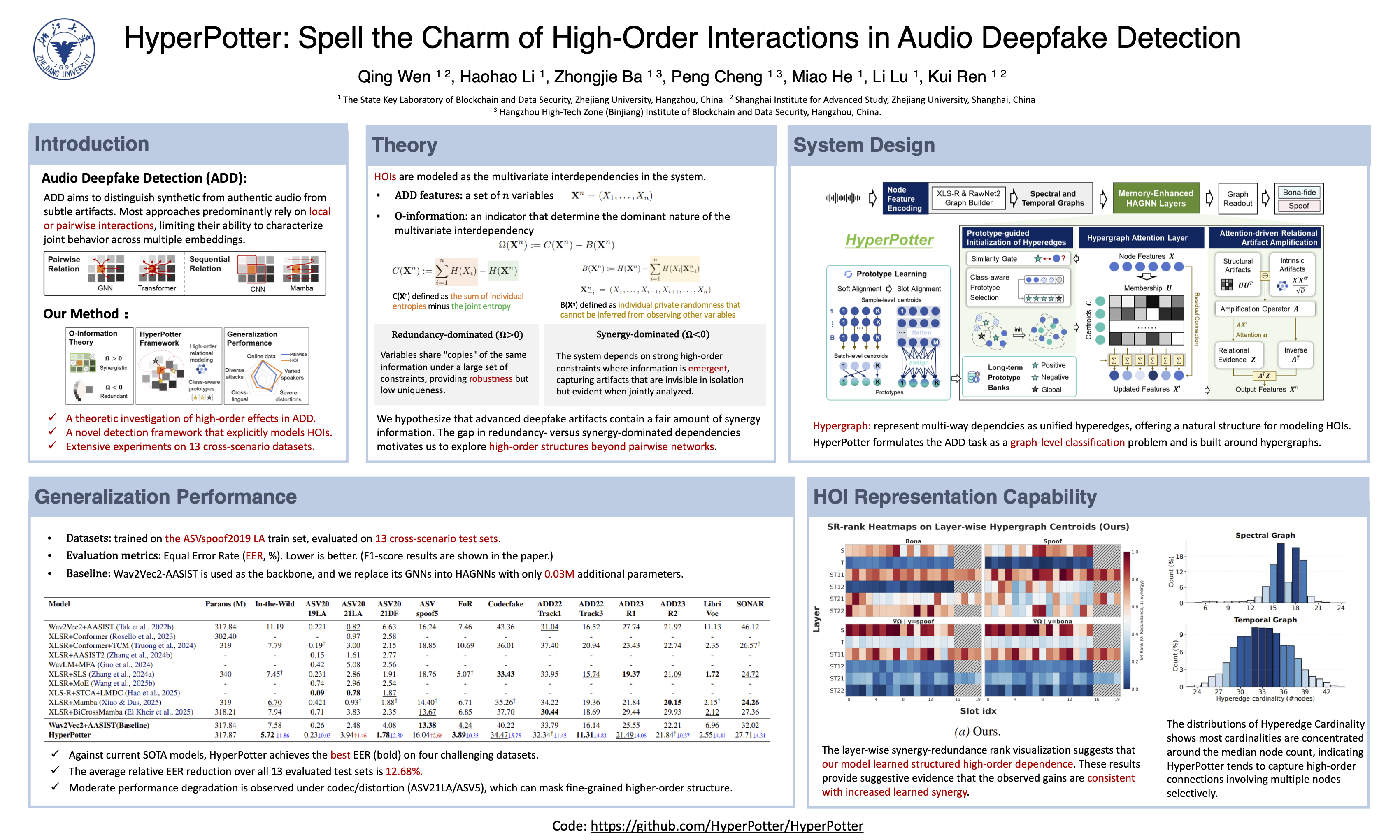
Advances in AIGC technologies have enabled the synthesis of highly realistic audio deepfakes capable of deceiving human auditory perception. Although numerous audio deepfake detection (ADD) methods have been developed, most rely on local temporal/spectral features or pairwise relations, overlooking high-order interactions (HOIs). HOIs capture discriminative patterns that emerge from multiple feature components beyond their individual contributions. We propose HyperPotter, a hypergraph-based framework designed to capture high-order relations associated with synergistic patterns through clustering-based hyperedges with class-aware prototype initialization. Extensive experiments on 13 test sets show that HyperPotter improves over the baseline on 11 sets, yielding an average relative EER reduction of 12.68\% across all test sets and 22.15\% on the improved sets. These results demonstrate strong cross-scenario generalization, while also revealing robustness limits under severe codec or channel distortion.
Lay Summary
Modern AI can generate highly realistic fake voices, making it difficult to distinguish real speech from synthetic speech using simple local or pairwise audio cues. HyperPotter addresses this problem by looking at how multiple audio patterns interact together, rather than analyzing them mostly one by one or in pairs. It represents speech features as a hypergraph, where each hyperedge can connect several related components, and uses class-aware prototypes to build these relationships more reliably. Across a broad set of audio deepfake benchmarks, HyperPotter generally detects fake speech better than a strong baseline, especially in cross-scenario settings with varied speakers, languages, and spoofing methods. However, its advantage can weaken when audio is heavily compressed or distorted, suggesting that future systems should adaptively combine high-order and more distortion-robust cues.