
PoMtVRS: Preference-Optimized Multi-Task Vehicle Routing Solver with Preference Gating
Abstract
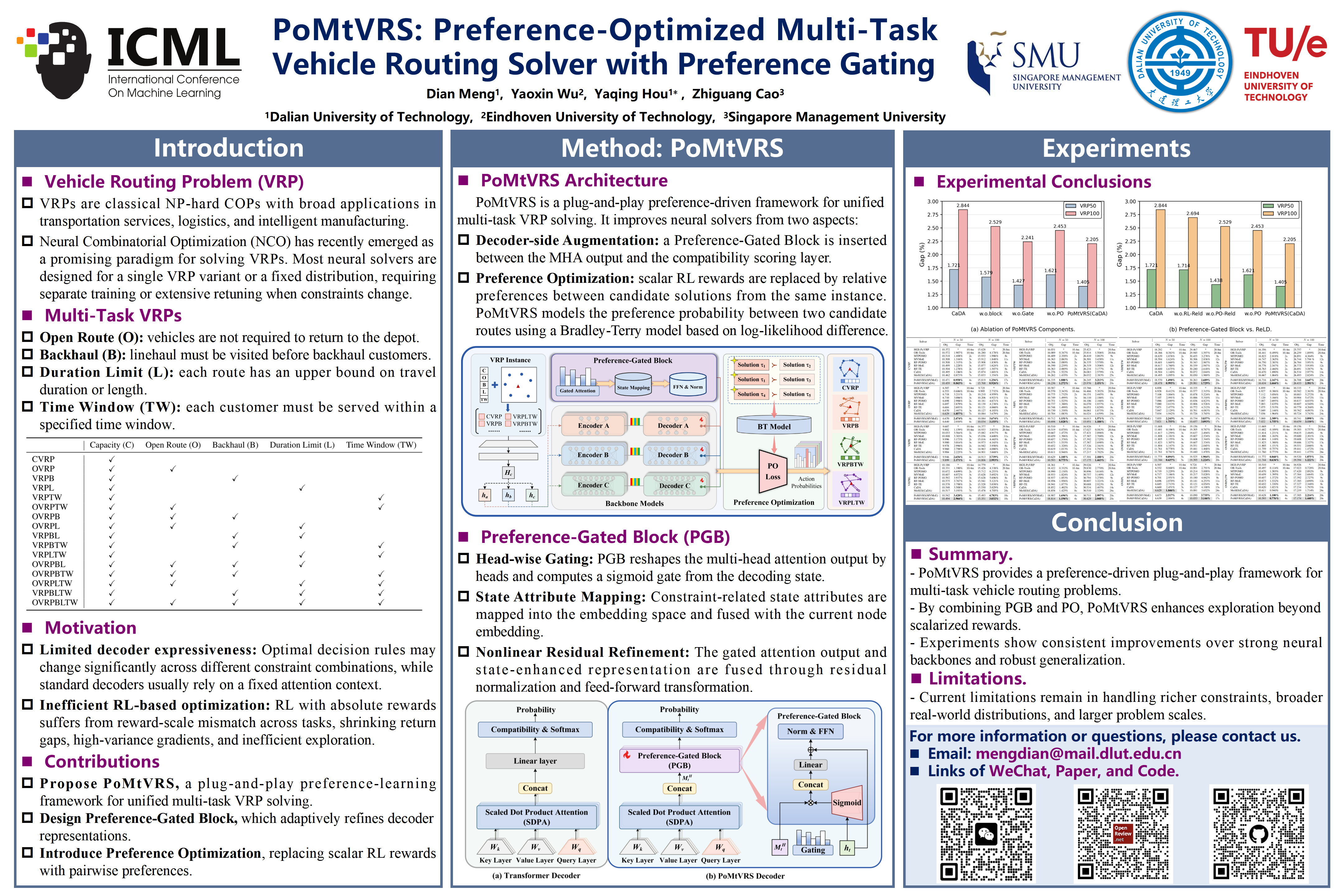
Multi-task vehicle routing solvers via deep reinforcement learning have attracted broad attention and achieved significant progress in handling multiple constraints. However, existing neural solvers still face critical challenges, including insufficient representation, unstable training, and inefficient exploration in large combinatorial action spaces, which often prevents performance from meeting its full potential. To address these issues, we propose PoMtVRS (Preference-Optimized Multi-Task Vehicle Routing Solver with Preference Gating), a plug-and-play framework that jointly improves decoder representations and exploration efficiency through a synergistic combination of decoder-side augmentation and preference-driven optimization. Specifically, we introduce the preference optimization objective to learn relative comparisons among candidate solutions for different routing tasks, encouraging a higher generation probability of better solutions. Meanwhile, we design a preference-gated block that adaptively modulates decoder representations via sparse gated attention and nonlinear residual refinement. Extensive experiments demonstrate that PoMtVRS elevates state-of-the-art unified neural VRP backbones, achieving leading performance in multi-task benchmarks and stronger generalization.
Lay Summary
Planning delivery routes is a common but difficult problem in logistics, transportation, and supply-chain management. A good route planner must handle many different requirements, such as vehicle capacity, travel distance, service order, or multiple depots. Existing learning-based route planners can often deal with several routing tasks, but they may become less reliable and not fully use the information available during route construction when the tasks involve many constraints or larger problem sizes. To address these issues, the paper presents PoMtVRS, a framework that improves existing route planners by helping them choose better routes more consistently. Instead of only learning from the final cost of a route, PoMtVRS learns from comparisons between candidate routes and encourages the planner to prefer better ones. It also helps the planner use task-related information more effectively while constructing routes. Experiments on many vehicle routing problems show that PoMtVRS improves strong existing planners, works well across different types of constraints, and generalizes better to real-world routing instances.