
AnyMod-LLVE: Low-Light Video Enhancement with Modality-Agnostic Inference
Abstract
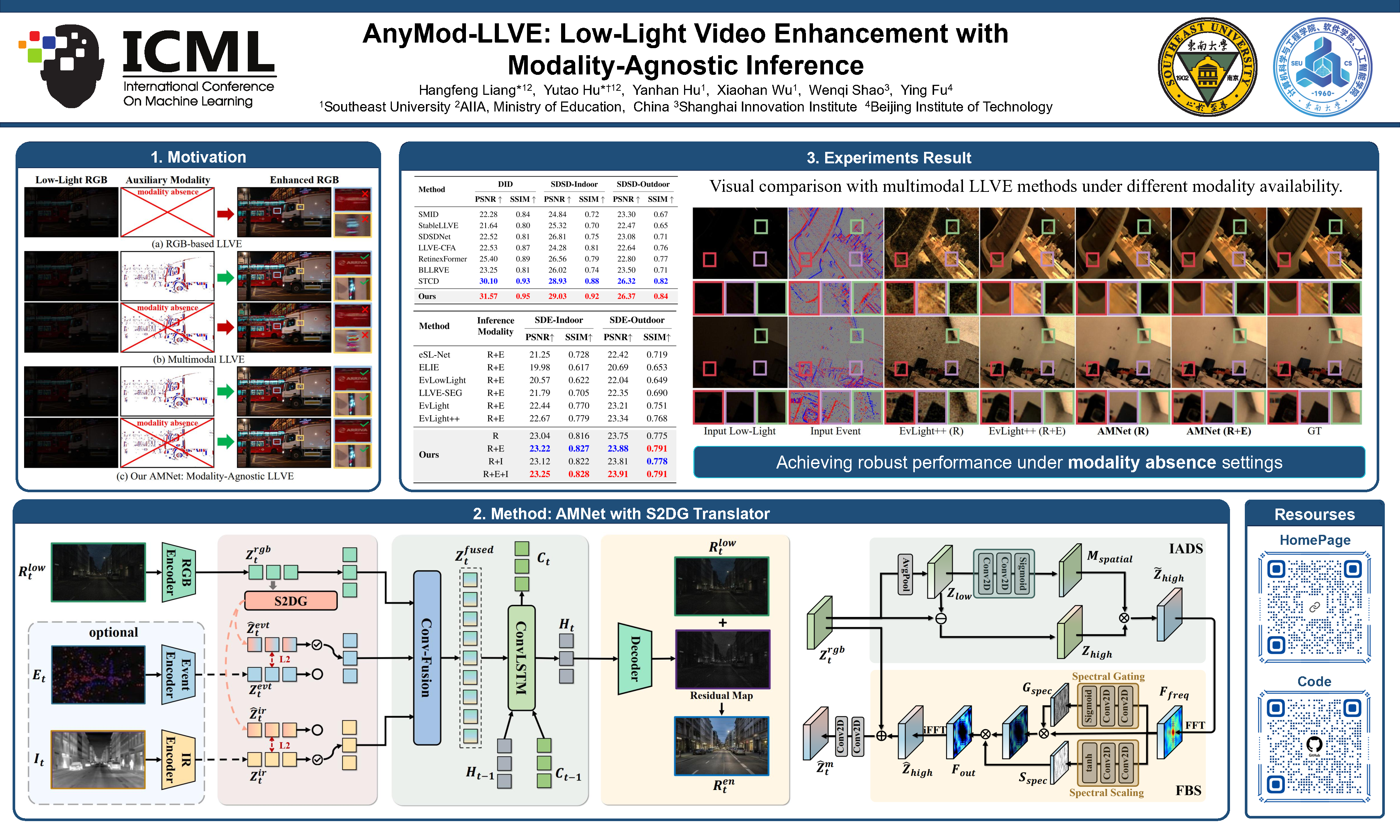
Low-light video enhancement (LLVE) remains a challenging task due to severe information degradation under low-illumination conditions. Recent multimodal approaches have significantly improved enhancement performance by incorporating auxiliary modalities, such as event streams and infrared images. However, these methods typically assume the availability of these modalities at inference, which is often not feasible in real-world scenarios. To solve this problem, in this work, we propose AMNet, a unified multimodal framework for LLVE, to support flexible modality-agnostic inference, where auxiliary modalities may be unavailable. To address the issue of modality absence, we introduce a Spatial-Spectral Dual-Gated Translator that learns the correspondence between auxiliary modalities and RGB inputs, producing implicit auxiliary representations to support the robust enhancement. Additionally, to fully facilitate the learning of cross-modal correspondence, we conduct large-scale multimodal pretraining based on the RGB-only dataset with synthetic auxiliary modalities. Extensive experiments demonstrate that AMNet could handle arbitrary inference-time modality combinations and exhibits superior performance for LLVE under modality absence conditions. Code and models are available on the project page.
Lay Summary
Videos recorded at night or in very dark environments often lose important visual details, such as object boundaries, textures, and motion cues. This makes it harder for cameras and vision systems to produce clear videos for applications such as mobile photography, surveillance, and autonomous perception. Recent methods improve low-light videos by using extra sensors, such as event cameras or infrared cameras, but these sensors are not always available in real-world settings. We propose AMNet, a video enhancement system that can use extra sensor information when it is available, but can still work well when only a regular low-light RGB video is provided. Instead of requiring missing sensor data at test time, AMNet learns during training how these extra sensors relate to normal video, and then creates useful internal representations of the missing information from the low-light video itself. To do this, it focuses on the few reliable details that remain in dark videos, both in image space and in frequency space, while reducing the influence of noise. This makes low-light video enhancement more flexible and practical, because the same model can adapt to different sensor setups without failing when some inputs are missing. Experiments show that AMNet improves video clarity and detail recovery across several benchmarks, even when only RGB video is available.