
Sequential Kernel-based Conditional Independence Testing via Adaptive Betting
Abstract
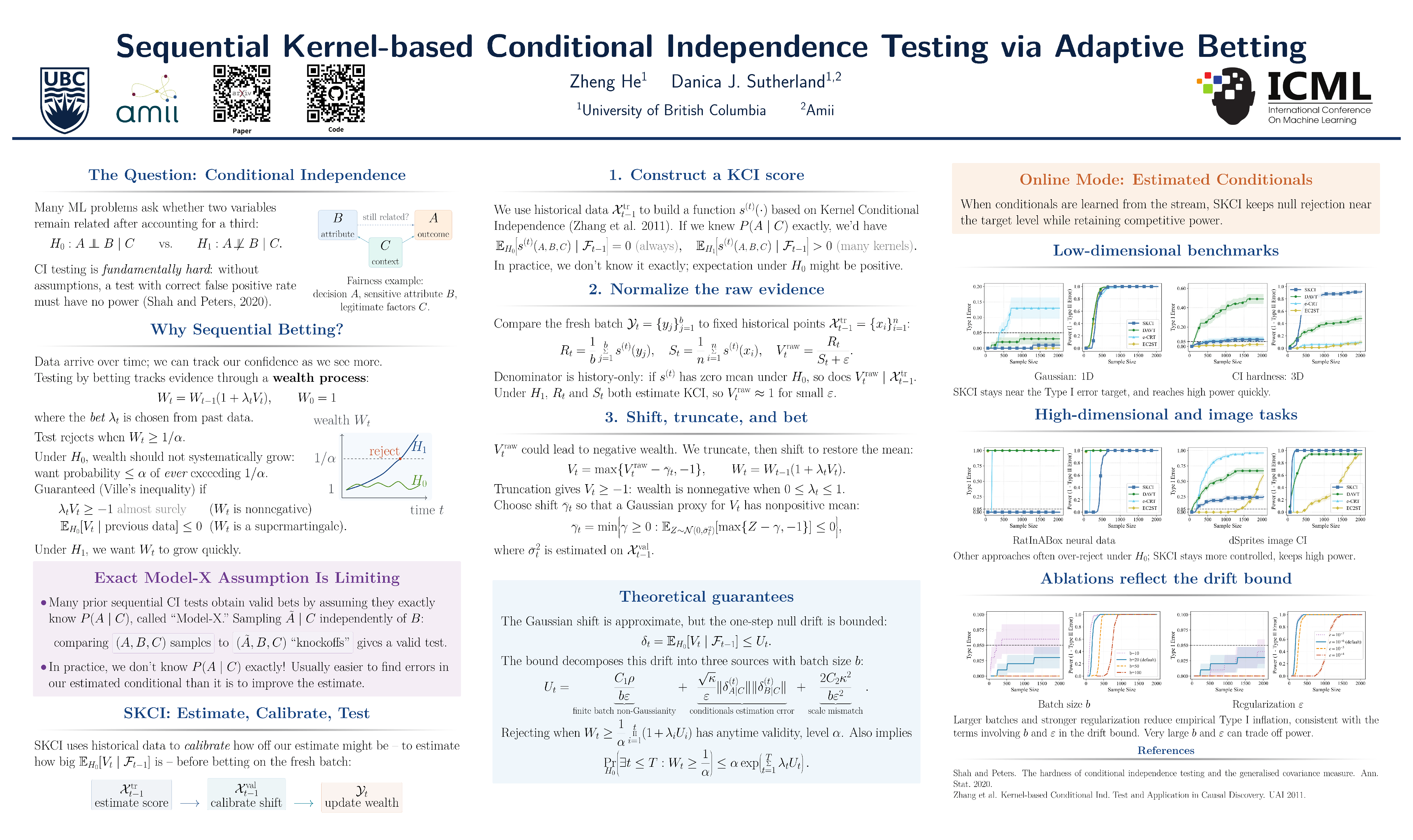
Testing conditional independence is fundamental yet intrinsically difficult: without additional assumptions, Type I error control is impossible in general. The ``Model-X'' paradigm addresses this difficulty by assuming exact knowledge of a relevant conditional distribution. While small deviations from this assumption can sometimes be tolerated in classical one-shot testing, existing sequential conditional independence tests typically require the Model-X conditional to be known exactly, making them fragile when it must instead be estimated. We propose a new approach that is substantially more robust to such estimation error. Our method applies testing-by-betting to an adaptively optimized Kernel Conditional Independence statistic, together with a normalization scheme and a truncate-and-shift calibration strategy. These modifications greatly reduce Type I error inflation while preserving high power across high-dimensional synthetic benchmarks and real-world fairness tasks, outperforming existing sequential Model-X approaches. Code is available at \url{https://github.com/he-zh/SKCI}.
Lay Summary
This paper studies sequential conditional independence testing, a fundamental but generally impossible task without assumptions. We introduce SKCI, a kernel-based method that accumulates evidence over time while being more robust to errors in estimated conditional distributions. Empirically, SKCI reduces false discoveries compared with existing sequential Model-X methods while maintaining high power beyond the exact Model-X setting.