
SSL4RL: Revisiting Self-supervised Learning as Intrinsic Reward for Visual-Language Reasoning
Abstract
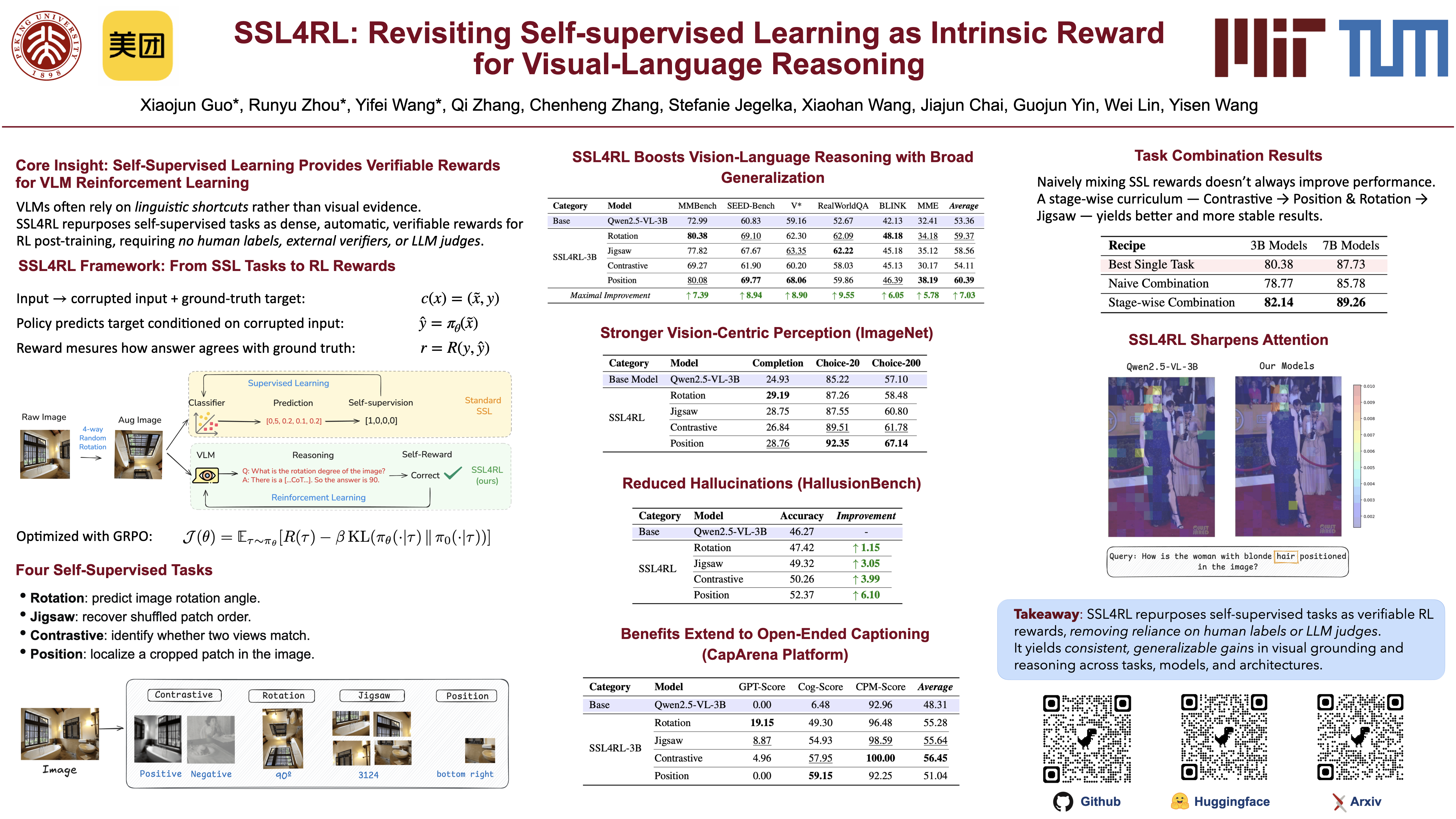
Vision-language models (VLMs) have shown remarkable abilities by integrating large language models with visual inputs. However, they often rely on textual shortcuts rather than adequately using visual evidence during reasoning. Although reinforcement learning (RL) can align models with desired behaviors, its application to VLMs has been hindered by the lack of scalable and reliable rewards. To overcome this challenge, we propose SSL4RL, a novel framework that leverages self-supervised learning (SSL) tasks as a source of verifiable rewards for RL. Our approach reformulates SSL objectives like rotation prediction and patch reconstruction into dense automatic rewards, removing the need for human preferences or AI evaluators. Experiments show that SSL4RL substantially improves performance on both vision-centric and vision-language reasoning benchmarks, with encouraging potentials on open-ended scenarios and stronger resilience to visual corruptions. Through systematic ablations, we identify key factors influencing SSL4RL, including data volume, model scale, model choice, task combination, and task difficulty, thereby offering new design principles for future work. Our implementation is open-sourced at https://github.com/PKU-ML/SSL4RL, with models hosted on Huggingface collection https://huggingface.co/collections/PKU-ML/ssl4rl.
Lay Summary
Vision-language models can answer questions about images, but they often rely on textual shortcuts instead of truly using visual evidence. This can lead to unreliable reasoning, especially in challenging visual scenarios. We propose SSL4RL, a framework that improves visual reasoning using reinforcement learning with automatically generated rewards. Instead of relying on human feedback, SSL4RL uses simple self-supervised tasks, such as predicting image rotations or reconstructing missing image patches, to teach models to better understand visual content.