
Grounding Multi-Hop Reasoning in Structural Causal Models via Group Relative Policy Optimization
Abstract
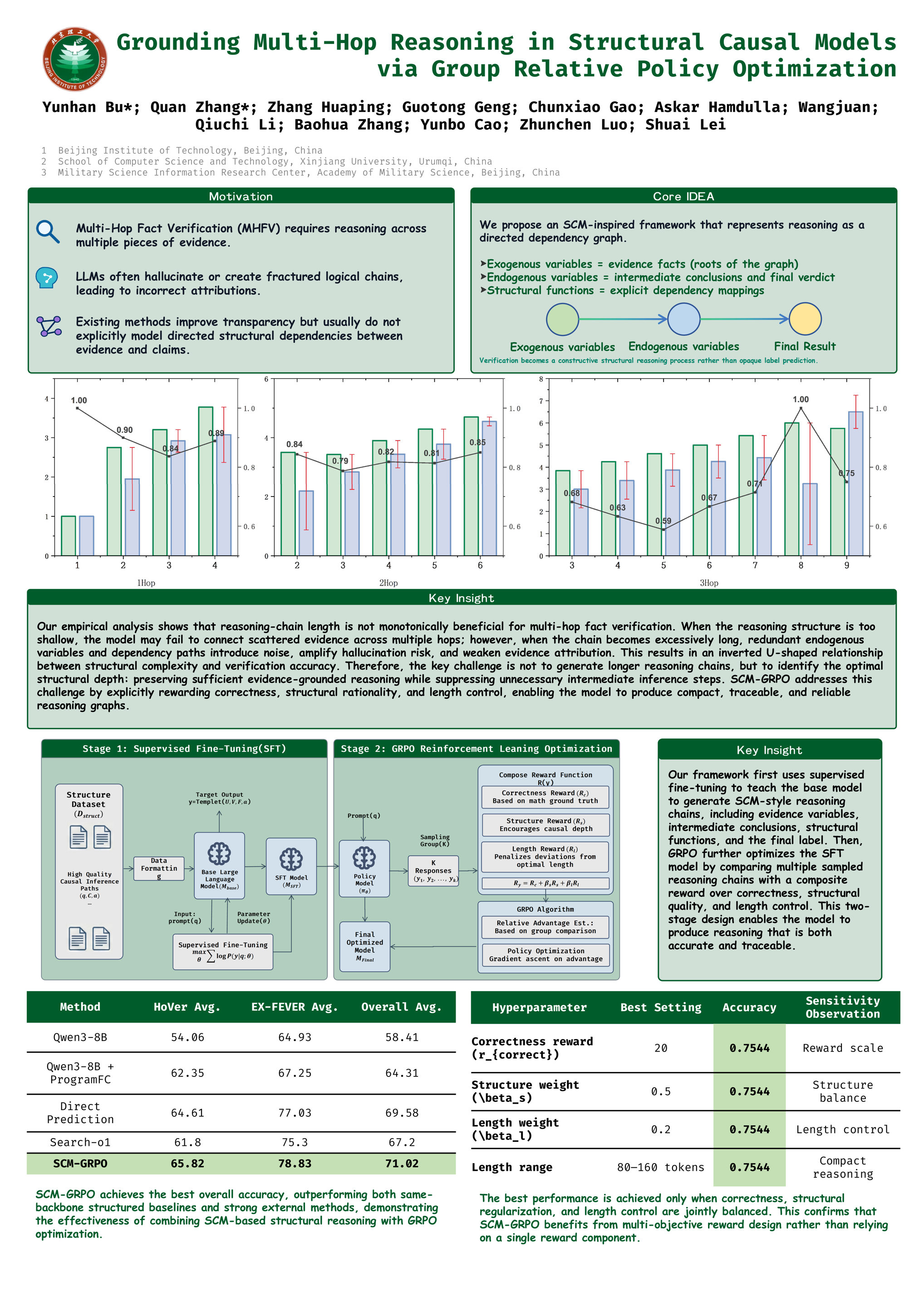
Multi-Hop Fact Verification requires complex reasoning across disparate evidence, posing significant challenges for Large Language Models , which may suffer from hallucinations and fractured logical chains. Existing methods, while improving transparency via Chain-of-Thought , often lack explicit modeling of the structural dependencies between evidence and claims. In this work, we introduce an SCM-inspired framework that grounds reasoning in explicit directed dependency graphs, treating verification as a constructive structural reasoning process rather than full causal inference with interventions or counterfactual semantics. We empirically identify an ``inverted U-shaped'' correlation between reasoning-chain length and accuracy, revealing that excessive structural complexity can degrade performance. To address this, we propose a rule-based reinforcement learning strategy using Group Relative Policy Optimization. This approach dynamically optimizes the trade-off between structural depth and conciseness. Extensive experiments on HoVer and EX-FEVER demonstrate that our SCM-GRPO framework outperforms strong baselines while producing more traceable reasoning structures for complex fact verification.
Lay Summary
Many real-world claims cannot be verified from a single piece of evidence. They often require connecting several facts step by step, which is difficult for large language models because they may skip important links, rely on unsupported assumptions, or generate explanations that are longer than necessary. This paper proposes a method that organizes the verification process as a structured reasoning graph. In this graph, pieces of evidence, intermediate conclusions, and the final decision are explicitly connected, making the reasoning process easier to inspect. The method also trains the model to avoid reasoning chains that are too short for complex claims or unnecessarily long for simple claims. Experiments on multi-hop fact verification benchmarks show that this approach improves verification accuracy while producing more traceable reasoning paths.