
MAFE: Enabling Equitable Algorithm Design in Multi-Agent Multi-Stage Decision-Making Systems
Abstract
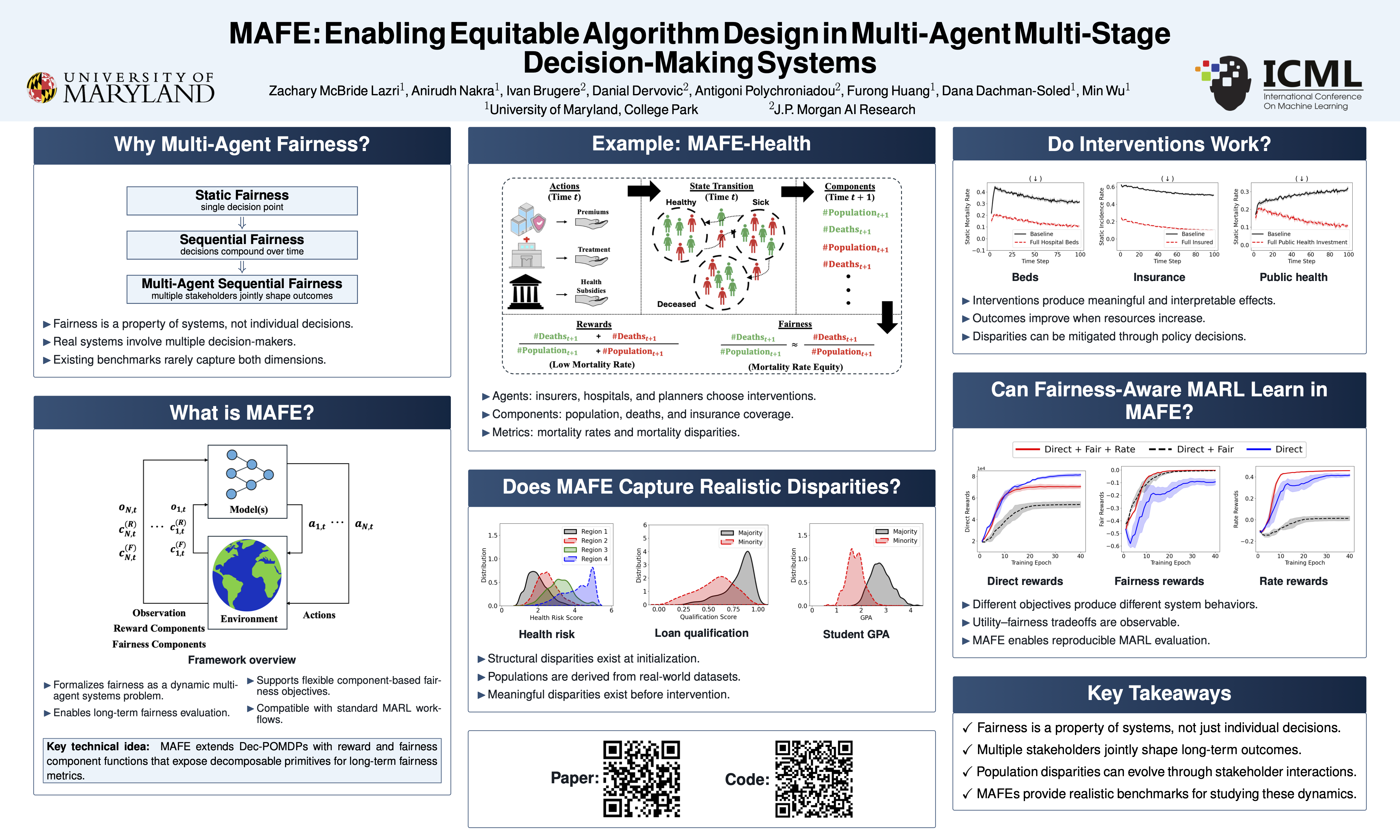
Algorithmic fairness is often studied in static or single-agent settings, yet many real-world decision-making systems involve multiple interacting entities whose multi-stage actions jointly influence long-term outcomes. Existing fairness methods applied at isolated decision points frequently fail to mitigate disparities that accumulate over time. Although recent work has modeled fairness as a sequential decision-making problem, it typically assumes centralized agents or simplified dynamics, limiting its applicability to complex social systems. We introduce MAFE, a suite of Multi-Agent Fair Environments designed to simulate realistic, modular, and dynamic systems in which fairness emerges from the interplay of multiple agents. We demonstrate MAFEs in three domains—loan processing, healthcare, and higher education—supporting heterogeneous agents, configurable interventions, and fairness metrics. The environments are open-source and compatible with standard multi-agent reinforcement learning (MARL) libraries, enabling reproducible evaluation of fairness-aware policies. Through extensive experiments on cooperative use cases, we demonstrate how MAFE facilitates the design of equitable multi-agent algorithms and reveals critical trade-offs between fairness, performance, and coordination. MAFE provides a foundation for systematic progress in dynamic, multi-agent fairness research.
Lay Summary
How can we make machine learning systems fair in real-world settings? Existing approaches often treat fairness as a fixed property of a single decision, but in practice fairness changes over time and depends on the interactions among many stakeholders. In this work, we study how fairness can be evaluated in complex societal systems where these stakeholders interact over time. To study this problem, we introduce Multi-Agent Fair Environments (MAFEs), a framework for modeling fairness in dynamic real-world systems. In these environments, decision-makers may operate under shared or differing objectives while also accounting for fairness goals. We study this framework across several domains, including finance, healthcare, and education. Our results show that, even in long-term and changing environments, performance and fairness goals can often be balanced simultaneously. These findings suggest that fairness should be viewed not only as a property of an individual decision made by a single stakeholder, but also as a long-term societal objective shaped by stakeholder interactions over time. To support future research, we release three realistic MAFE environments that provide controlled testbeds for studying fairness-aware decision-making in complex systems. Researchers and domain experts can use them to better understand how decisions and incentives influence outcomes over time.