
Feature Collapse Under Corruption: An Entropy Perspective on Robust Neural Networks
Abstract
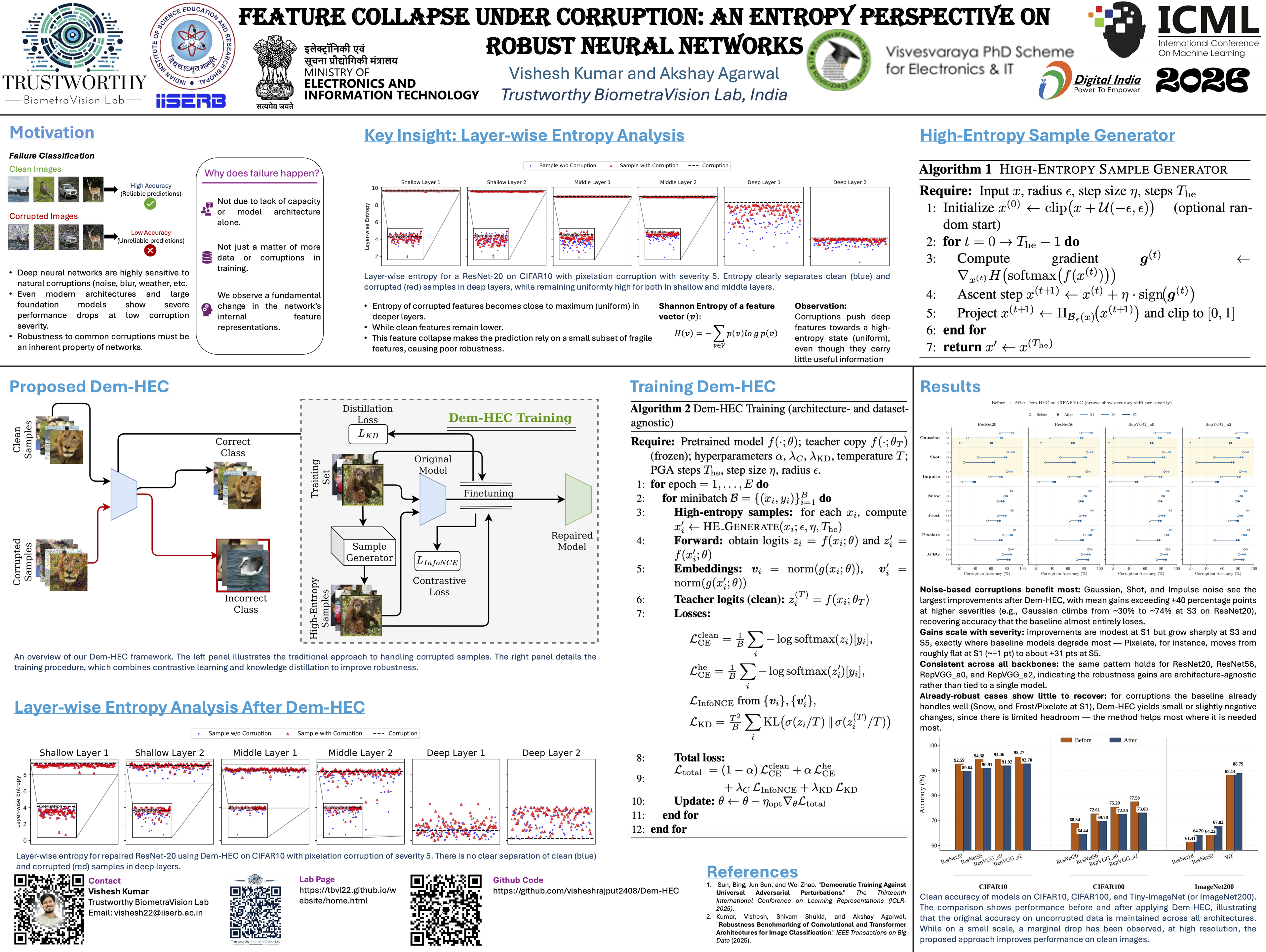
Even after decades of advances in neural network training, the inherent robustness challenge remains open. While the sensitivity to adversarial perturbations is understandable given their intentional learning, the most surprising fact is the vulnerability to natural corruptions. Surprisingly, not only is the cause of this inherent vulnerability unknown, but the concern extends beyond traditional CNNs; it also applies to current models, including transformers and large foundation models. For the first time, through this work, we observe that natural corruptions often collapse the network's internal feature space into a high-entropy state, causing predictions to rely on a small subset of fragile features. Inspired by this, we propose a simple yet effective entropy-guided fine-tuning framework, Dem-HEC, that strengthens corruption robustness while maintaining clean accuracy. Our method generates high-entropy samples within a bounded perturbation region and repairs the model using both clean and high-entropy samples. We further combine this objective with distilling knowledge from a teacher snapshot to maintain stable predictions. The proposed Dem-HEC is effective across datasets ranging from small to large-resolution, from pure CNNs to transformers, and to large foundation models, including DinoV3. The proposed approach outperforms the state-of-the-art (SOTA) models not only in improving robustness but also in retaining or boosting clean accuracy.
Lay Summary
Through this research, we trained deep learning models to understand the uncertainty in the data and feature spaces. Due to this high uncertainty, the models are vulnerable to common image corruptions. We synthetically generate high-entropy samples in the feature space using the original label as the raw image input and ensure the feature space remains compact enough to remain resilient when high-entropy samples occur during model testing.