
ArcDAE: Asymmetric Rectified Contrastive Diffusion Autoencoder for Unified Representation Learning
Abstract
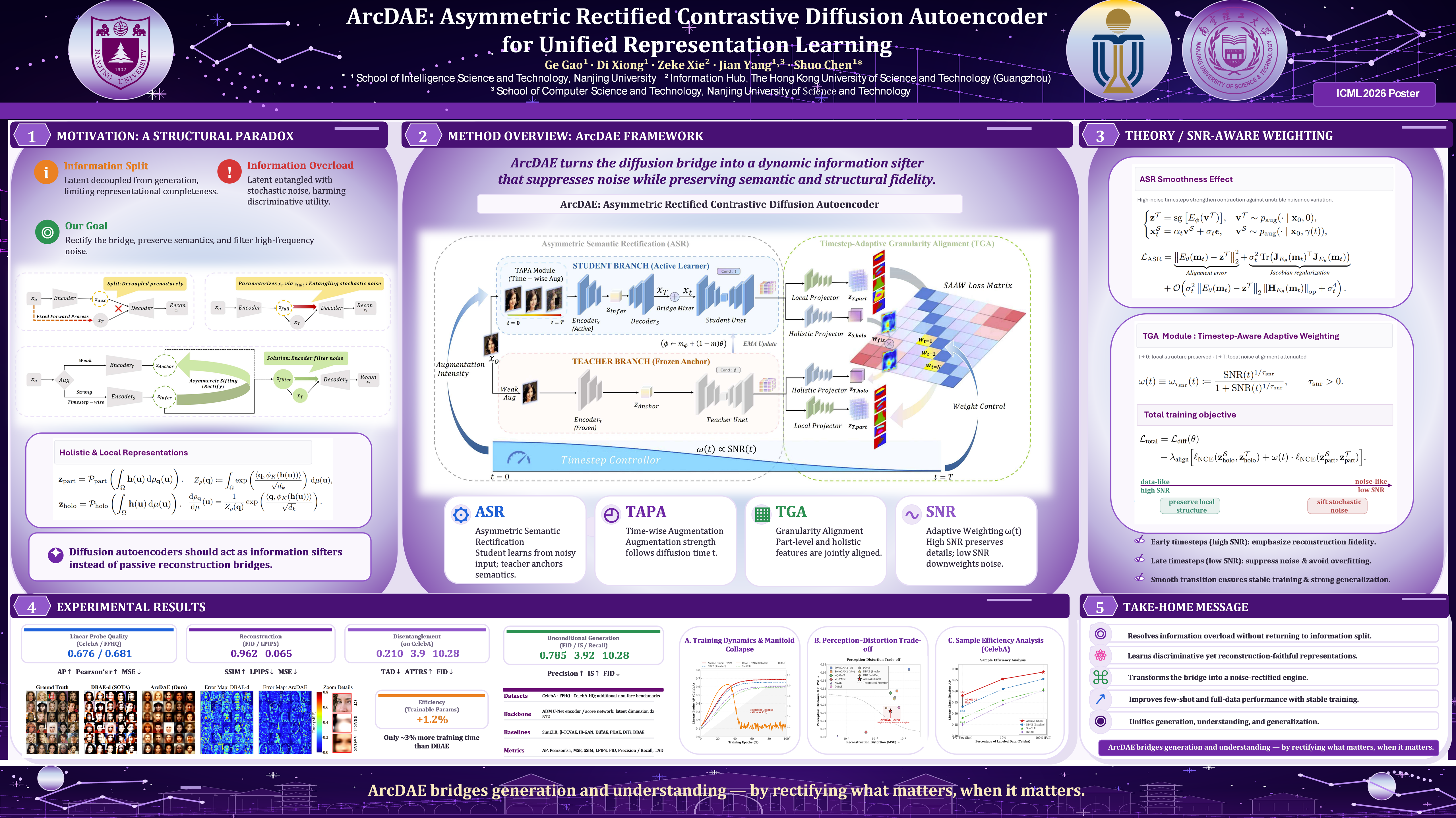
The unification of generative details and discriminative semantics presents a structural paradox in diffusion-based representation learning. Early approaches decouple semantics from generation, inevitably compromising representational completeness (i.e., information split). While recent bridge-based methods achieve unification via a tightly coupled mapping, they suffer from information overload. This is because unconstrained reconstruction objectives incentivize the encoder to entangle high-frequency stochastic noise into the latent bottleneck. To solve this, we introduce asymmetric rectified contrastive diffusion autoencoder (ArcDAE), which rebuilds the diffusion bridge as a dynamic sifter. Through imposing a timestep-aware rectification constraint that orthogonalizes the semantic manifold from the stochastic noise space, ArcDAE compels the bottleneck to distill discriminative features while actively shedding high-frequency redundancy. Consequently, our approach eliminates the overload trap without reverting to decoupling. Extensive experiments validate the superiority of our FFHQ-trained ArcDAE, surpassing state-of-the-art methods by up to 6.4% in downstream semantics regression and 9.7% in reconstruction fidelity.
Lay Summary
AI systems can create realistic images, but it is hard for these models to understand and separate the meaningful content from random noise. Existing methods either separate the understanding of image features from image generation, losing important details, or combine them too tightly, causing the model to mix noise with useful information. ArcDAE solves this by guiding the model’s representations toward a clean reference while carefully balancing structural and semantic information throughout the image generation process. This helps the model focus on important features without losing visual quality. Experiments show that ArcDAE consistently produces more informative and interpretable image representations while maintaining high-quality visuals. This approach makes it easier for researchers to study what the model has learned, to build better image generation systems, and to apply these techniques to tasks in computer vision and graphics where clear and robust features are critical. ArcDAE provides a practical and reliable tool for understanding and improving generative AI.