
Dynamics and Representation Structure of Local Approximations to Gradient-Based Learning in Linear Recurrent Neural Networks
Abstract
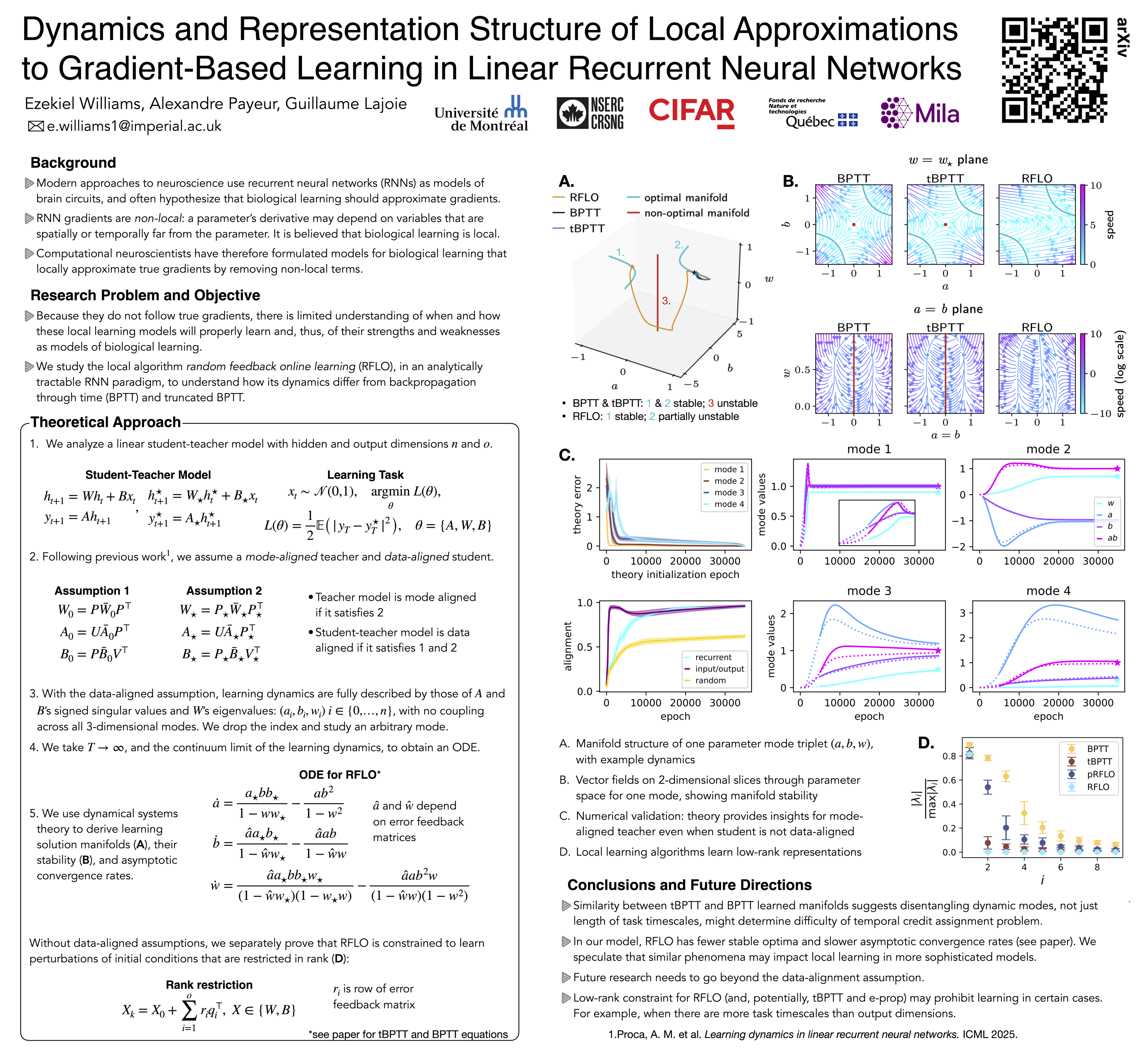
Biological and neuromorphic recurrent neural networks (RNNs) are subject to spatial and temporal locality constraints on the information that can plausibly be used during learning. A common strategy to satisfy these constraints is to modify gradient descent by neglecting non-local terms to varying degrees, as in random feedback local online (RFLO) learning and truncated backpropagation through time (tBPTT). However, the learning dynamics of these algorithms, and how they compare with BPTT, remain poorly understood. We apply dynamical systems theory to data-aligned linear RNNs---whose dynamics can be separated into orthogonal modes---to compare stationary solutions, stability properties, and convergence rates, finding qualitatively distinct behaviour for RFLO versus BPTT and one-step tBPTT. We further observe that the solutions learned by RFLO are restricted to low-rank perturbations of initial parameters, a result which holds beyond the data-aligned setting. Our work provides analytical insight into how locality constraints shape learning dynamics, with implications for neuroscientific models of learning and alternative optimization approaches for RNNs.
Lay Summary
When you learn a task, many connections between the cells in your brain change. How these changes are coordinated so that you can properly learn remains a mystery. To try to solve it, neuroscientists build mathematical models, called recurrent neural networks, of your brain’s cells and the connections between them. They then test learning rules—hypotheses for how brain cells coordinate learning—by simulating them in the network models. Unfortunately neuroscientists do not have a good understanding of when many of these rules will enable learning and when they will not. In this study, we use mathematical analysis of a simplified recurrent neural network model, to shed light on these ``black box’’ learning rules. To do this, we compare the rules that neuroscientists use with optimal learning rules used in artificial intelligence, whose properties are better understood. In the simple model that we study, we find that a common rule used by neuroscientists can match an optimal rule from AI on task performance, but often takes longer to learn and is restricted in the kinds of solutions it finds. We hope these results will provide a starting point that researchers can build upon to better understand the brain.