
Stage-wise Distortion–Perception Traversal in Zero-shot Inverse Problems with Diffusion Models
Abstract
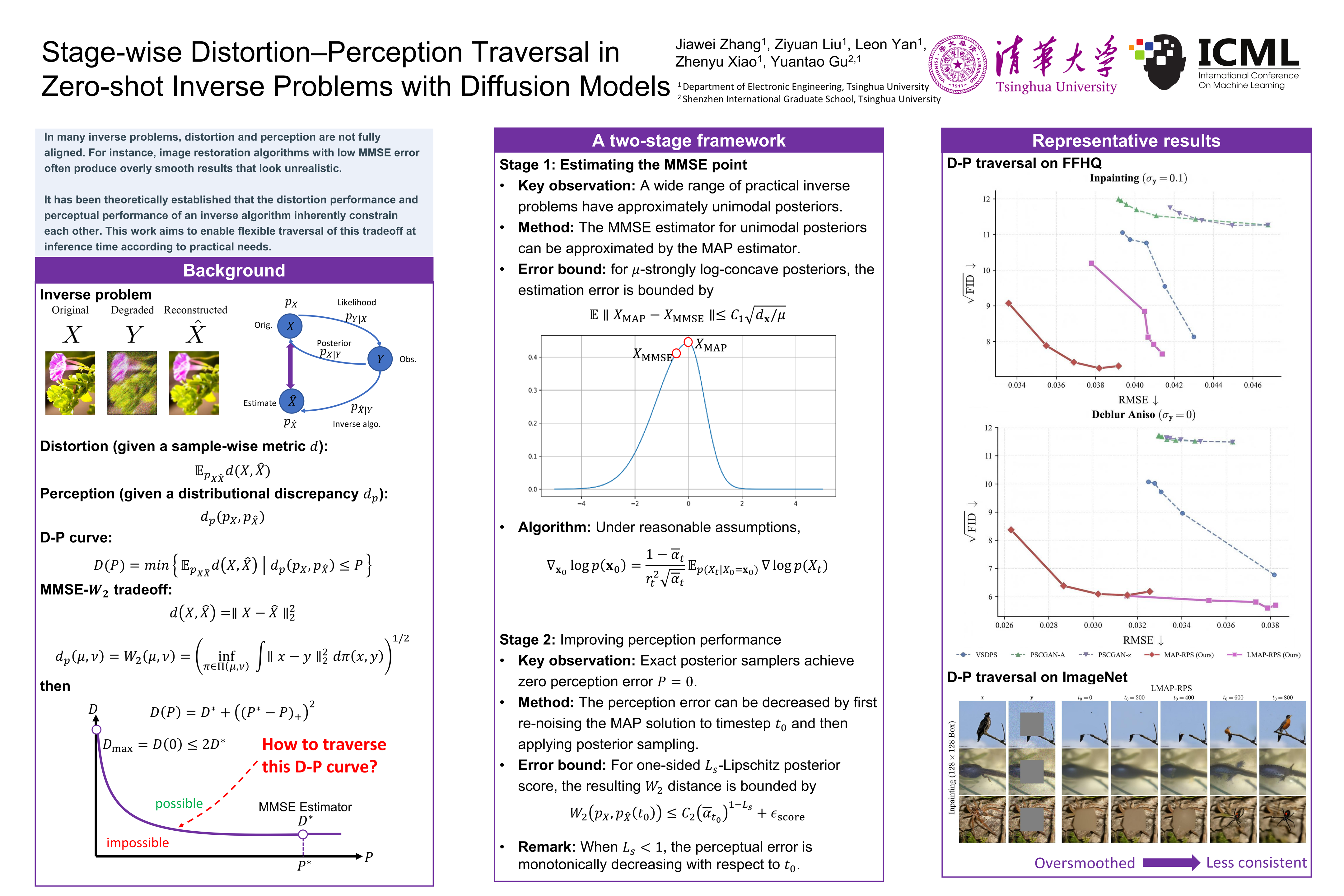
The distortion–perception (D–P) tradeoff is a fundamental phenomenon of Bayesian inverse problems, which characterizes the inherent tension between distortion performance and perceptual quality. Enabling flexible traversal of the D-P tradeoff at inference time is crucial for practical applications. Despite the recent success of diffusion models in zero-shot inverse problem solving, efficient and principled strategies for D-P traversal in diffusion-based inverse algorithms remain inadequately characterized. In this paper, we propose a stage-wise framework for realizing D-P traversal using a single diffusion model in zero-shot inverse problems. Our proposed method, termed MAP-RPS, starts with an MAP estimation stage that approximates the MMSE solution and provides a low-distortion initialization, followed by a re-noised posterior sampling stage that progressively improves perceptual quality. We provide theoretical analyses for both stages, establishing the validity and effectiveness of the proposed design. Furthermore, we extend MAP-RPS to the latent space, yielding LMAP-RPS, which enjoys broader applicability by leveraging large-scale pre-trained latent diffusion backbones. Extensive experiments demonstrate that MAP-RPS and LMAP-RPS enable more effective D-P traversal on various tasks, while also exhibiting strong performance as efficient solvers for real-world inverse problems.
Lay Summary
When an image is blurred, incomplete, or noisy, there are often many possible clean images that could explain the same observation. A good restoration should be faithful to the input, but it should also look like a realistic natural image. These two goals can conflict: making an image more realistic may reduce its agreement with the input, while enforcing the measurement too strongly may produce less natural results. This paper studies how to control this balance using diffusion models. We propose a two-stage method that first finds a input-faithful reconstruction and then gradually improves its visual quality by reintroducing noise and sampling with a diffusion model. The same idea is also extended to latent diffusion models, which allows the method to use large pre-trained generative models. Experiments on tasks such as inpainting, deblurring, super-resolution, compressed sensing, and HDR reconstruction show that our method can produce different restorations along this balance. This gives users more control over whether they prefer pixel-wise accuracy or better perceptual quality.