
Segment-driven Structural Induction and Semantic Alignment for Heterogeneous Tabular Representation
Abstract
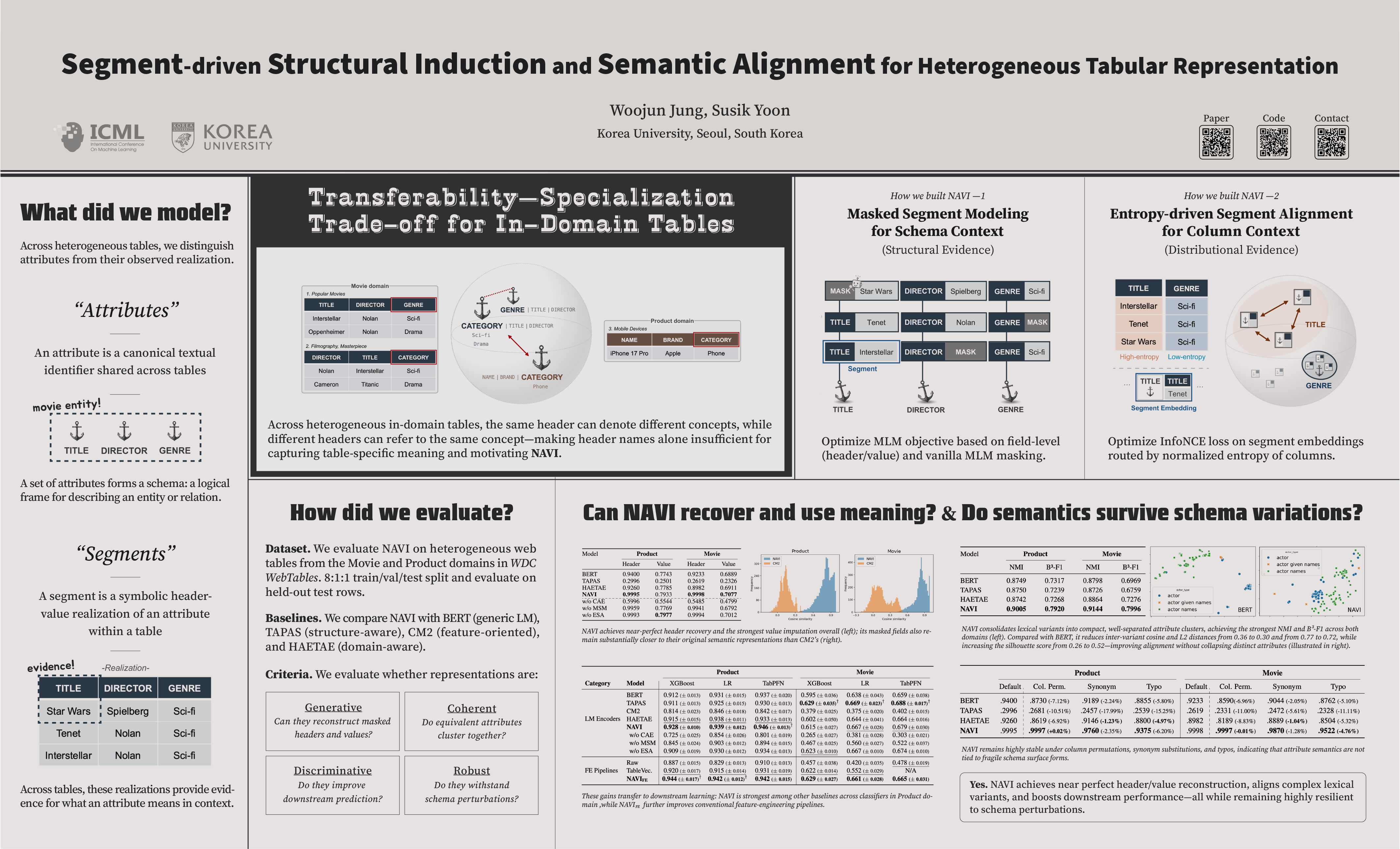
Real-world domains often contain heterogeneous tables whose headers vary while their underlying attribute semantics are shared, making it difficult to induce domain-specialized semantics from table-local evidence alone. Existing encoders model parts of this problem, but often underuse column-level value distributions and apply uniform objectives across attributes with different semantic roles. We propose NAVI, a segment-centric pretraining framework that treats each header–value pair as the unit for aggregating schema-level structural evidence and column-level distributional evidence. We realize this design through Masked Segment Modeling and Entropy-driven Segment Alignment, which jointly enforce structured header–value coupling and semantic alignment across stable and instance-specific attributes. Experiments on heterogeneous in-domain tables show improved reconstruction, semantic consistency, and downstream utility across evaluation settings overall.
Lay Summary
Modern AI systems often need to work with information stored in tables, such as product catalogs, movie databases, and enterprise records. However, tables from the same domain often use different column names, formats, and structures, even when they describe similar kinds of information. This makes it difficult for AI models to recognize when different tables are referring to the same underlying concepts. This paper introduces NAVI, a method that helps models learn more consistent meanings from collections of related but differently structured tables. NAVI does this by looking at each column name together with its corresponding value, and by deciding which information should be treated as stable across tables and which information is specific to individual records. Experiments on real-world table collections show that NAVI improves table reconstruction, semantic consistency, robustness to structural variation, and downstream prediction performance. This work can support future AI systems that search, answer questions, or retrieve knowledge from large collections of heterogeneous tables.