
Utility Boundary of Dataset Distillation: Scaling and Coverage Laws
Abstract
Lay Summary
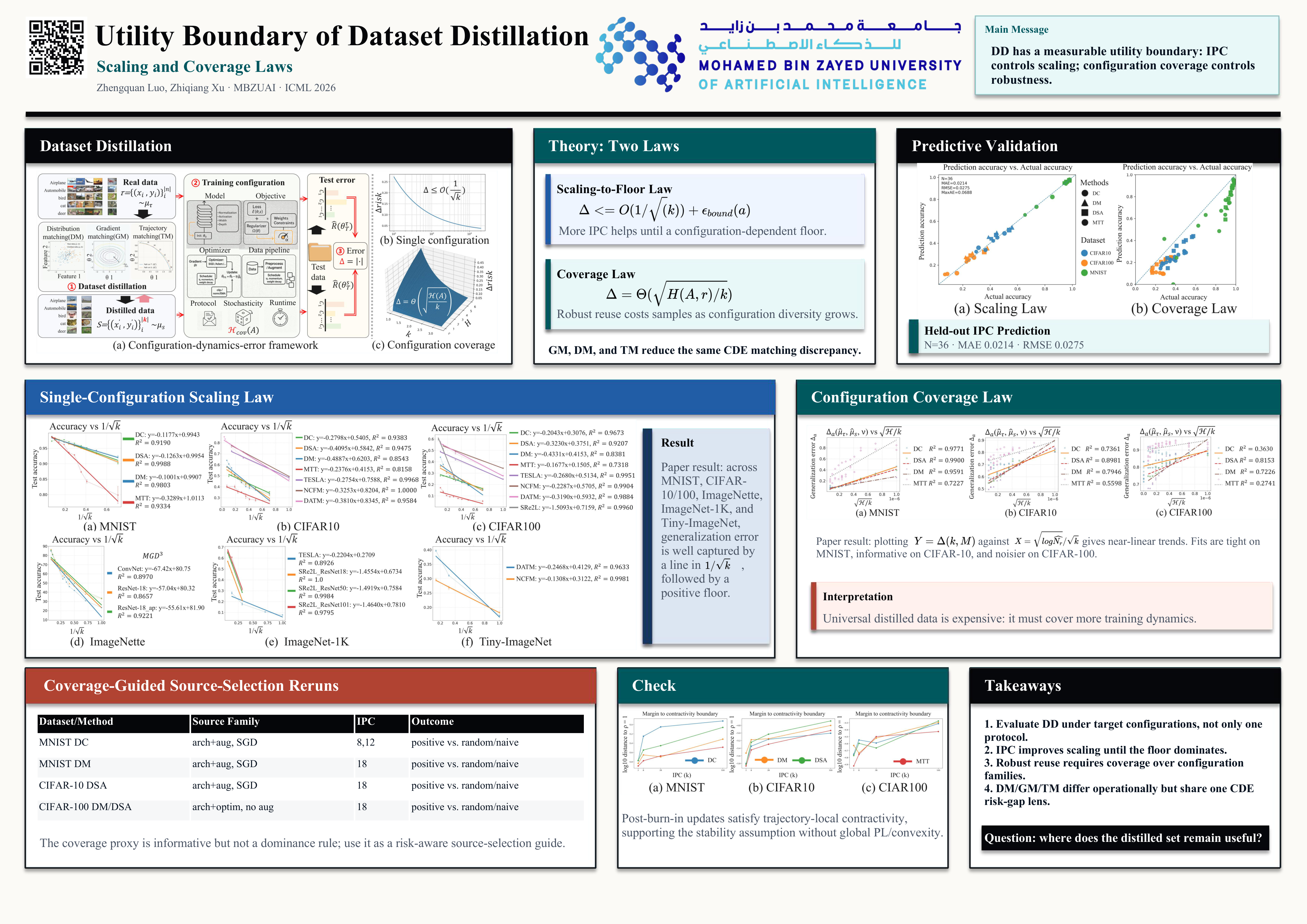
Training modern machine learning models often requires huge datasets, which are expensive to store, share, and reuse. Dataset distillation tries to replace a large dataset with a much smaller artificial one that can train models almost as well. But these small datasets can be fragile: a set that works for one training recipe may fail when the optimizer, model architecture, or data augmentation changes. We study this fragility by comparing how training on the small artificial dataset differs from training on the full dataset across different recipes. Our analysis shows that several popular ways to build distilled datasets are actually trying to control the same underlying training error. It also predicts two practical limits: adding more distilled examples helps only up to a point, and making a distilled dataset work across more varied training recipes requires more examples. Experiments across datasets, distillation methods, and recipe changes support these predictions. These results give researchers clearer guidance on when dataset distillation can reliably save data and compute, and when its limits are likely to appear.