
Rethinking Low-Confidence Pseudo Labels: Influence-Aware Semi-Supervised Fine-Tuning for Hyperspectral Change Detection
Abstract
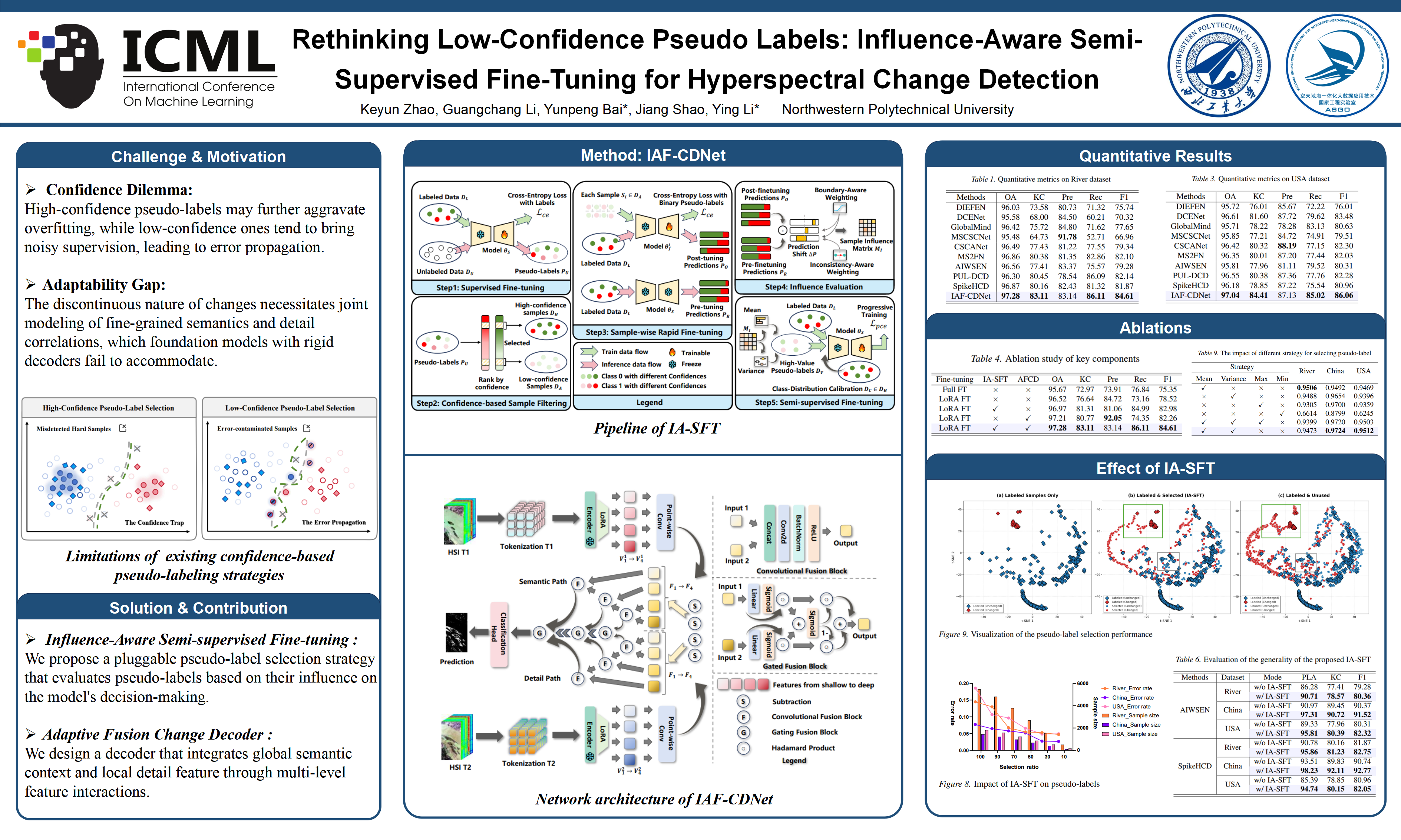
Hyperspectral image change detection (HSI-CD) suffers from severe annotation scarcity and complex change patterns, which fundamentally limit the effectiveness of directly fine-tuning pre-trained foundation models. Although semi-supervised learning provides a promising direction, existing approaches mainly rely on confidence-based pseudo-label selection, leading to limited data diversity or severe error propagation. In this paper, we propose Influence-Aware Semi-supervised Fine-tuning (IA-SFT), a novel framework that evaluates the influence of pseudo-labels on model decision behavior to identify truly valuable supervision signals. Instead of confidence-based selection, IA-SFT evaluates each low-confidence pseudo-label by measuring its impact on labeled data, enabling reliable filtering of high-value pseudo-labels with minimal noise. To further adapt foundation models to HSI-CD, we design an Adaptive Fusion Change Decoder (AFCD) that jointly models global semantic consistency and local change details. Extensive experiments on three benchmark datasets demonstrate that IA-SFT consistently improves pseudo-label quality and detection performance, achieving superior accuracy compared to state-of-the-art methods. Additional analyses validate the transferability of IA-SFT when integrated into different frameworks in a plug-and-play manner. Code will be released.
Lay Summary
Accurate tracking of Earth’s surface dynamics via hyperspectral imagery is severely hindered by the high costs of manual data annotation. While existing semi-supervised models attempt to learn from unlabeled data, they typically rely on confidence thresholds, which either limit data diversity or introduce error accumulation. We developed IAF-CDNet, a novel framework that shifts the focus from how confident a prediction is to how much influence it has. By measuring how low-confidence labels alter the model's core decision boundaries, it selectively uncovers high-value signals while filtering out harmful noise, all paired with a specialized decoder designed to capture intricate change details. Tested across multiple real-world datasets, our approach dramatically improves change detection accuracy and outperforms state-of-the-art methods. This plug-and-play strategy provides a highly accurate, cost-effective tool for critical environmental monitoring.