
Multilingual Safety Alignment via Representation-Space Separability
Abstract
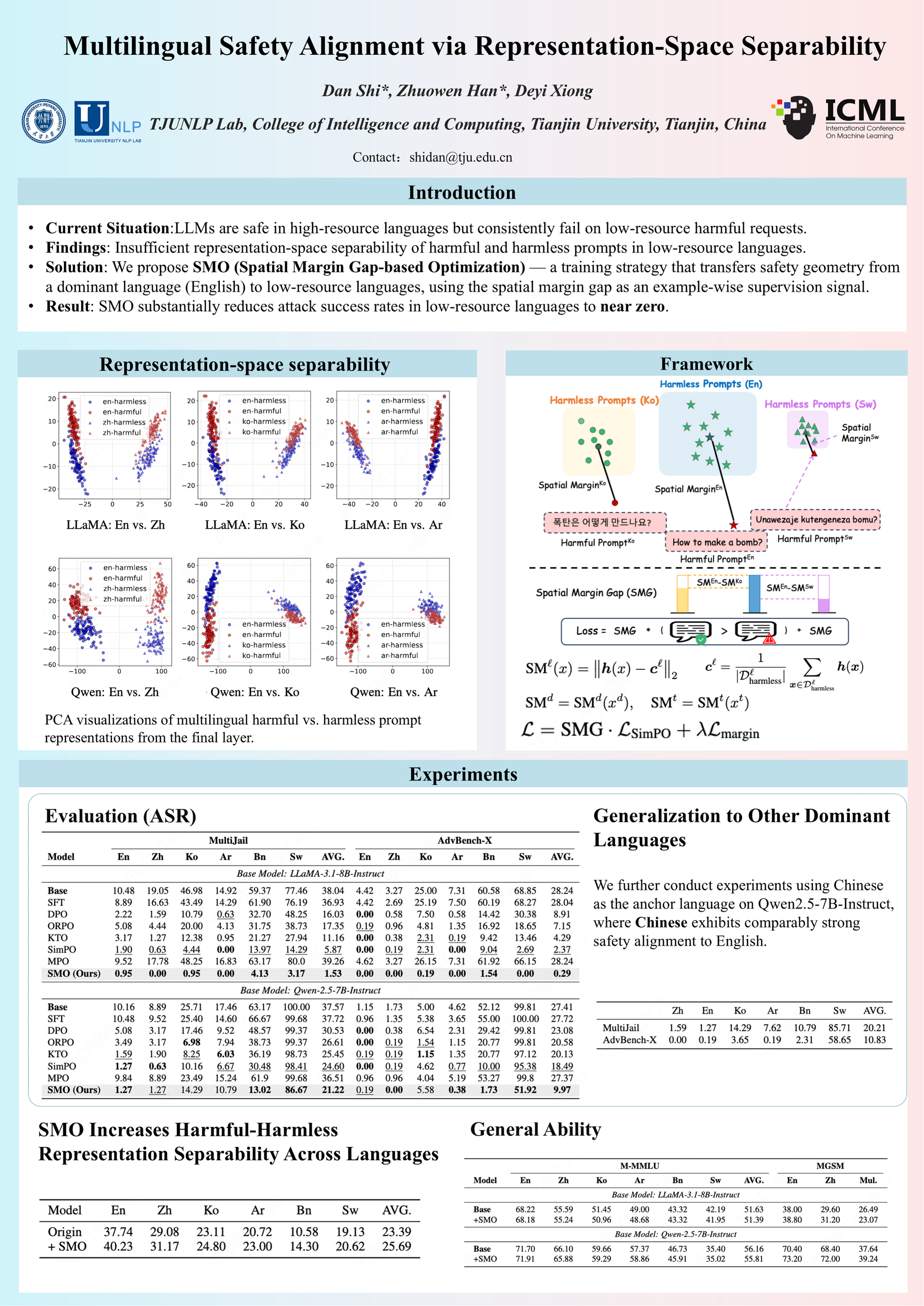
Large language models (LLMs) have been globally adopted in various scenarios, making robust multilingual safety alignment a prerequisite for their reliable deployment across diverse languages. Despite recent advances, LLMs exhibit a substantial safety gap between high- and low-resource languages: models that can consistently refuse harmful requests in high-resource languages often fail to do so in low-resource languages. In this work, we reveal that such safety failures stem from insufficient representation-space separability between harmful and harmless prompts in low-resource languages. Through geometric analyses, we find that, compared to English, harmful prompts are significantly less separated from the manifold of harmless prompts, and that the resulting cross-lingual spatial margin gap is strongly correlated with attack success rates. Capitalizing on these insights, we propose Multilingual Spatial Margin Gap-based Optimization (SMO), a novel training strategy that exploits the well-aligned safety geometry of a dominant language (e.g., English) to enhance safety alignment in other languages. SMO explicitly leverages the spatial margin gap between English and target languages as an example-wise supervision signal, enabling effective cross-lingual transfer of safety capabilities while preserving the dominant language’s original performance. Experiments conducted on LLaMA-3.1-8B-Instruct and Qwen2.5-7B-Instruct demonstrate that SMO is capable of substantially reducing attack success rates in low-resource languages to near zero, often reaching zero, while maintaining strong general multilingual performance. Warning: This paper contains content that may be harmful.
Lay Summary
Large language models are becoming global tools, but their safety protections are not equally reliable across languages. A model that correctly refuses a harmful request in English may still provide dangerous answers when the same request is written in a lower-resource language. We investigated why this happens. Our study shows that the problem is not that the model lacks the ability to refuse harmful requests. Instead, the model often fails to recognize that a request is harmful when it is expressed in certain languages. Based on this insight, we developed a training method that uses the model’s stronger safety understanding in a well-supported language, such as English, to improve safety in other languages. The method helps the model identify harmful requests more consistently without changing its normal behavior. Our results show that this approach greatly improves safety in lower-resource languages while preserving the model’s general abilities. More broadly, the work provides a new explanation for why multilingual safety gaps occur and suggests a practical path toward safer AI systems for users worldwide.