
RE-TRAC: REcursive TRAjectory Compression for Deep Search Agents
Abstract
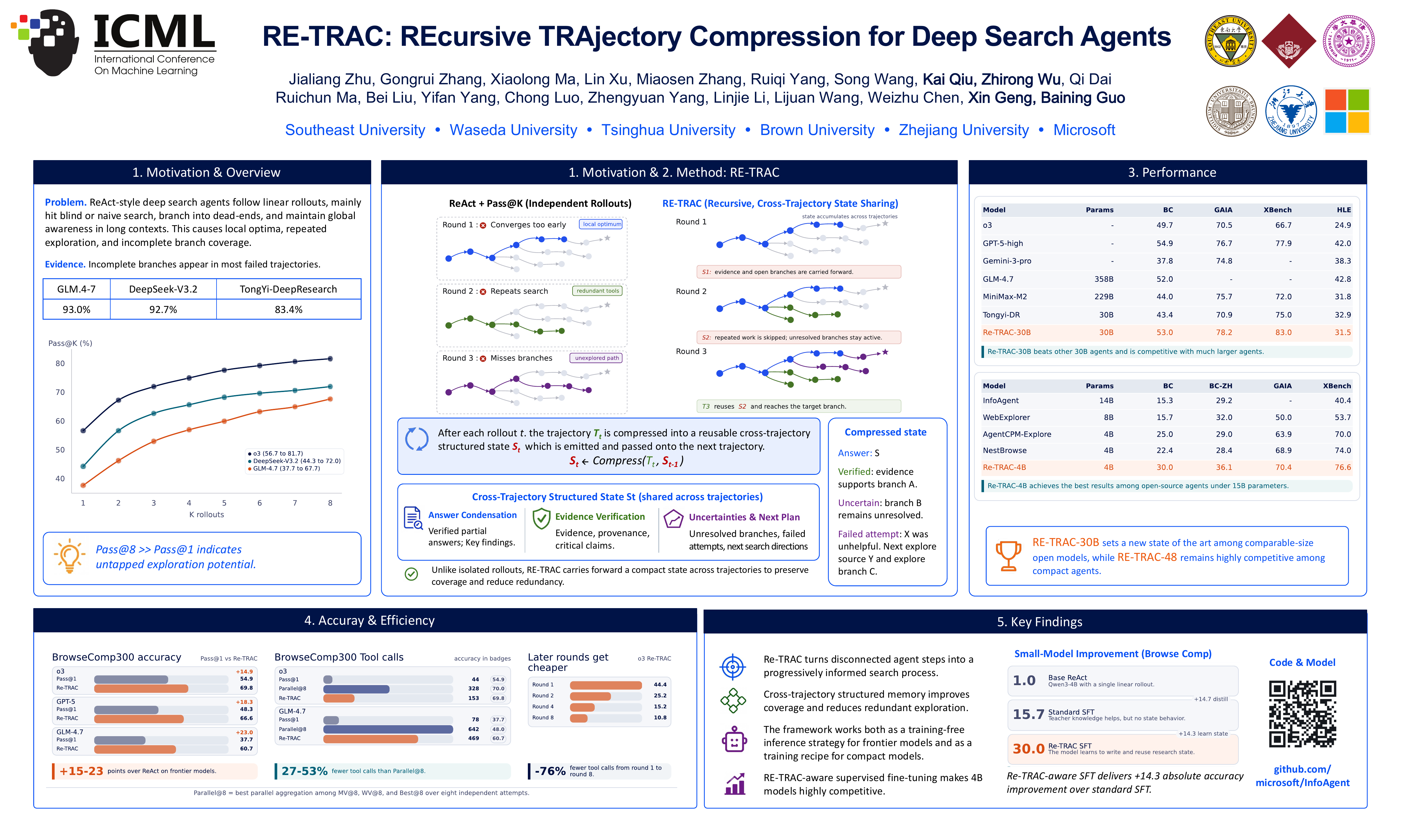
LLM-based deep research agents are largely built on the ReAct framework. This linear design makes it difficult to revisit earlier states, branch into alternative search directions, or maintain global awareness under long contexts, often leading to local optima, redundant exploration, and inefficient search. We propose Re-TRAC, an agentic framework that performs cross-trajectory exploration by generating a structured state representation after each trajectory to summarize evidence, uncertainties, failures, and future plans, and conditioning subsequent trajectories on this state representation. This enables iterative reflection and globally informed planning, reframing research as a progressive process. Empirical results show that Re-TRAC consistently outperforms ReAct by 15–20% on BrowseComp with frontier LLMs. For smaller models, we introduce Re-TRAC-aware supervised fine-tuning, achieving state-of-the-art performance at comparable scales. Notably, Re-TRAC shows a monotonic reduction in tool calls and token usage across rounds, indicating progressively targeted exploration driven by cross-trajectory reflection rather than redundant search.
Lay Summary
AI assistants are increasingly used to perform open-ended research on the web, answering questions that require reading many pages, comparing sources, and reasoning across multiple steps. Today's systems usually attempt such tasks in a single, linear thread of thought — which becomes brittle on long, multi-step questions: the assistant forgets what it has already tried, chases dead ends, or misses promising directions. We propose Re-TRAC, a framework that runs the assistant multiple times on the same question and, between runs, compresses what was discovered — useful evidence, unanswered sub-questions, dead ends, and a plan for what to try next — into a short, structured summary. The next run starts from this summary instead of from scratch, so the assistant can build on its own progress rather than repeat it. With Re-TRAC, we train compact open-source models (4 billion and 30 billion parameters) that match the performance of much larger, closed-source systems on demanding research benchmarks. The result is a recipe for stronger research assistants that can run on more modest hardware, making capable web-research AI accessible beyond the largest labs.