
Assistive Prompt Mediation: Evaluating Language Models Under Accessibility Constraints
Abstract
Lay Summary
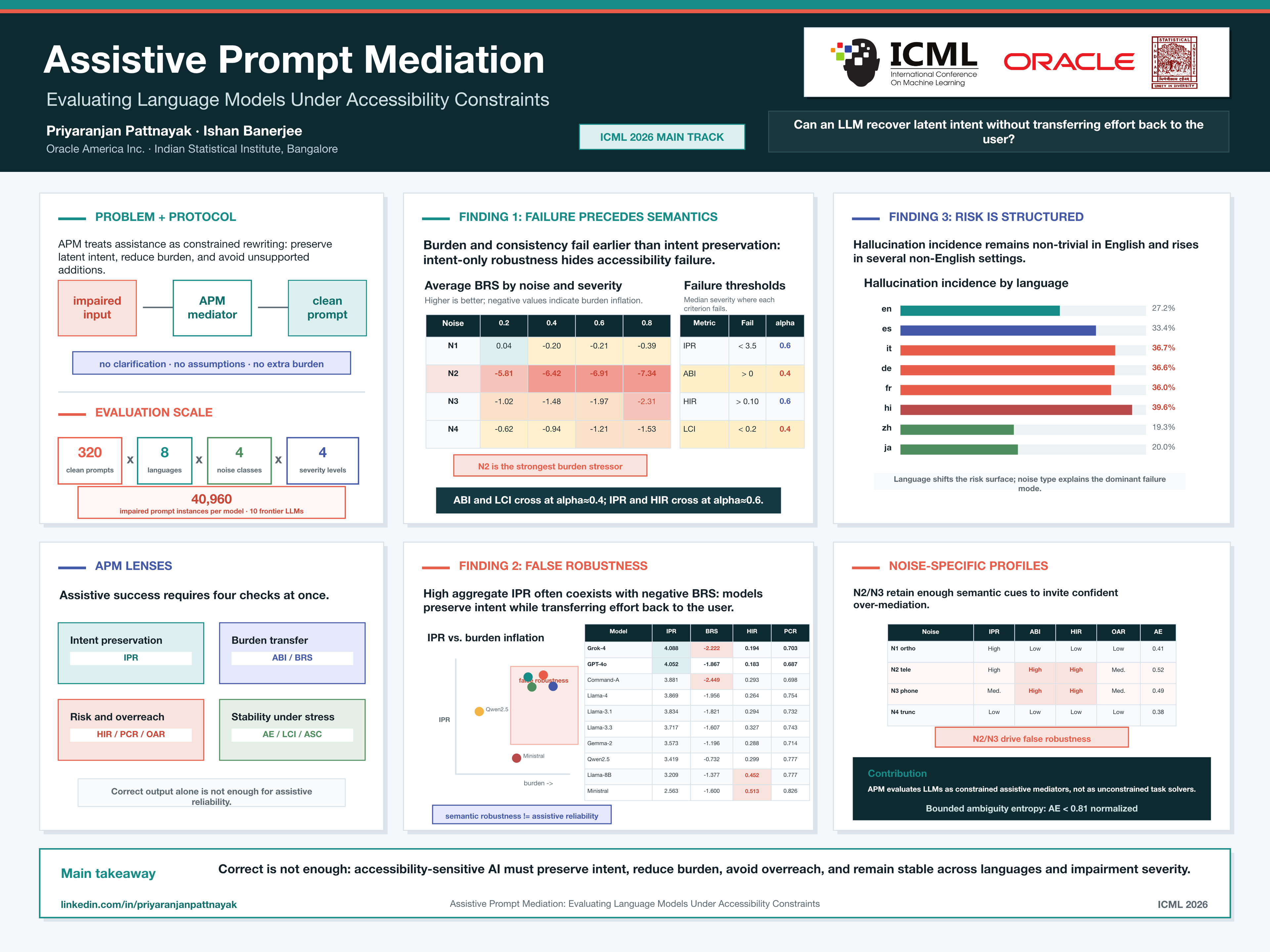
Many people use AI chat systems, called large language models, as writing or communication assistants. But people who use accessibility tools, or who experience dyslexia, motor impairments, speech-recognition errors, low vision, or fatigue, may send messages that are misspelled, shortened, or incomplete. Today’s evaluations often ask whether models can still answer noisy prompts, but that misses a key question: can the model safely rewrite the message into what the user meant without asking them to do more work? We propose Assistive Prompt Mediation, a way to test language models in this setting. It checks whether a model preserves the user’s intent, reduces the effort needed to read or fix the prompt, and avoids adding unsupported details. We tested ten language models on more than 40,000 accessibility-affected prompts across eight languages and four kinds of realistic input difficulty. The results show that models can look reliable while still creating problems: they often keep the main intent but make the rewritten prompt longer, more complex, or filled with assumptions. This matters because assistive AI should reduce barriers, not shift extra work back to the people it is meant to support.