
Interpreting and Enhancing Emotional Circuits in Large Vision-Language Models via Cross-Modal Information Flow
Abstract
Lay Summary
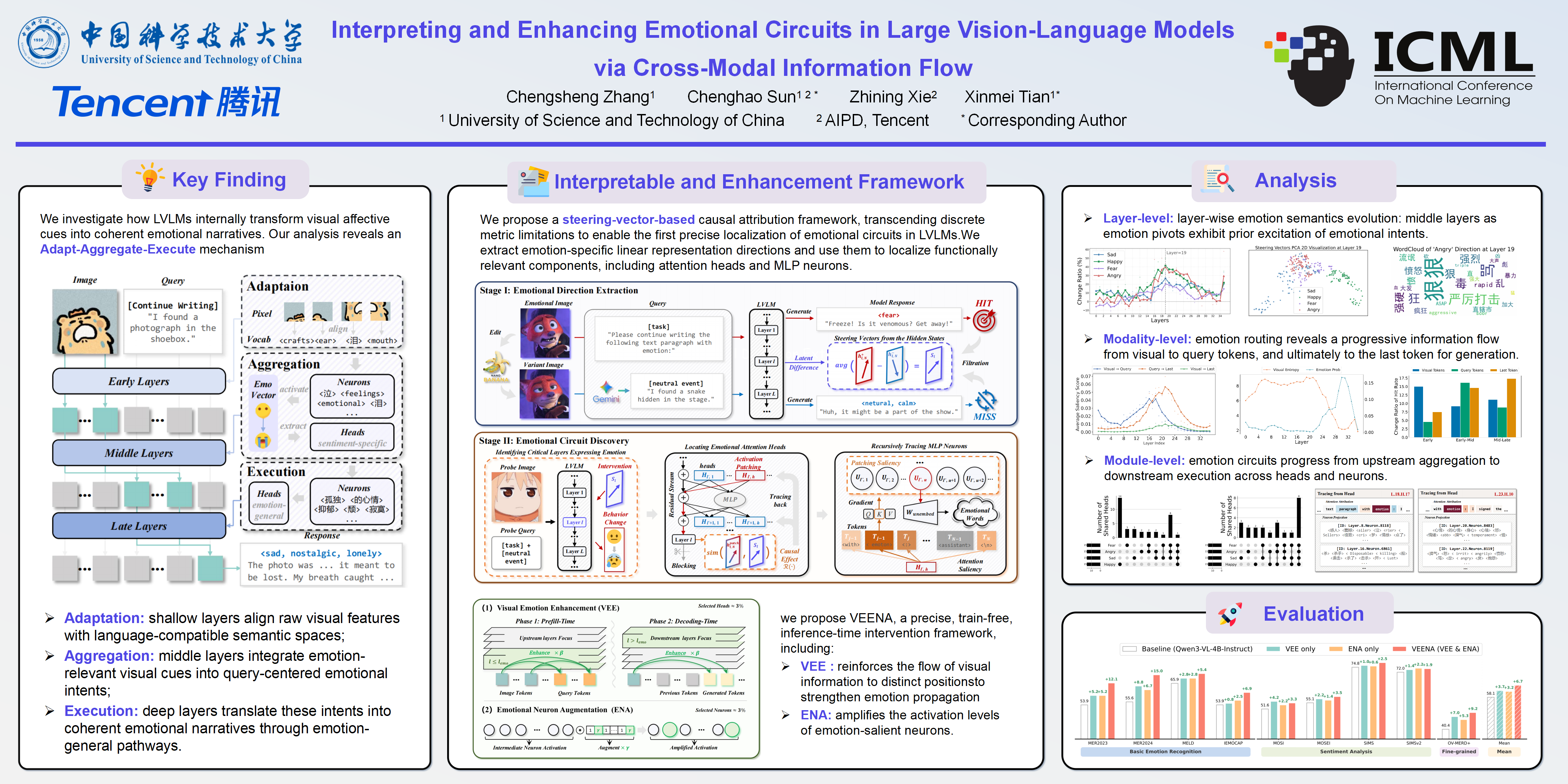
Vision-language AI systems are increasingly expected to understand not only objects in images, but also the emotions and social cues behind them. However, their emotional understanding is still unreliable: for example, a model may describe a sad or distressed scene as cheerful. To improve this ability, it is not enough to only train models on more examples; we also need to understand how they internally recognize emotional cues and turn them into written descriptions. Our work studies this hidden process inside large vision-language models. We build carefully paired image examples that separate emotional information from other visual content, and use them to trace which parts of the model carry and use emotion-related signals. We find that emotional understanding follows three stages: early layers adapt visual information, middle layers gather emotion-specific cues, and deeper layers turn these cues into general emotional language. Based on this understanding, we introduce VEENA, a training-free method that adjusts the model during inference so that emotional information is routed and expressed more reliably. Across a broad benchmark of multimodal emotion understanding tasks, VEENA improves performance and reduces emotional hallucinations without retraining the model. This work helps make emotion-aware AI systems more transparent, reliable, and socially responsible.