
Heterogeneity-Aware Knowledge Sharing for Graph Federated Learning
Abstract
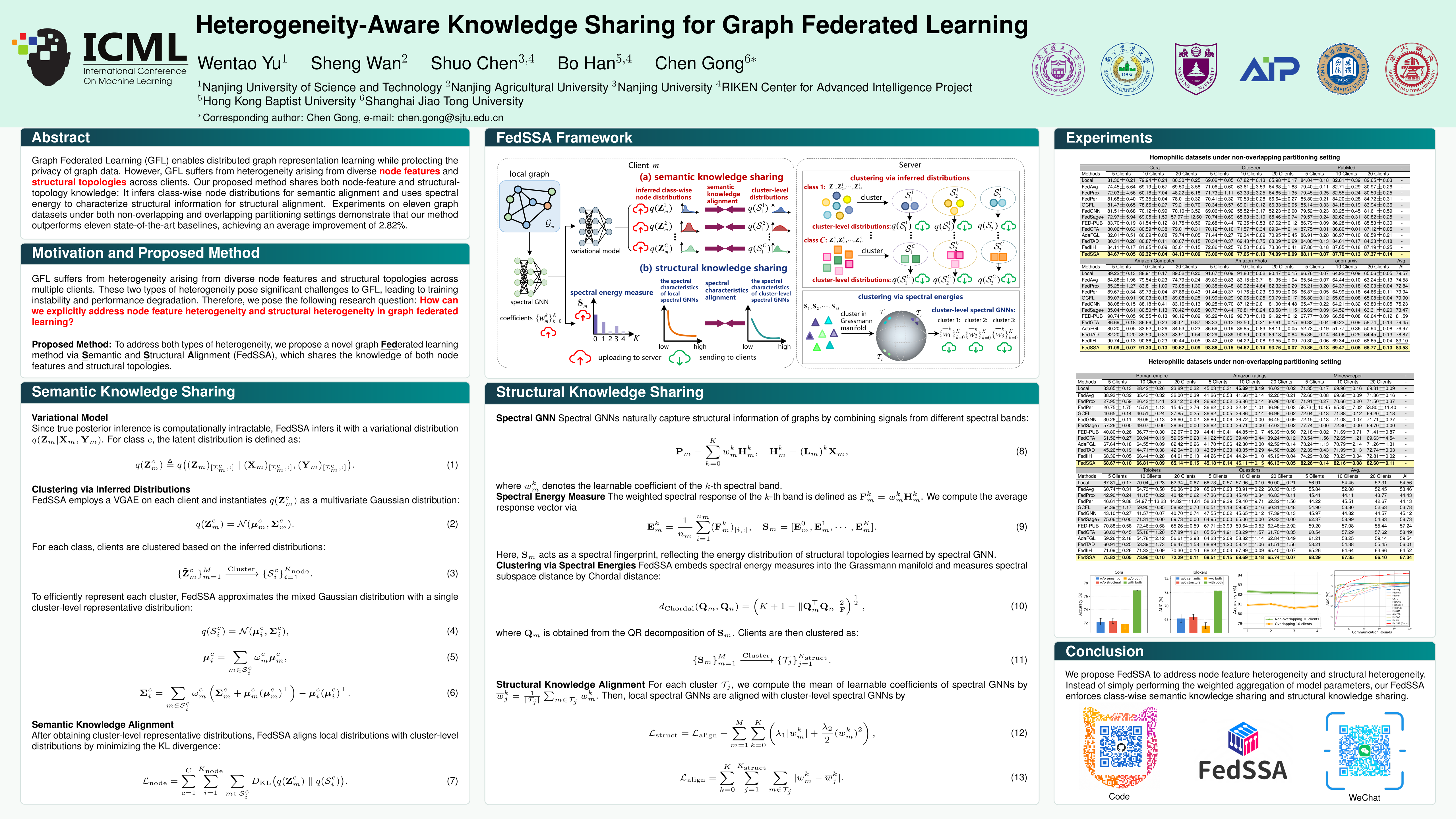
Graph Federated Learning (GFL) enables distributed graph representation learning while preserving graph data privacy. However, it suffers from heterogeneity in node features and graph structures across clients. To address this challenge, we propose a novel graph Federated learning method via Semantic and Structural Alignment (FedSSA). For node feature heterogeneity, FedSSA infers class-wise node distributions through a variational model, clusters clients according to the inferred distributions, and aligns local distributions with cluster-level representatives. For structural heterogeneity, FedSSA employs spectral Graph Neural Networks (GNNs) and introduces a spectral energy measure to characterize graph topology, enabling structural alignment between local and cluster-level spectral GNNs. Experiments on eleven homophilic and heterophilic graph datasets under non-overlapping and overlapping partitioning settings demonstrate that FedSSA consistently outperforms eleven state-of-the-art methods. Our code is available at https://github.com/blgpb/FedSSA.
Lay Summary
Many real-world data can be represented as networks, such as social networks, citation networks, and recommendation systems. In practice, these networks are often stored by different clients and cannot be directly shared due to privacy concerns. Graph Federated Learning allows these clients to train models collaboratively without sharing raw data, but it faces a key challenge: Different clients may have very different node information and connection patterns. We propose FedSSA, a method that helps clients learn from others with similar semantic and structural patterns. Instead of forcing all clients to share the same knowledge, FedSSA groups clients according to their data characteristics and aligns useful knowledge within each group. Experiments on various network datasets show that FedSSA achieves better performance than existing methods.