
SimulCost: A Cost-Aware Benchmark and Toolkit for Automating Physics Simulations with LLMs
Abstract
Lay Summary
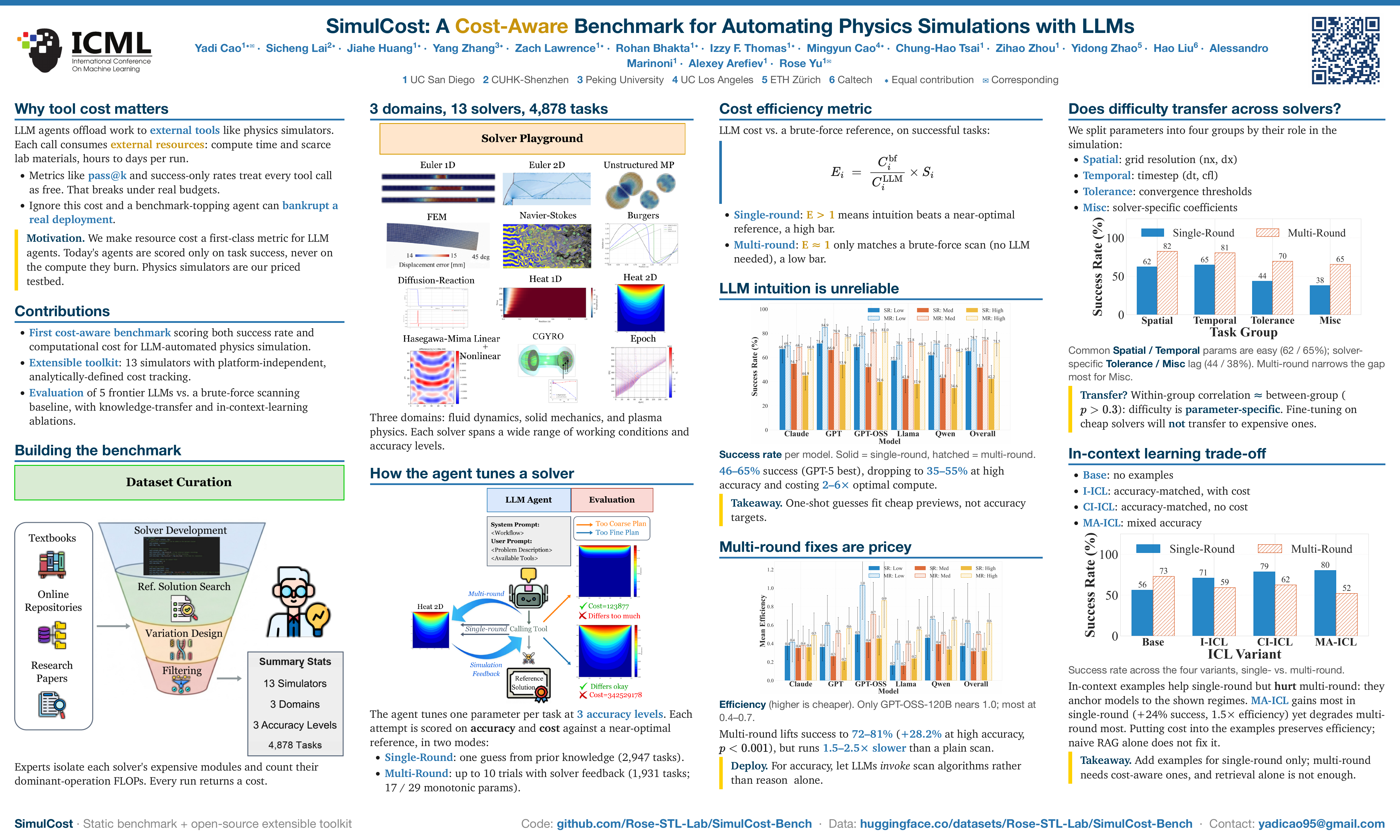
Scientists use computer simulations to study complex physical systems like plasma behavior or fluid flow, but running these simulations is expensive and time-consuming. AI assistants could potentially help by suggesting good starting configurations, reducing the trial-and-error typically needed. But do they actually save time and resources compared to traditional approaches? We created SimulCost, a benchmark to test whether AI assistants can effectively tune simulation settings while being mindful of computational costs. We tested leading AI systems on nearly 5,000 tasks across 13 physics simulators covering fluid dynamics, solid mechanics, and plasma physics. Our findings reveal a gap between promise and practice. AI assistants struggle with accurate initial guesses (succeeding 46-65% of the time), dropping to just 35-55% when high accuracy is required. While they improve when given feedback (72-81% success), they actually consume 1.5-2.5 times more computational resources than traditional parameter scanning methods. We also examine how related parameters can inform each other (for potential knowledge transfer) and how providing examples or encouraging more reasoning affects performance, offering practical guidance for deployment and improvement. This suggests current AI tools are not yet cost-effective for scientific parameter tuning. We release SimulCost as an open benchmark to help researchers develop more resource-efficient AI assistants for scientific computing.