
Nested Spatio-Temporal Time Series Forecasting
Abstract
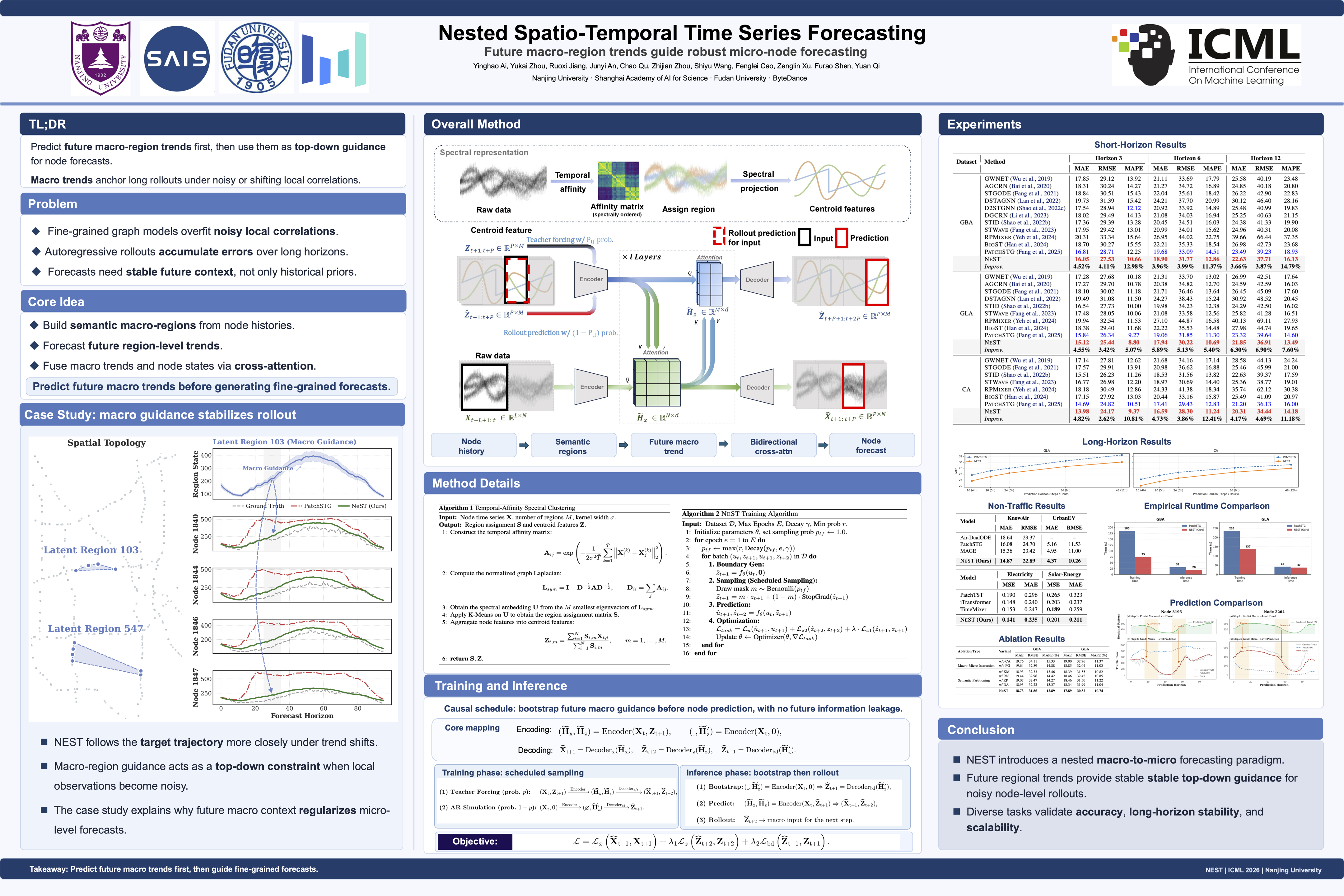
Spatio-temporal forecasting is critical for real-world applications like traffic management, yet capturing complex interactions under high-noise conditions remains challenging. While current methods have shown improved accuracy using spatial physical priors, they often struggle with evolving temporal correlations and systematic errors. In this work, we propose a nested forecasting framework that couples future macro-level regional trends with micro-level historical observations, enabling top-down guidance from abstract future representations for fine-grained forecasting. Specifically, we construct semantically coherent regions via spectral clustering and design a progressive coarse-to-fine predictor to inject macro-dynamics into node-level forecasting. Extensive experiments on multiple real-world datasets demonstrate that our method consistently outperforms state-of-the-art baselines, validating the effectiveness of future macro-guided nested forecasting.
Lay Summary
Predicting how things change over space and time, such as forecasting city traffic or energy usage, is highly important but difficult because real-world data is often messy and chaotic. Existing computer models often get confused by small, unpredictable local fluctuations, leading to errors that pile up over time. To solve this, we created a new forecasting approach that looks at both the "big picture" and the fine details. Instead of only trying to predict what happens at every single location individually, our system first automatically groups similar areas together to predict broader, more stable regional trends for the future. It then uses this reliable macro-level view as a guide to correct and fine-tune its predictions for individual, local spots. By letting the broader future trends guide the local details, our method filters out the noise. When tested on real-world datasets, our approach proved to be significantly more accurate and stable than current top-performing tools.