
Towards Professional-Grade Financial Agents: Benchmarking, Tooling, and Structured Reasoning
Abstract
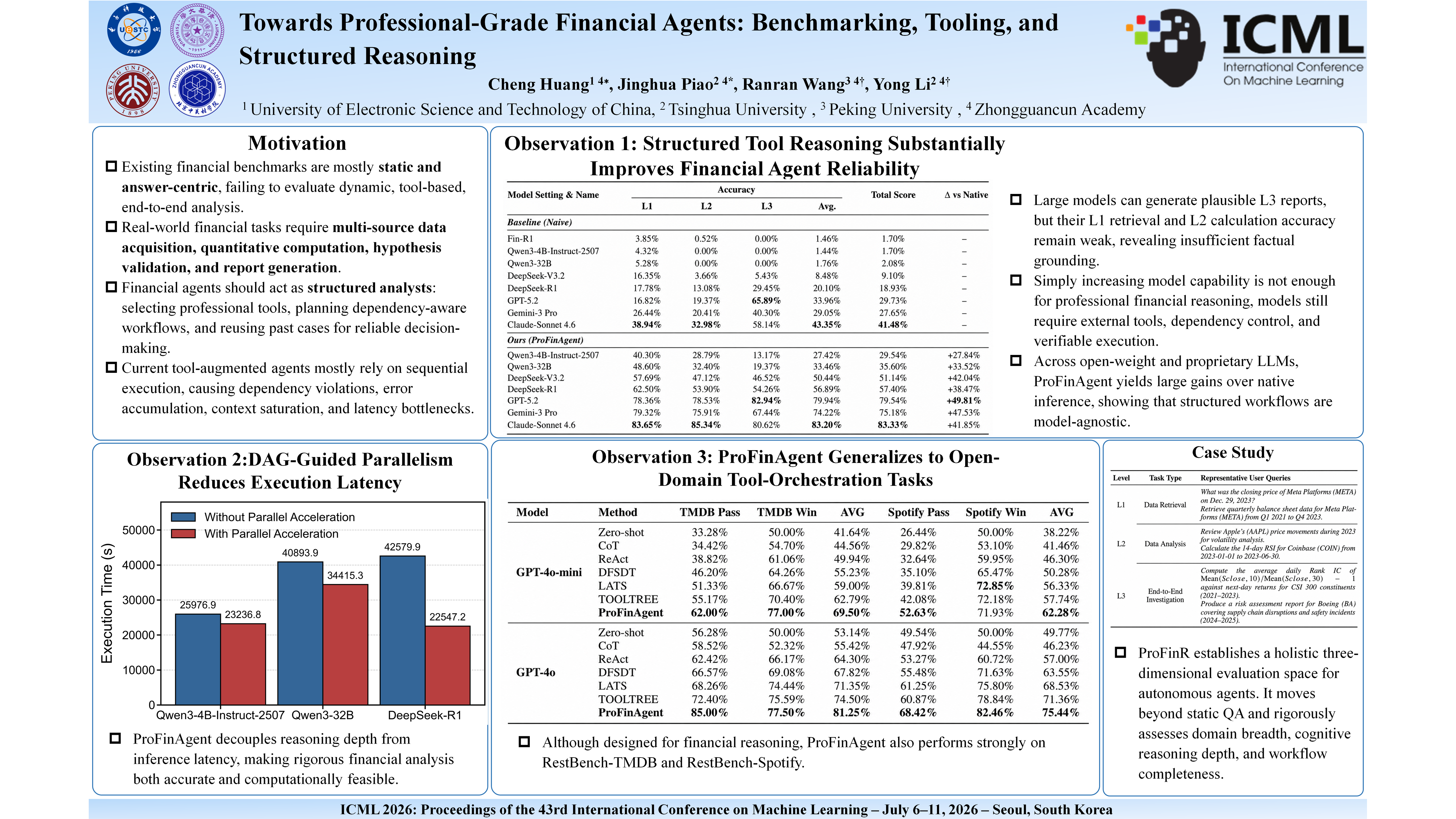
While Large Language Model (LLM) agents have shown encouraging progress in financial reasoning, their effectiveness in realistic financial workflows is severely hindered by the lack of holistic benchmarks and the fragility of unstructured reasoning. To address this gap, we introduce ProFinR, the first Professional Finance Reasoning benchmark, covering four financial domain tasks and comprising 528 expert-designed problems. To solve these complex financial reasoning questions, we construct the Financial Tool Universe, a tool library containing 53 domain-specific tools organized into 13 categories. Building on the tool library, we introduce ProFinAgent, a structured agent framework based on Directed Acyclic Graph (DAG) and Case-Based Memory (CBM). Compared with strictly sequential workflows, ProFinAgent coordinates tool execution through a DAG planner for parallel efficiency and uses CBM to retrieve prior cases for more reliable decision-making. Experimental results demonstrate that ProFinAgent achieves a 49.81% performance gain over state-of-the-art baselines with a 47.1% reduction in inference latency. Our code is available at https://github.com/tsinghua-fib-lab/ProFinAgent.
Lay Summary
Artificial intelligence (AI) is increasingly used in the financial sector, but current models struggle with complex, real-world tasks. They often invent incorrect information and try to solve problems in a rigid, one-step-at-a-time manner, which leads to compounding errors. To address this, we introduce ProFinR, a new and highly realistic test designed to measure how well AI can perform professional financial analysis. To help AI succeed, we also built a financial tool universe containing 53 practical financial tools. Furthermore, we developed ProFinAgent, a new AI system that works more like a human expert. Instead of working strictly in sequence, ProFinAgent creates a comprehensive plan beforehand, completes independent tasks simultaneously to save time, and remembers past successes and mistakes to make better future decisions. Our experiments show that this new approach is significantly more accurate and much faster than existing AI models, marking a major step toward reliable AI assistants for the financial industry.