
Adaptive Memory Retention in Dynamic Graphs
Abstract
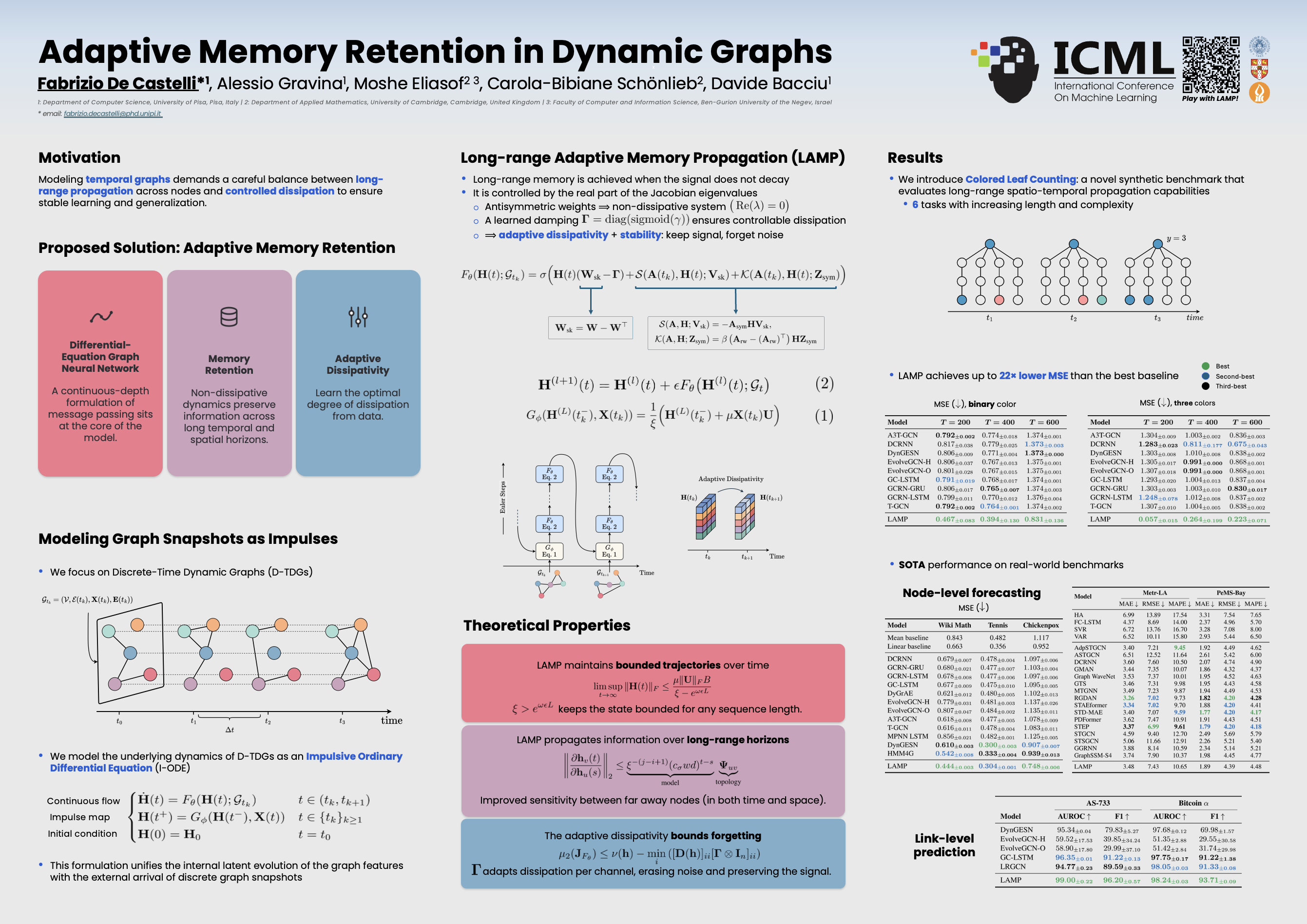
Modeling graphs demands a careful balance between long-range propagation of information across nodes and the controlled dissipation of noisy or redundant signals to ensure stable learning and generalization. This challenge is exacerbated in dynamic graphs, where structural and temporal information interact, leading to uncontrolled information accumulation and amplifying noise, thereby affecting generalization. We introduce LAMP, a dynamic graph model for snapshot-based dynamic graphs that incorporates adaptive, learned dissipation within a principled dynamical systems framework. Our architecture combines impulsive neural ODEs with antisymmetric parameterization to model conservative information flow, alongside data-driven dissipative dynamics that regulate information retention over space and time. This formulation yields stable yet expressive representations and enables effective long-range dependency modeling while avoiding pathological information buildup. We provide a theoretical analysis establishing stability guarantees and characterizing the representational power. Extensive experiments on synthetic and real-world benchmarks demonstrate state-of-the-art performance, particularly on tasks requiring extended-range dependency modeling.