
DualOptim+: Bridging Shared and Decoupled Optimizer States for Better Machine Unlearning in Large Language Models
Abstract
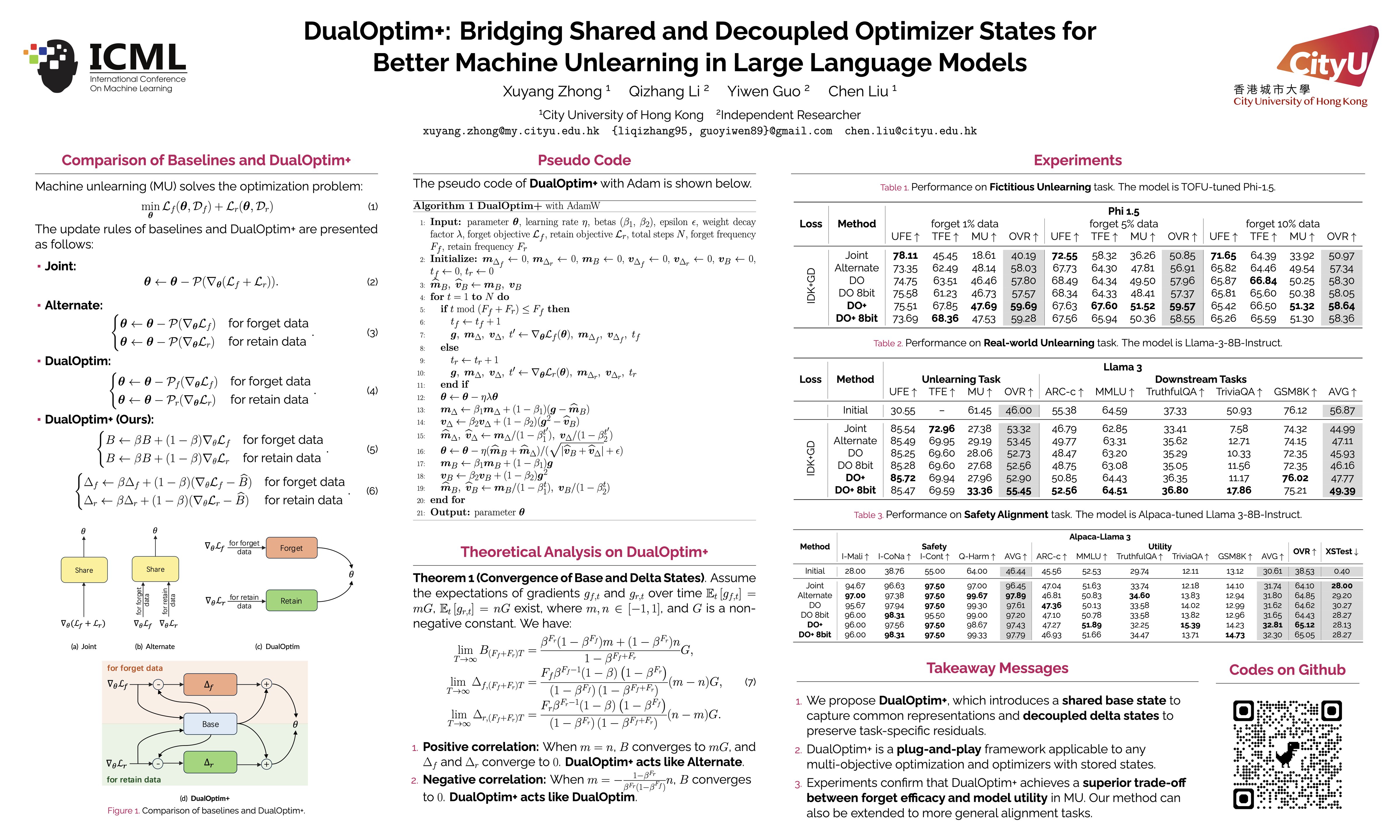
We propose DualOptim+, a novel optimization framework for improving machine unlearning in large language models. It introduces a base state to capture common representations shared by forgetting and retaining objectives and delta states to preserve objective-specific residuals. This architecture allows the optimizer to adaptively bridge shared and decoupled states based on the directional conflict between forgetting and retaining gradients. We further introduce DualOptim+ 8bit, a quantized variant that reduces memory overhead without compromising performance. Extensive experiments across fictitious and real-world unlearning, safety alignment, and multi-task learning tasks demonstrate that DualOptim+ consistently achieves a superior trade-off between different objectives. Codes are available at https://github.com/CityU-MLO/DualOptimPlus.
Lay Summary
Large language models (LLMs) often need to "unlearn" specific information—such as private data or harmful content—without forgetting the useful knowledge they were originally taught. Balancing these two conflicting goals is difficult, as removing one piece of information often accidentally damages the model's overall intelligence. We developed DualOptim+, a new system that helps models multitask more efficiently during this unlearning process. Our framework identifies which parts of the model's knowledge are shared across tasks and which parts are unique to "forgetting" or "retaining" information. By treating these as separate layers that can be adjusted independently, the model can surgically remove specific data while keeping its core knowledge intact. We also created a "lightweight" version that uses significantly less computer memory. Our research provides a more reliable way to keep AI models safe and private. By allowing models to precisely delete problematic data without losing their general abilities, we make it easier to maintain high-performing AI that remains aligned with human safety standards and privacy laws.