
High-Probability Convergence Guarantees of Decentralized SGD
Abstract
Lay Summary
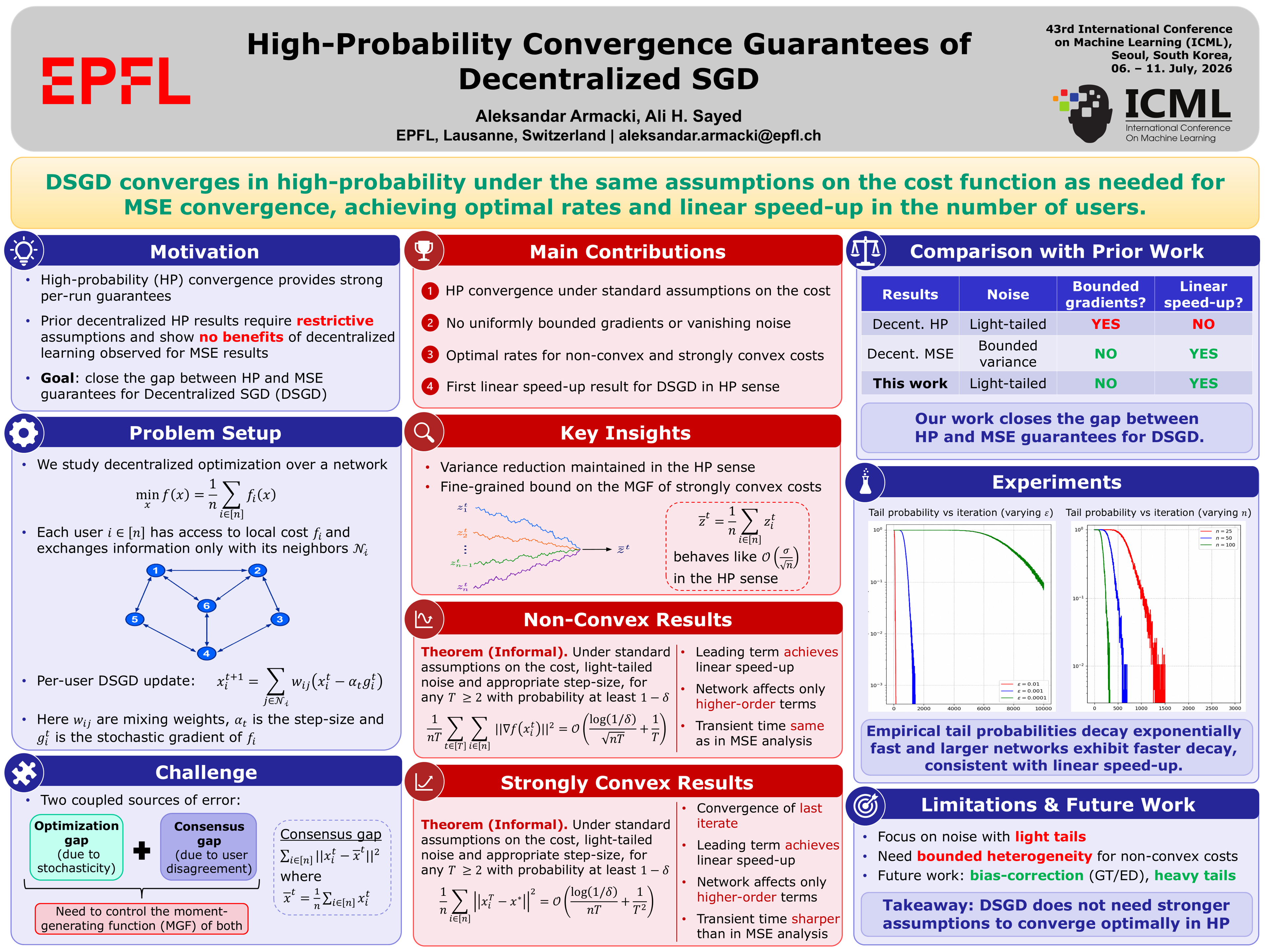
Machine learning algorithms are often judged by how well they perform on average, but in many applications it is also important to know that a single run is very likely to succeed. This kind of “high-probability” guarantee gives stronger confidence that an algorithm will not fail due to random noise. For decentralized learning, where many users or devices cooperate without sending all data to one central machine, such guarantees are still poorly understood. Existing results often rely on unrealistic assumptions, such as gradients being uniformly bounded or noise disappearing over time. We study Decentralized Stochastic Gradient Descent, a widely used method for training models across a network of users, and prove that it converges with high probability under much weaker and more standard conditions. In particular, we show that the same assumptions used for traditional average-case guarantees are enough to obtain strong guarantees for individual runs. Our analysis also proves optimal convergence rates and shows that adding more users can speed up the learning linearly. This helps close an important gap in the theory of decentralized optimization and supports the practical reliability of decentralized learning methods.