
Order Matters in Retrosynthesis: Structure-aware Generation via Reaction-Center-Guided Discrete Flow Matching
Abstract
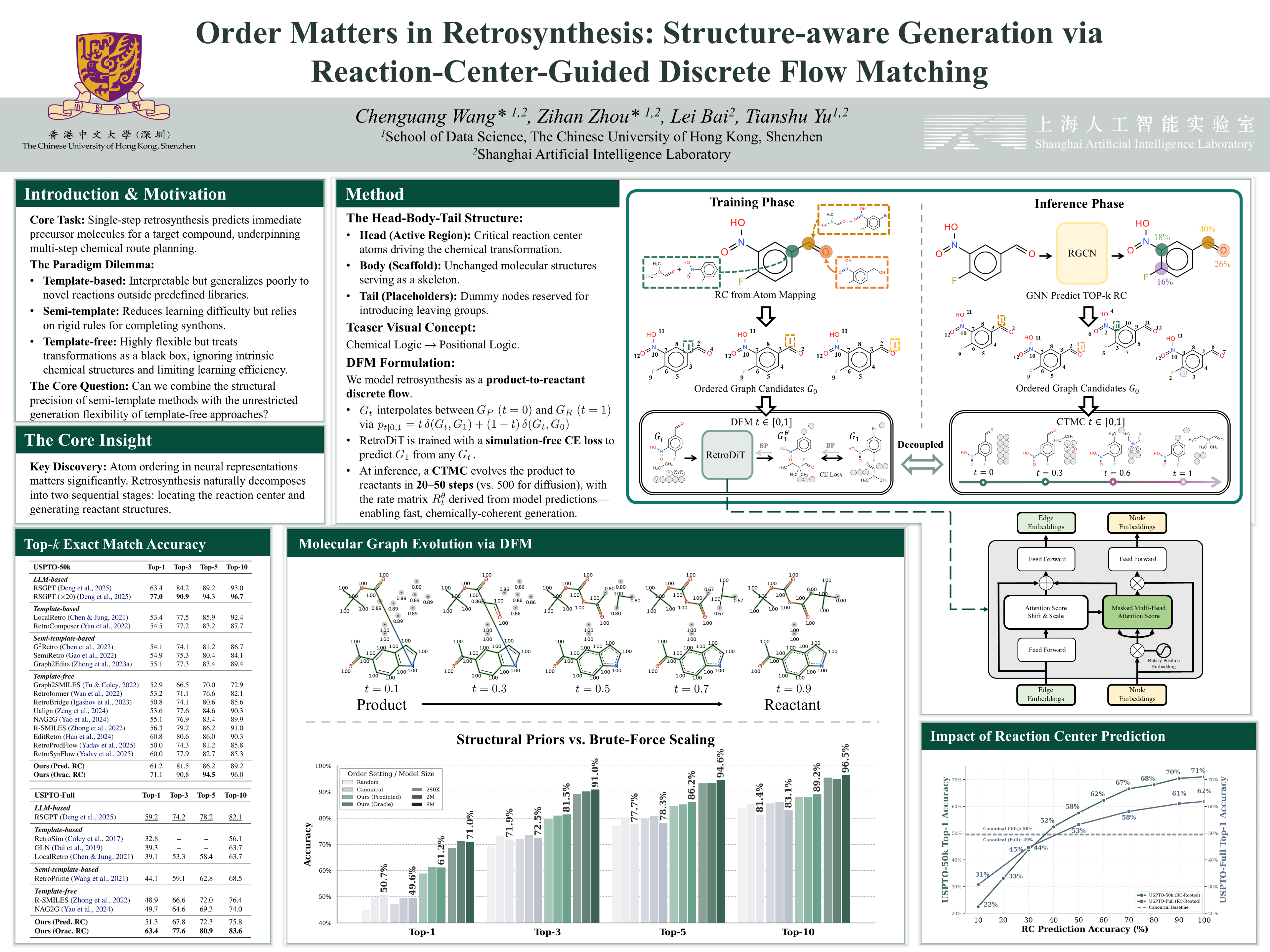
Template-free retrosynthesis methods treat the task as black-box sequence generation, limiting learning efficiency, while semi-template approaches rely on rigid reaction libraries that constrain generalization. We address this gap with a key insight: atom ordering in neural representations matters. Building on this insight, we propose a structure-aware template-free framework that encodes the two-stage nature of chemical reactions as a positional inductive bias. By placing reaction center atoms at the sequence head, our method transforms implicit chemical knowledge into explicit positional patterns that the model can readily capture. The proposed RetroDiT backbone, a graph transformer with rotary position embeddings, exploits this ordering to prioritize chemically critical regions. Combined with discrete flow matching, our approach decouples training from sampling and enables generation in 20--50 steps versus 500 for prior diffusion methods. Our method achieves state-of-the-art performance on both USPTO-50k (61.2\% top-1) and the large-scale USPTO-Full (51.3\% top-1) with predicted reaction centers. With oracle centers, performance reaches 71.1\% and 63.4\% respectively, surpassing foundation models trained on 10 billion reactions while using orders of magnitude less data. Ablation studies further reveal that structural priors outperform brute-force scaling: a 280K-parameter model with proper ordering matches a 65M-parameter model without it.
Lay Summary
Retrosynthesis (working backwards to create target chemicals) is a crucial puzzle in drug discovery. Current AI tools struggle because they either use rigid rules or treat molecules like random data, ignoring their actual chemical structure. To solve this, we discovered that the order in which AI reads a molecule's atoms is highly important. We built a new model, RetroDiT, that identifies the active site where chemical changes occur and places it at the very beginning of the AI's input. This teaches the AI to prioritize the most critical chemical regions. Our approach achieves state-of-the-art accuracy and generates chemical recipes up to 25 times faster than previous methods. It proves that teaching AI fundamental structural chemistry is far more efficient than simply using larger models or massive datasets.