
TerraBind: Fast and Accurate Binding Affinity Prediction through Coarse Structural Representations
Abstract
Lay Summary
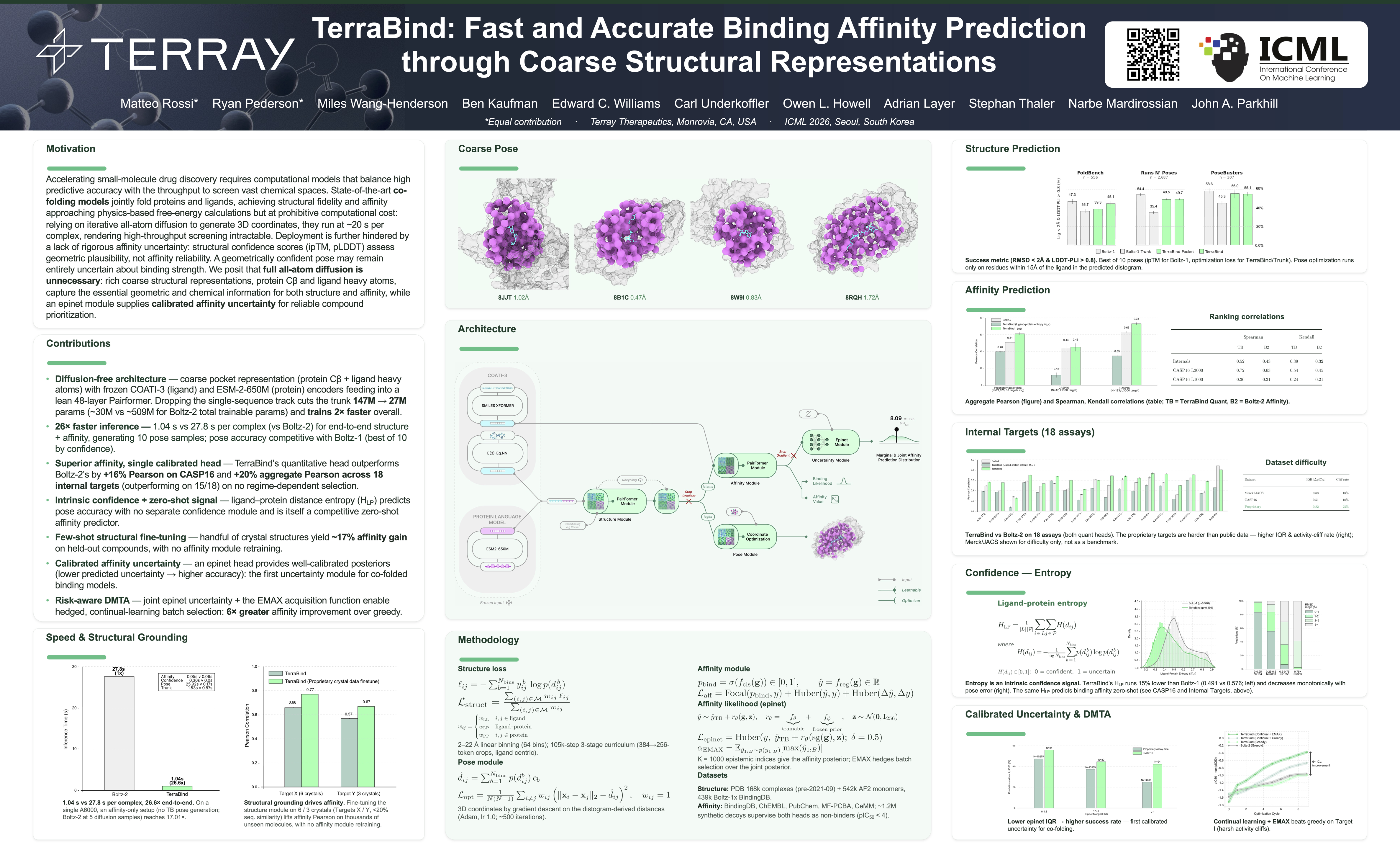
Developing new medicines requires finding chemical molecules that bind tightly to disease-causing proteins. Modern AI models can predict this binding with high accuracy, but they are painfully slow — they simulate the position of every atom step by step, taking about twenty seconds per molecule. This creates a major bottleneck when scientists need to screen the billions of compounds available in modern chemical libraries. We developed TerraBind, a streamlined AI model that eliminates this bottleneck. We found that simulating every atom in microscopic detail is unnecessary; instead, our model focuses on a simplified, high-level map of the crucial contact areas between the drug and the protein. By stripping away the expensive atom-by-atom step, TerraBind predicts binding 26 times faster than the leading method (Boltz-2) — and is also 16–20% more accurate on both a public benchmark and eighteen real drug discovery programs. TerraBind also provides a calibrated confidence score for each prediction, so scientists can prioritize the most reliable candidates and avoid wasting expensive lab experiments on uncertain guesses. By combining speed, accuracy, and trustworthy uncertainty estimates, TerraBind makes it practical to apply state-of-the-art AI to far larger chemical libraries than before — helping accelerate the search for treatments for diseases that currently lack good options.