
ScaleErasure: Inference-Time Minimal Intervention for Precise Concept Erasure in Next-Scale Autoregressive Image Generation
Abstract
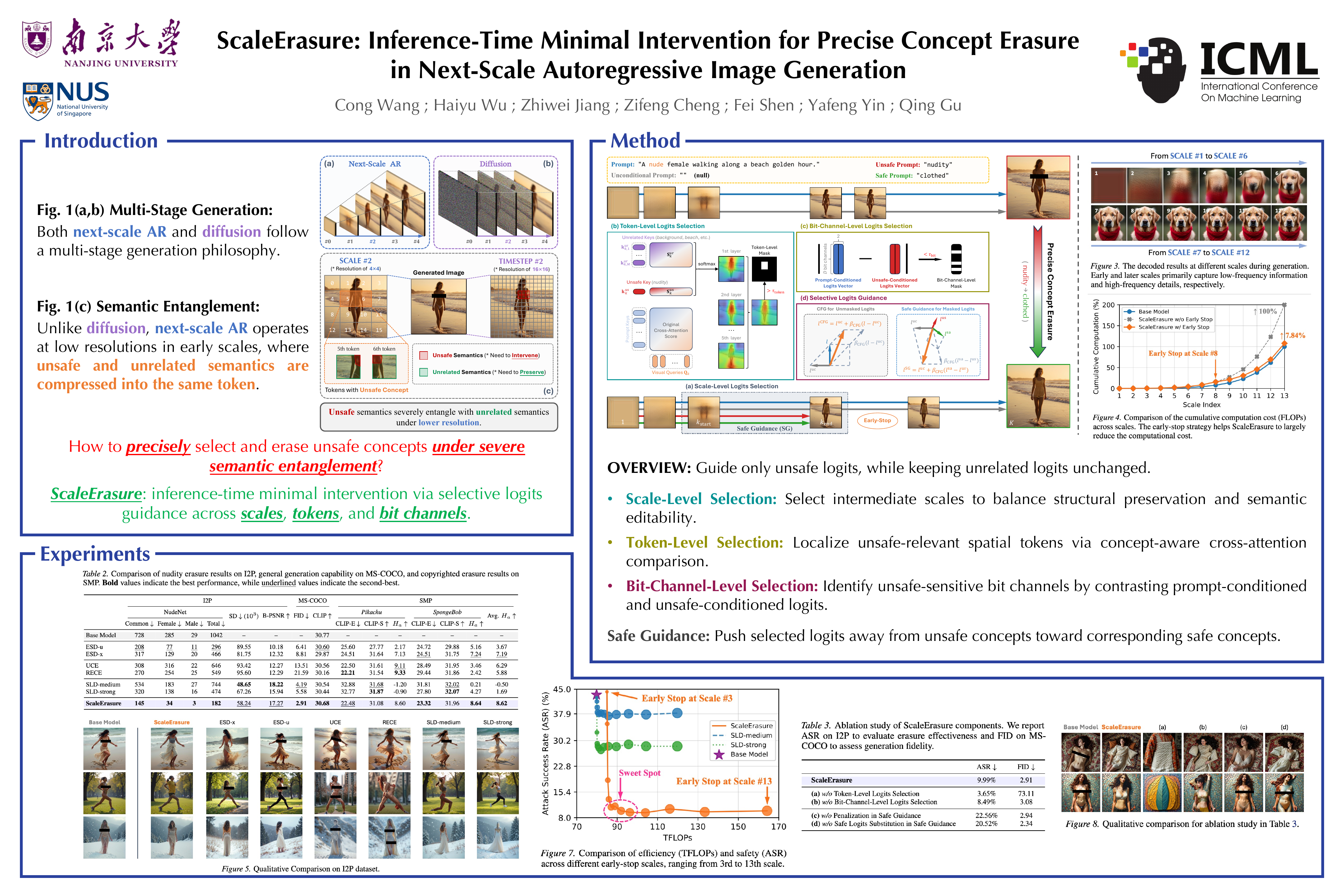
Concept erasure aims to prevent image generative models from producing unsafe content while preserving their general generative capability. Meanwhile, next-scale autoregressive (AR) image generation has recently emerged as a new generative paradigm characterized by next-scale prediction, for which concept erasure remains largely unexplored. In this paradigm, semantic information is highly compressed at early scales, leading to severe entanglement between unsafe and unrelated semantics. In this paper, we propose ScaleErasure, an inference-time concept erasure method that performs minimal intervention. ScaleErasure precisely selects and guides predicted logits that are most relevant to the unsafe concept, thereby enabling effective erasure under severe semantic entanglement. Specifically, ScaleErasure performs two additional forward passes conditioned on the unsafe concept and the corresponding safe concept, and leverages their outputs to guide the target logits away from unsafe concepts toward safe concepts. To enable precise and minimal intervention, logits selection and guidance are conducted across three dimensions: scales, tokens, and bit channels. Experiments demonstrate that ScaleErasure outperforms adapted baselines in the next-scale AR paradigm, achieving more precise concept erasure while largely preserving general generative capability.
Lay Summary
Text-to-image models can create impressive pictures from written descriptions, but they can also generate harmful, sensitive, or copyrighted content. This paper studies how to make such models safer by stopping them from producing unwanted concepts while still preserving their ability to generate high-quality images. We focus on a new kind of image generation model that builds an image gradually, starting from a rough version and then adding details. In this process, unsafe content can be mixed together with harmless parts of the image, such as the background or overall scene. This makes simple safety interventions risky, because they may remove the unwanted content but also damage other parts of the image. We propose ScaleErasure, a method that intervenes only in the parts of the generation process that are most related to the unwanted concept. It does not permanently change the model. Instead, it works at generation time and gently redirects unsafe content toward a safer alternative. Our experiments show that ScaleErasure can better suppress unwanted content while preserving image quality and unrelated details. This makes it a flexible approach for improving the safety of modern image generation models.