
Physics from Video: Identifiability of Time-Invariant Second-Order ODEs under Minimal Trajectory Conditions
Abstract
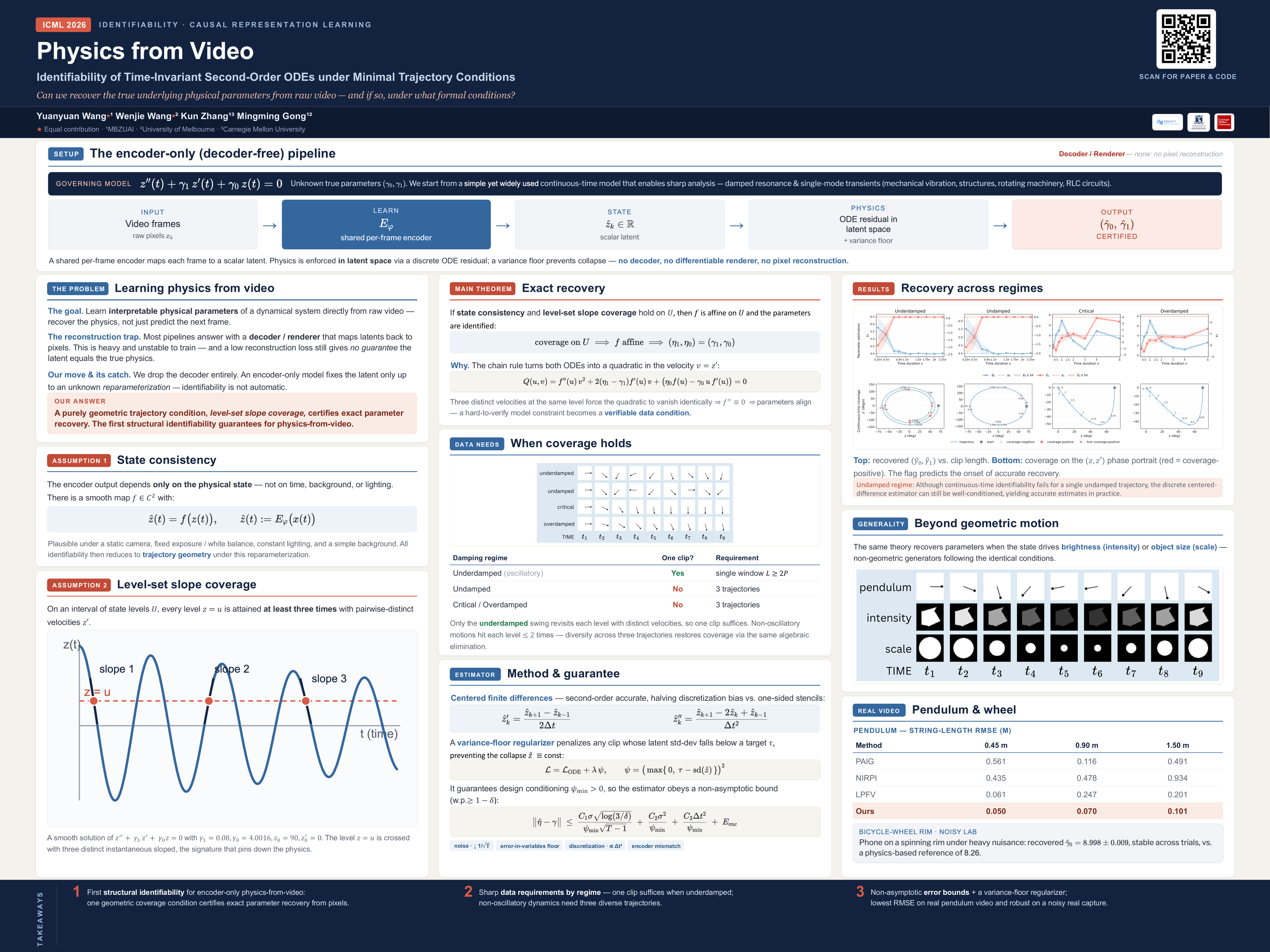
Bridging the gap between visual realism and physical understanding is a core challenge for video-based world models. We study the structural identifiability of continuous-time physical laws from raw pixels, focusing on whether an encoder-only pipeline can uniquely recover the parameters of second-order linear ODEs. We prove that a level-set slope-coverage condition ensures the learned latent space is locally affine to the true physical state, enabling exact parameter recovery. Our theory provides the first characterization of minimal data requirements across damping regimes, establishing that underdamped systems are identifiable from a single video clip, whereas other regimes require three diverse trajectories. We further introduce a variance-floor regularizer to stabilize the decoder-free objective and prevent latent collapse. Validated on synthetic and real-world data, our approach demonstrates that interpretable physical constants can be reliably estimated from video without the need for compute-intensive pixel reconstruction, ensuring both physical correctness and transparency. Code is available at https://github.com/wenjiewang3/PhysicsFromVideo.
Lay Summary
Many real-world systems, like swinging pendulums and vibrating beams, follow simple physical laws. Being able to recover these laws automatically from a video would give us a contactless tool for science and engineering, requiring no sensors and no manual labeling. The catch is that cameras record pixels rather than physical states. The same motion can produce very different videos depending on lighting, background, and viewpoint, so it is not obvious whether a model trained on video has captured the underlying physics or just imitated the visual appearance. We answer this question for a basic class of physical systems: those described by second-order linear differential equations, which govern oscillations, damping, and ring-down behavior. We prove when a single video clip is enough to uniquely recover the physical parameters, and when multiple clips are needed. We also propose a simple training adjustment that prevents the model from collapsing to a trivial shortcut. Experiments on simulated systems and on real videos confirm the theory.