
LIF Recurrent Memory Enables Long-Horizon Spiking Computation
Abstract
Lay Summary
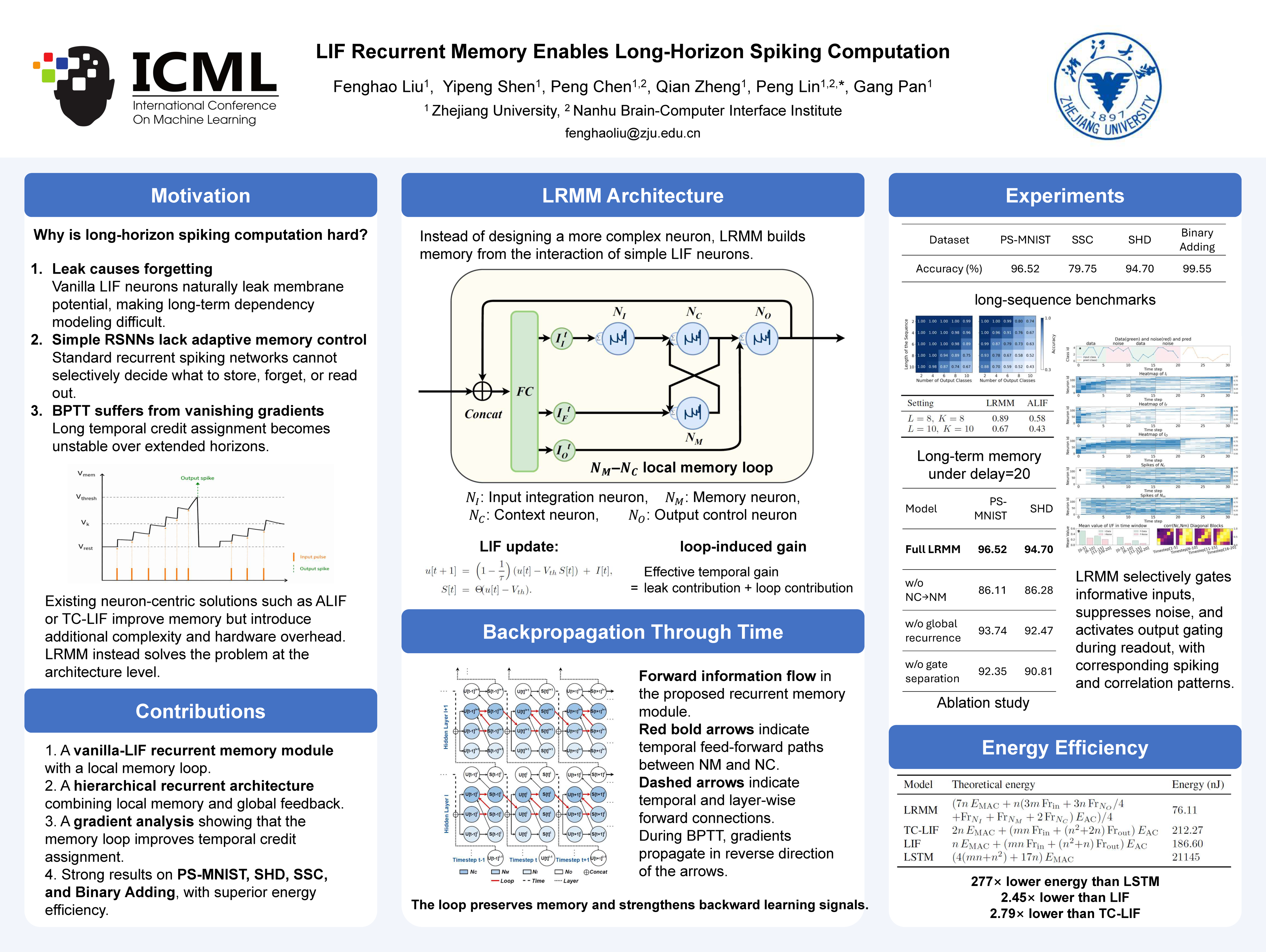
Artificial intelligence often needs to process long streams of data, such as speech or sensor signals, but standard spiking neural networks struggle to retain information over extended periods. Their neurons tend to forget earlier inputs, limiting performance on tasks with long-term dependencies. We propose the LIF Recurrent Memory Module (LRMM), a compact spiking neural architecture built from standard neurons arranged into a local memory loop. This loop selectively stores important information, suppresses noisy inputs, and dynamically regulates memory through interactions among neurons. The module enhances gradient propagation during training, preserves long-term dependencies, and operates in a spike-driven manner so that it is compatible with energy-efficient neuromorphic hardware. Experiments on long-sequence benchmarks show that LRMM achieves high performance while consuming far less energy than conventional models such as LSTM. This approach provides an efficient and hardware-friendly solution for reliable long-term memory in spiking neural networks.