
HumanLM: Simulating Users with State Alignment Beats Response Imitation
Abstract
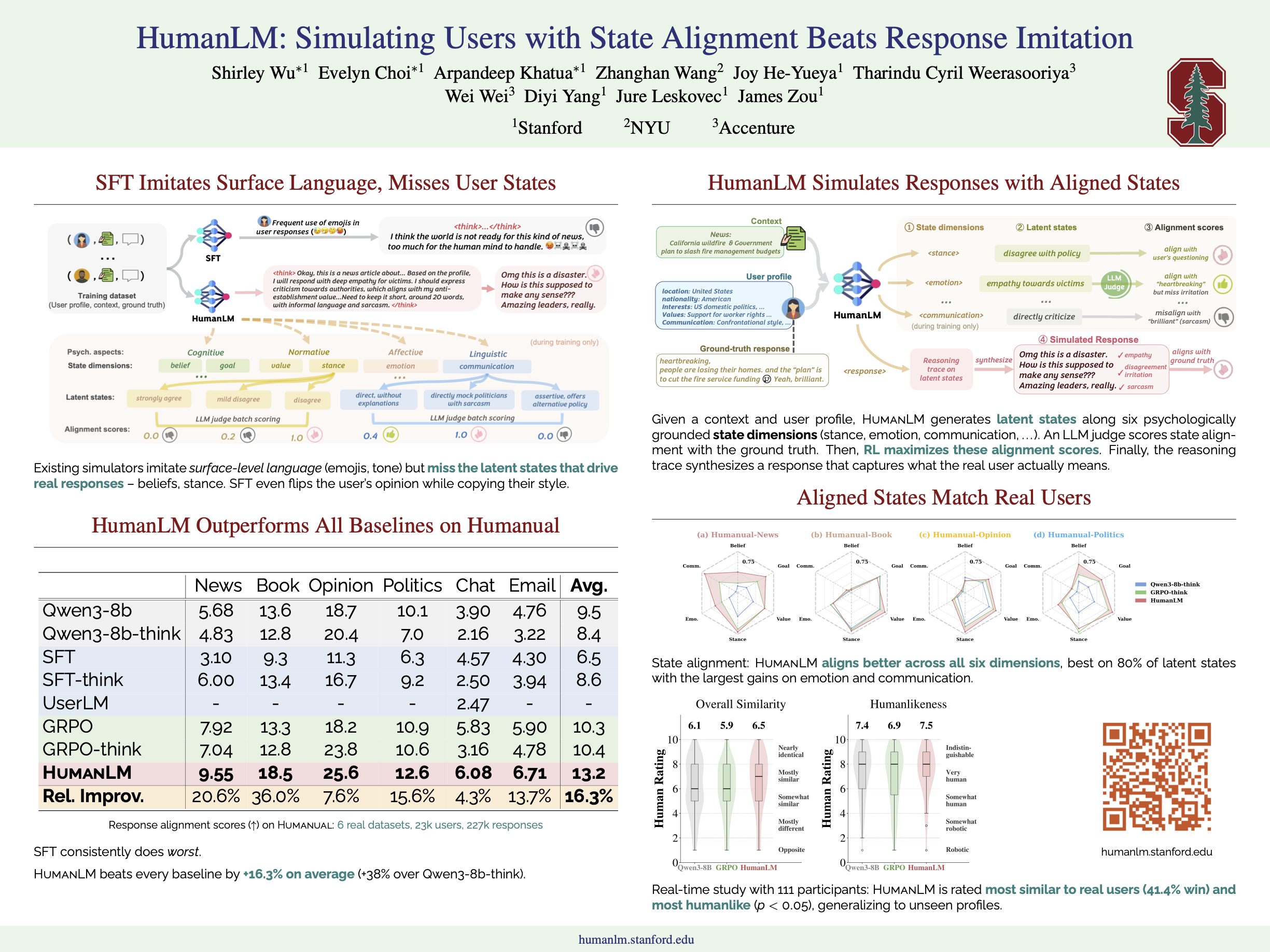
Large Language Models (LLMs) are increasingly used to simulate how specific users respond to any context, enabling more user-centric applications that rely on user feedback. However, existing user simulators mostly imitate surface-level patterns and language styles, which fails to reflect the underlying state of real users (e.g., beliefs, emotions). To address these limitations, we propose a novel training framework, HumanLM, which builds user simulators that accurately reflect real users. Our key insight is, in addition to generating responses, we generate natural-language latent states that align with the ground truth responses through reinforcement learning. These latent states correspond to a set of state dimensions which psychologically lead to how real users respond. HumanLM further synthesizes these aligned latent states into responses that accurately represent real users. For extensive evaluation, we develop Humanual, a comprehensive benchmark on simulating real users based on public data. Humanual consists of six large-scale datasets with 26k users and 216k responses in total. It spans diverse tasks such as generating user responses to daily life issues, political blogs, and chat sessions with LLM assistants. Across the datasets, HumanLM significantly outperforms the best alternative approaches by an average relative improvement of 16.3% on alignment score from an LLM judge. In a real-time simulation study with 37 participants, HumanLM achieves the highest scores on similarity with real user responses and human-likeness.
Lay Summary
Imagine you want to know how a specific person would react to a news story, a book, or a new product before you ever show it to them. Researchers increasingly use AI to play the role of such users, but today's systems mostly copy a person's surface writing style and miss what really drives a reaction, like their beliefs, values, and emotions. As a result, these AI stand-ins often respond in ways the real person never would. We built a training method, called HumanLM, that teaches an AI to first work out a person's inner mental states before writing anything. The AI reasons about what the person believes, wants, feels, and cares about, and is rewarded for getting these hidden states right rather than just matching words. It then weaves these states together into a natural reply. To test this, we collected a large benchmark of real responses from tens of thousands of people across six everyday settings. Our method produced replies that were noticeably closer to what real people actually wrote and sounded more human. This could help writers, policymakers, and product teams test their ideas on realistic stand-ins before reaching real audiences.