
Expandable, Compressible, Mineable: Open-World Thermal Infrared Image Restoration
Abstract
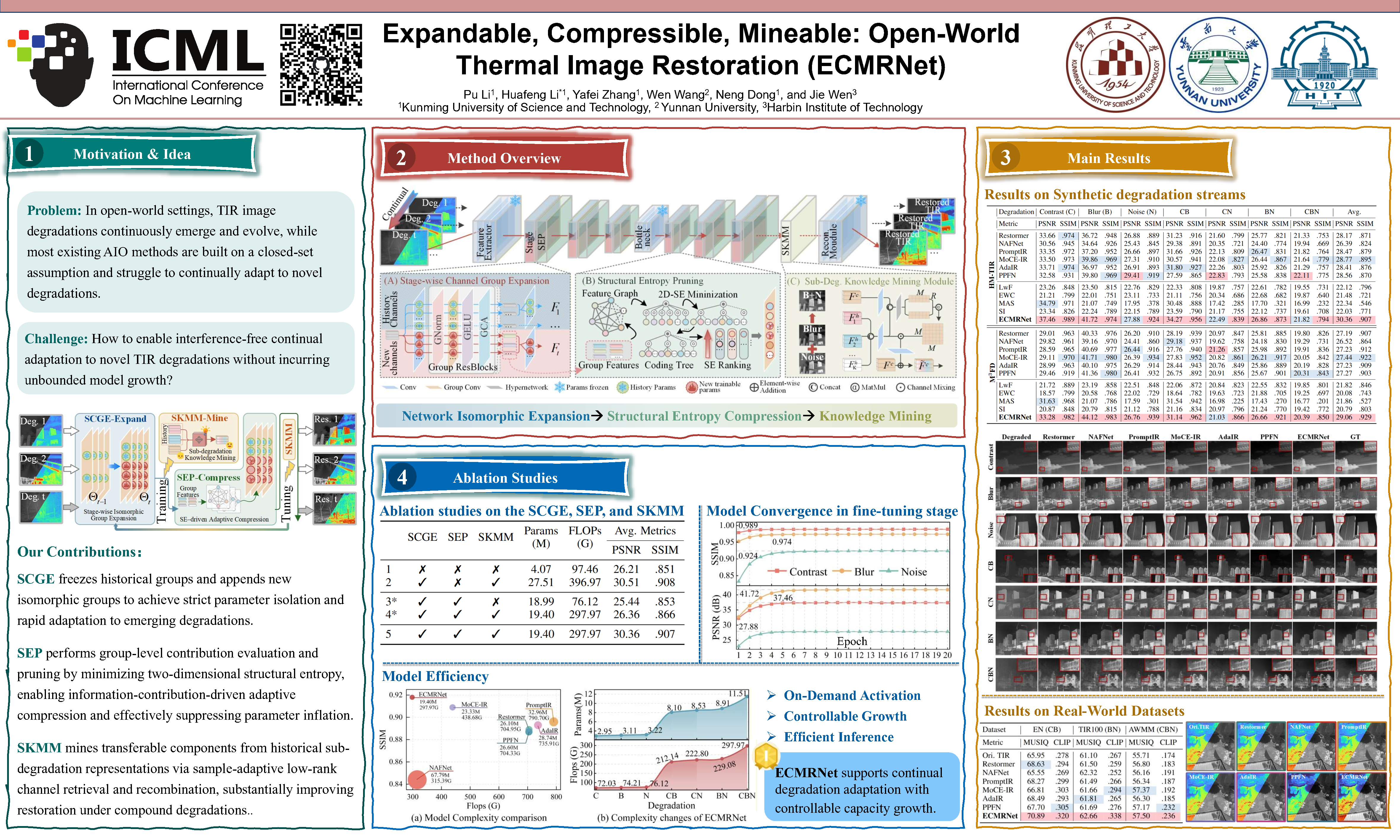
In open-world settings, thermal infrared (TIR) image degradations continuously emerge and evolve, while most existing all-in-one restoration methods are built on a closed-set assumption and struggle to continually adapt to novel degradations. To address this, we propose ECMRNet, an Expandable, Compressible, and Mineable Restoration Network for open-world TIR restoration from a continual learning perspective. Conceptually, ECMRNet unifies continual degradation learning as an "expand–compress–mine" closed-loop process, enabling sustained adaptation to new degradations with controllable evolution. Structurally, ECMRNet decomposes intermediate representations into group-isolated subspaces, and achieves strict parameter isolation and fast adaptation to new degradations by freezing historical groups and isomorphically expanding new ones. To curb model growth as tasks accumulate, we present Structural Entropy Pruning, which identifies and removes redundant channel groups via two-dimensional structural entropy minimization, achieving information contribution–driven adaptive compression. Moreover, we design a Sub-degradation Knowledge Mining Module that dynamically retrieves and recombines transferable components from historical representations to improve restoration under compound degradations. Experimental results demonstrate that ECMRNet achieves superior overall performance across diverse single and compound degradations while using fewer parameters and lower computational cost.
Lay Summary
Thermal infrared cameras can capture useful images in darkness, smoke, or bad weather, but their images are often damaged by blur, noise, low contrast, or other degradations at the same time. In real-world use, these degradations may appear gradually over time, so an image enhancement model needs to keep learning new types of degradation without forgetting how to handle old ones. We propose ECMRNet, a new model that can continually adapt to new thermal infrared image degradations. The key idea is to let the model grow when it meets a new problem, make the model smaller by removing redundant parts that are less helpful for image restoration, and reuse useful knowledge learned from previous degradations. This allows the model to adapt to new situations while keeping its size and cost under control. Our experiments show that ECMRNet produces clearer thermal infrared images across many types of image degradations, including both single and mixed degradations, while using fewer resources than many existing methods.