
Causal Discovery for Irregularly Time Series with Consistency Guarantees
Abstract
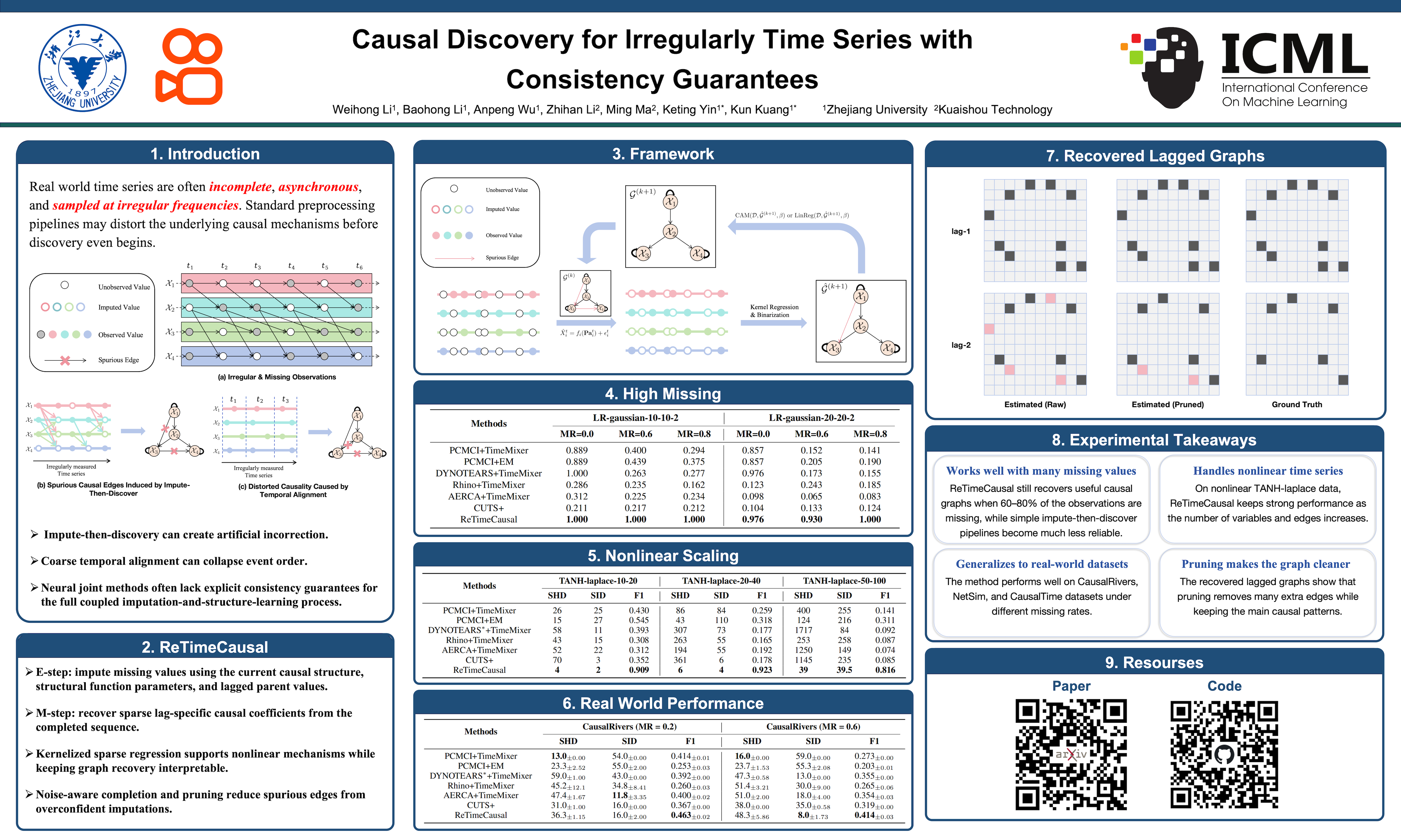
This paper studies causal discovery in irregularly sampled time series—a key challenge in risk-sensitive domains like finance, healthcare, and climate science, where missing data and inconsistent sampling frequencies distort causal mechanisms. The main challenge comes from the interdependence between missing data imputation and causal structure recovery: errors in imputation and structure learning can reinforce each other, leading to an inaccurate causal graph. Existing methods either impute first and then discover, or jointly optimize both via neural representation learning, but lack explicit mechanisms to ensure mutual consistency of imputation and structure learning. We address this challenge with ReTimeCausal, an EM-based framework that alternates between imputation and structure learning, which encourages structural consistency throughout the optimization process. Our framework provides theoretical consistency guarantees for structure recovery and extends classical results to settings with irregular sampling and high missingness. ReTimeCausal combines kernel-based sparse regression and structural constraints in an alternating process that updates the completed data and the causal graph in turn. Experiments on synthetic and real-world datasets show that ReTimeCausal is more effective than existing methods under challenging irregular sampling and missing data.
Lay Summary
Many real-world time-series datasets are incomplete and irregular: some values are missing, and different variables are measured at different times. This makes causal discovery difficult, because common shortcuts such as filling in missing values first or aligning all measurements to a fixed timeline can introduce false causal relationships. We propose ReTimeCausal, a method that learns missing values and causal relationships together. Instead of treating imputation as a separate preprocessing step, ReTimeCausal repeatedly updates two estimates: what the missing values should be, and which variables causally influence others over time. The key idea is that these two tasks should agree with each other: the filled-in data should support the discovered causal graph, and the causal graph should guide how missing values are filled in. The method also keeps the recovered relationships interpretable by learning sparse, time-lagged causal links. Experiments on synthetic and real-world datasets show that ReTimeCausal is more reliable than existing methods when time-series data are highly incomplete or irregularly sampled. This can help researchers analyze messy temporal data in areas such as healthcare, finance, and climate science, while reducing the risk of drawing misleading causal conclusions from missing or poorly aligned measurements.