
Foreground-Aware Token Routing Vision Transformer for Real-Time Satellite Video Tracking
Abstract
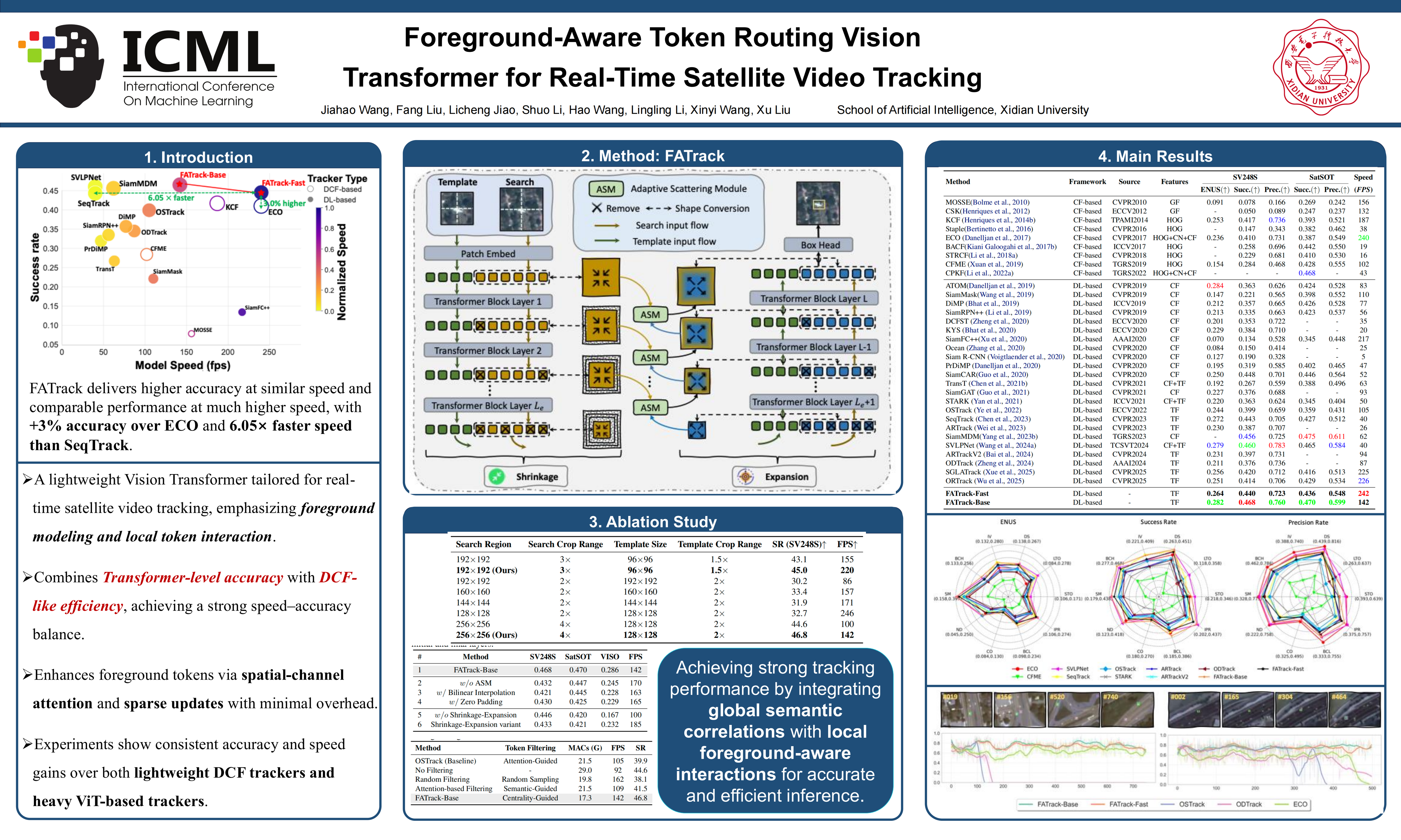
Real-time satellite video tracking poses distinct challenges, including accommodating high spatial-temporal resolution, dynamic backgrounds, and constrained onboard computational resources. While Discriminative Correlation Filter (DCF)-based methods offer high-speed inference, they suffer from limited accuracy. In contrast, Vision Transformer (ViT)-based trackers achieve strong performance by unifying representation and aggregation in a single-stream design, yet their heavy computational footprint limits practical deployment in real-time satellite scenarios. In this work, we present FATrack, a novel tracking framework that effectively balances tracking accuracy and computational efficiency. At its core is FA-ViT, a lightweight Vision Transformer backbone that introduces foreground-aware token routing, enabling the model to concentrate computation on target-relevant regions while suppressing redundancy. To mitigate semantic degradation caused by token sparsification, we propose the Adaptive Scatter Module (ASM), which selectively reinforces informative tokens via joint spatial-channel attention and sparse structural propagation, thereby enhancing both semantic fidelity and spatial coherence. By synergistically integrating FA-ViT and ASM, FATrack forms a unified architecture that delivers real-time performance with significantly improved tracking precision. Extensive evaluations on multiple satellite video benchmarks demonstrate that FATrack surpasses existing real-time trackers in accuracy and achieves inference efficiency comparable to DCF-based methods, highlighting its potential for practical deployment in large-scale aerial video tracking systems.
Lay Summary
Satellite videos can be useful for tasks such as monitoring traffic, ships, and disaster areas, but tracking small moving objects in these videos is difficult. The objects are often tiny, the background is large and complex, and satellites may have limited computing power, so tracking methods must be both accurate and fast. We propose FATrack, a new tracking method designed for real-time satellite videos. Instead of processing every part of the image equally, FATrack focuses more computation on the likely target area and reduces unnecessary work on background regions. To avoid losing useful information when reducing computation, we also introduce a module that helps restore important spatial and semantic details. Our experiments show that FATrack achieves strong tracking accuracy while running very fast, close to the speed of traditional lightweight trackers. This makes it promising for practical large-scale satellite video tracking applications.