
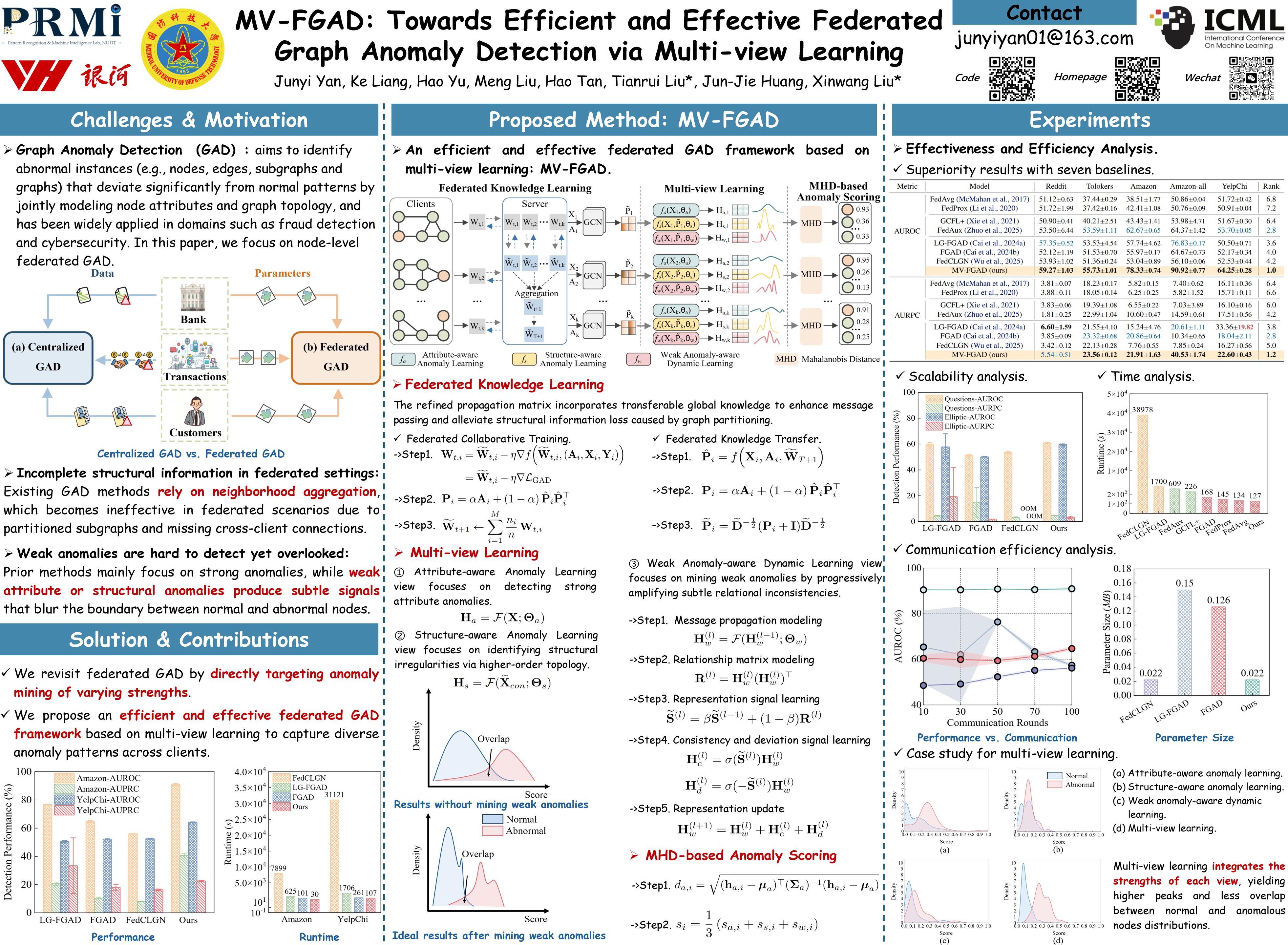
MV-FGAD: Towards Efficient and Effective Federated Graph Anomaly Detection via Multi-view Learning
Abstract
Federated graph anomaly detection (GAD) aims to identify abnormal nodes in distributed subgraphs through collaborative learning. However, existing methods suffer from two limitations. 1) Their reliance on neighborhood aggregation assumes that anomalous information can be sufficiently captured, which often fails in federated learning with partitioned client subgraphs. 2) They overlook the detection bottleneck caused by weak attribute or structural anomalies. To tackle these challenges, we revisit federated GAD and reveal that weak anomalies exhibit harder-to-detect signals compared to strong anomalies. Specifically, we propose MV-FGAD, an efficient and effective federated GAD framework based on multi-view learning designed to mine anomalies of varying strengths. MV-FGAD introduces a federated knowledge learning module to aggregate and broadcast shared knowledge, which is further exploited to optimize local topological structures. Moreover, it designs a multi-view learning mechanism to capture diverse anomaly patterns, and adopts Mahalanobis distance–based scoring strategy to quantify node abnormality across views. Extensive experiments on real-world datasets of varying types and scales demonstrate MV-FGAD's efficiency and effectiveness.