
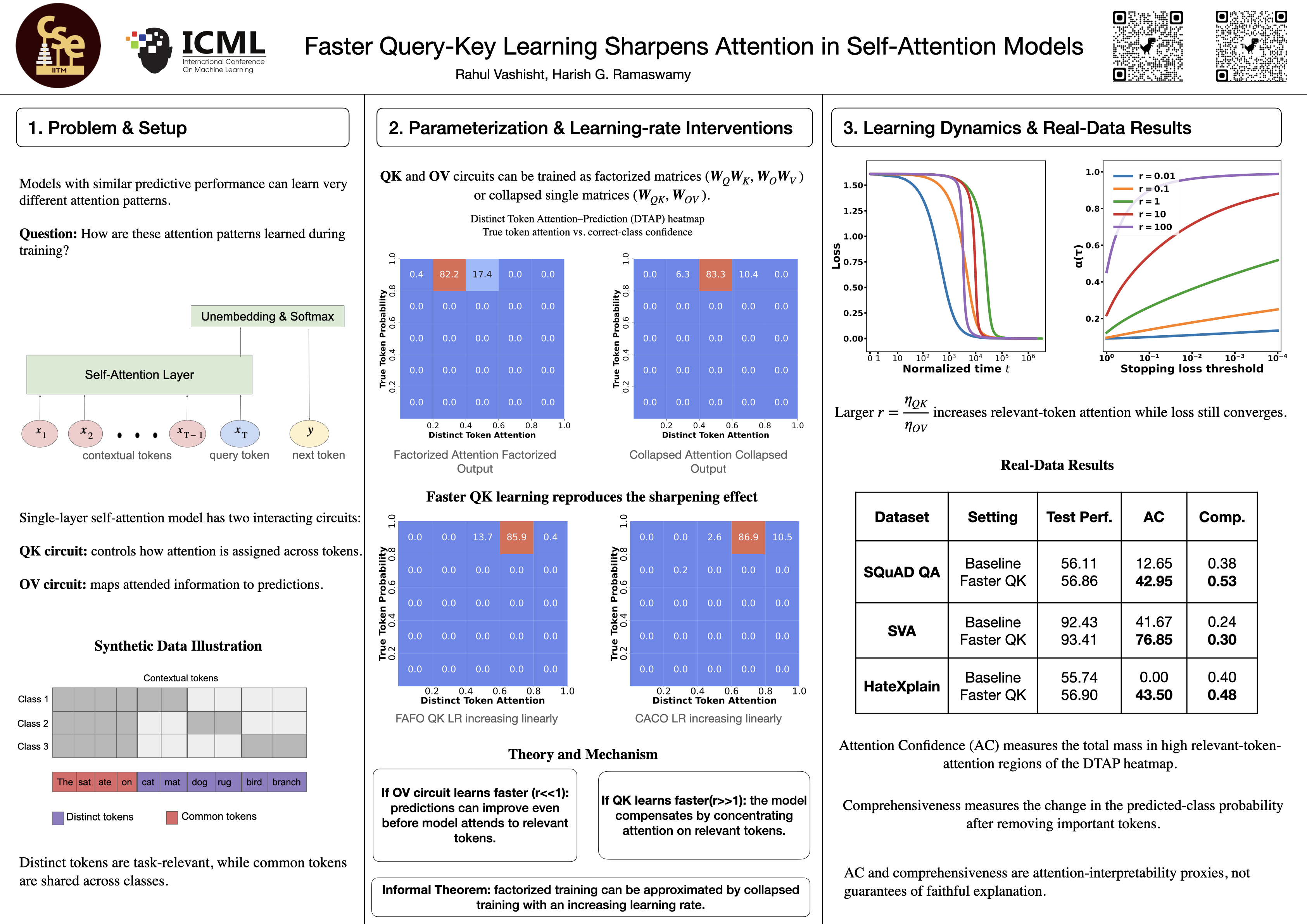
Faster Query-Key Learning Sharpens Attention in Self-Attention Models
Abstract
A standard self-attention layer consists of two interacting circuits: the query-key circuit that governs attention allocation, and the output-value circuit that maps attended representations to predictions. Collapsed and factorized parameterizations of the query-key and output-value circuits lead to qualitatively different attention patterns. In particular, some parameterizations give sharper attention to task-relevant tokens, at a similar training loss. We analyze how the parameterizations of these circuits shape the parameter trajectories in single-layer self-attention models trained on next-token prediction. Through gradient-flow analysis, we show that factorization induces implicit rescaling of the two circuits' learning rates. We derive closed-form dynamics showing that output-value and query-key parameters move along a line, with relative speeds determined by their learning rates. Faster query-key learning relative to output-value learning thus produces sharper attention, as the model compensates for slower output-value learning by increasing attention mass on relevant tokens. Experiments show that differences in the relative learning rates of the two circuits govern attention concentration. This improves attention interpretability while maintaining comparable predictive performance.
Lay Summary
Attention-based models use attention weights to indicate which words the model relies on when making a prediction. However, models with similar prediction accuracy can learn very different attention patterns, making it unclear how these patterns are learned during training. In this work, we show that attention behavior is shaped by the interaction between two components: one that influences how the attention is assigned across words, and another that influences how the attended information is used for prediction. The rate at which these components learn strongly affects the final attention pattern. When the component that assigns attention learns faster, the model concentrates more on task-relevant words, even when prediction performance remains similar. This explains why models with similar accuracy can behave differently internally.