
Self-Supervised Learning as Discrete Communication
Abstract
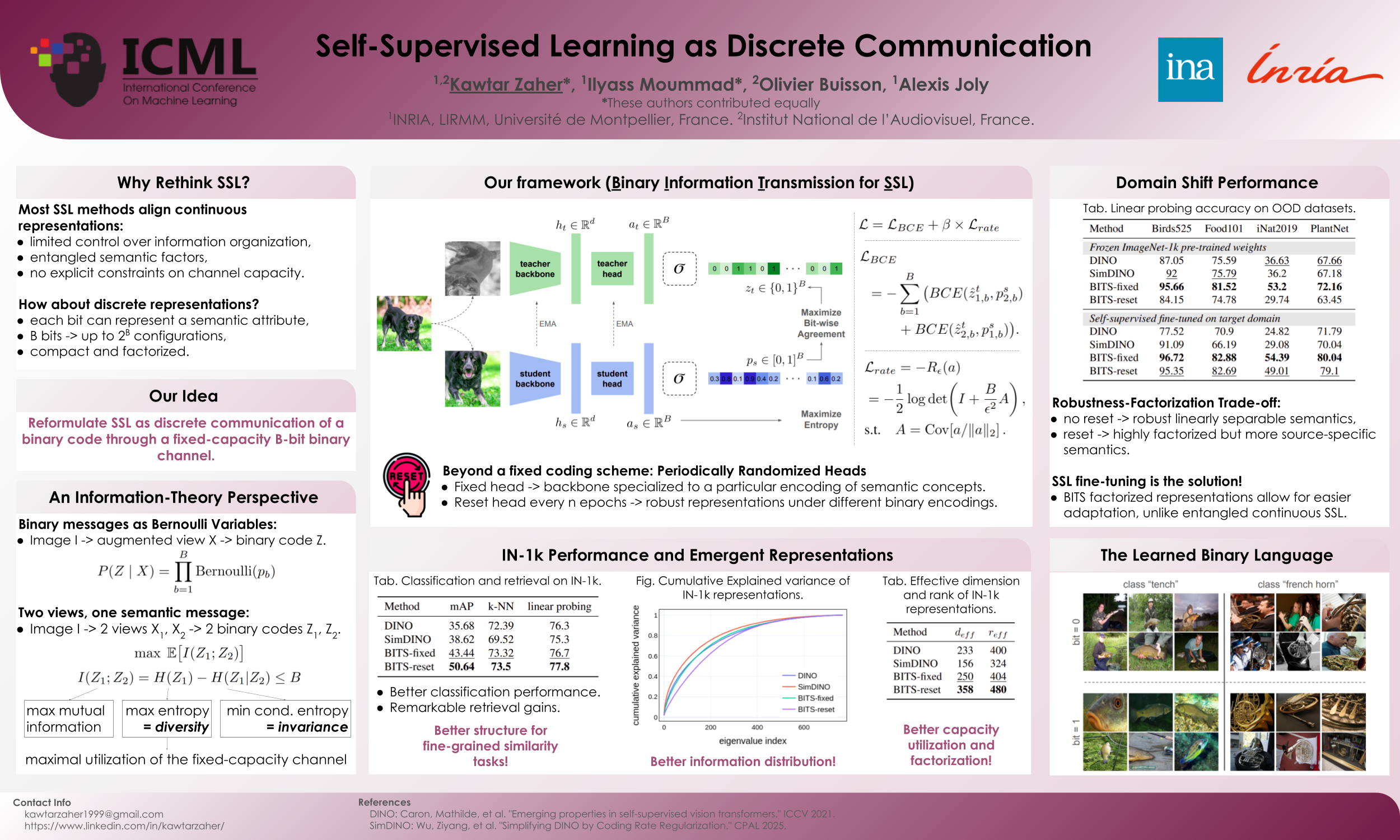
Most self-supervised learning (SSL) methods learn continuous visual representations by aligning different views of the same input, offering limited control over how information is structured across representation dimensions. In this work, we frame visual self-supervised learning as a discrete communication process between a teacher and a student network, where semantic information is transmitted through a fixed-capacity binary channel. Rather than aligning continuous features, the student predicts multi-label binary messages produced by the teacher. Discrete agreement is enforced through an element-wise binary cross-entropy objective, while a coding-rate regularization term encourages effective utilization of the constrained channel, promoting structured representations. We further show that periodically reinitializing the projection head strengthens this effect by encouraging embeddings that remain predictive across multiple discrete encodings. Extensive experiments demonstrate consistent improvements over continuous agreement baselines on image classification, retrieval, and dense visual prediction tasks, as well as under domain shift through self-supervised adaptation. Beyond backbone representations, we analyze the learned binary codes and show that they form a compact and informative discrete language, capturing semantic factors reusable across classes.
Lay Summary
Today, many Artificial Intelligence systems learn to understand images by comparing different versions of the same picture. For example, if an image is cropped, blurred, or seen from another angle, the system learns that it is still the same object. Most existing methods do this using long lists of numbers. While effective, these representations often mix many visual ideas together, making it difficult to separate concepts such as shapes, objects, textures, or scene elements. In this work, we explore a simpler approach. Instead of asking two AI systems to agree using complex numerical signals, we ask them to communicate using only yes/no decisions, similar to turning switches on or off. Each switch can react to a visual property in the image, such as the presence of a person, an animal, or another pattern. We show that this simple form of communication is enough for the AI system to easily understand images without human annotations and represent them numerically. Importantly, it encourages the system to organize visual information into reusable building blocks within these representations. Our method performs competitively to classify the object present in the image, or to find similar images. Overall, our results suggest that binary communication could provide a simple and effective way for AI systems to learn about the visual world.