
Efficient Multi-Agent Reasoning via Confidence-Guided Adaptive Debate
Abstract
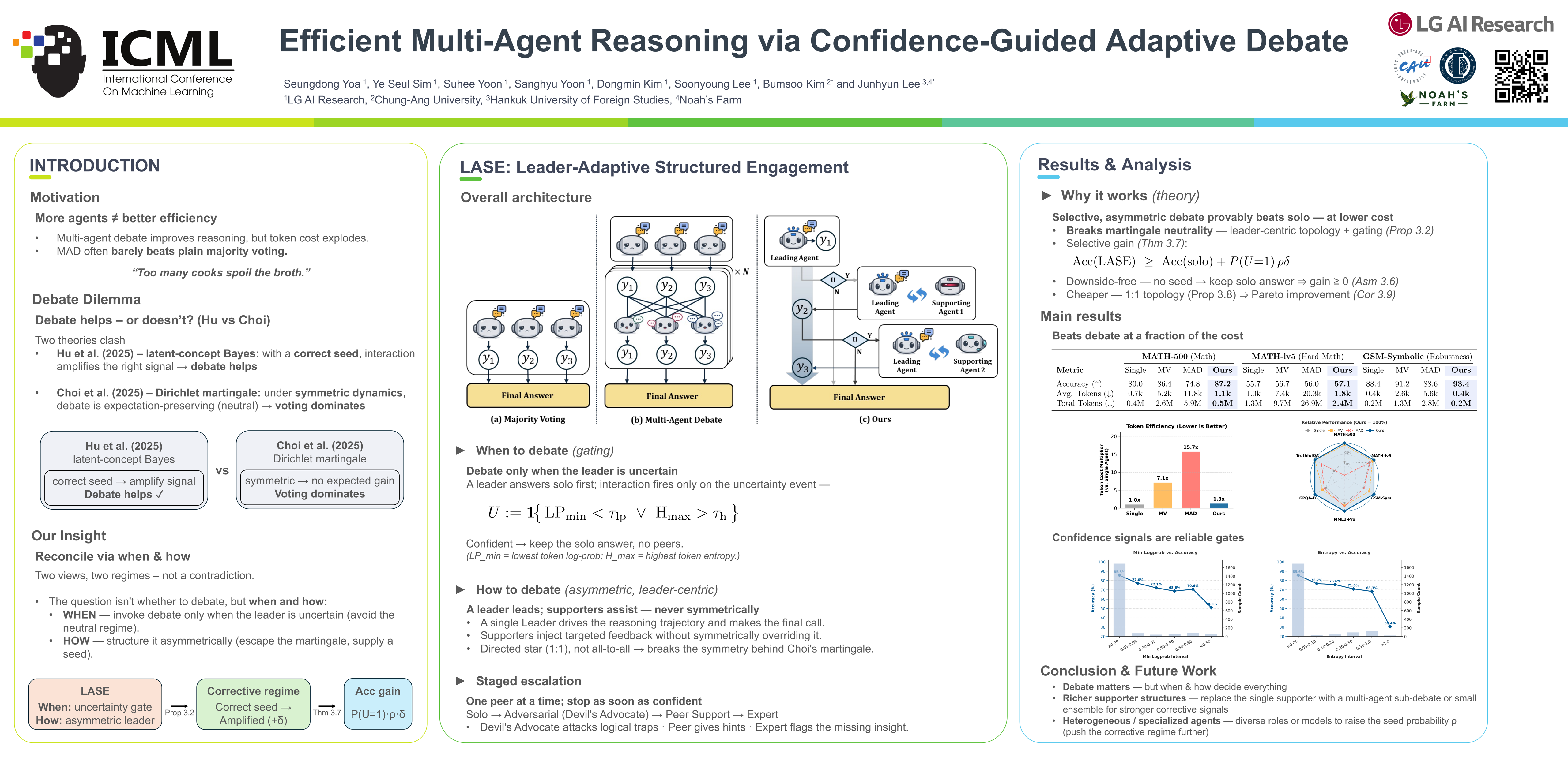
Multi-agent debate has shown promise for improving the reasoning of large language models, yet recent theory suggests its benefits are highly regime-dependent. While interaction can amplify informative signals under corrective conditions, symmetric debate dynamics are neutral in expectation, often making majority voting preferable. We reconcile these views by arguing that debate is effective only when invoked at the right time and with appropriate structure. Based on this insight, we propose LASE: Leader-Adaptive Structured Engagement, a leader-centric multi-agent debate framework that selectively engages interaction only in non-neutral regimes. LASE introduces an asymmetric leader–supporter architecture that enables directed information flow and selective signal amplification, while defaulting to simple aggregation otherwise. Experiments across diverse reasoning benchmarks show that LASE achieves multi-agent-level performance with near single-agent token cost, substantially improving efficiency over static debate and voting baselines.
Lay Summary
"Too many cooks spoil the broth." When several people argue over a single decision, they don't always reach a better answer—sometimes they just talk in circles. The same turns out to be true for AI. A popular idea for making AI language models reason more reliably is to have several agents "debate" a problem so they can catch each other's mistakes. But this is expensive—running many agents on every question costs far more computation and energy—and recent research shows it does not always help: when the agents are too similar and merely trade opinions, the debate adds little over simply taking a majority vote. This raises a basic question: is multi-agent debate really necessary? Our answer is that debate is worth its cost only when the model is genuinely unsure. So our method, LASE, first lets the model attempt the problem alone and measures its confidence. If it is confident, we keep that answer; only when it is uncertain do we bring in helper agents to challenge and refine the reasoning, with one lead agent staying in charge instead of letting everyone argue at once. Across math, science, and knowledge tests, LASE matches or beats the accuracy of full multi-agent debate while using roughly the same computation as a single agent—often more than ten times less than standard debate—making reliable AI reasoning much cheaper and more practical.